A wind farm project in Türkiye (a RES, or rüzgâr enerjisi santrali) moves through three main stages: first the developer secures a grid connection capacity right, then obtains a pre-licence from EPDK (the Energy Market Regulatory Authority), and within the pre-licence period completes the land, zoning, environmental and technical permits before converting to a generation licence. YEKDEM (Yenilenebilir Enerji Kaynakları Destekleme Mekanizması, the Renewable Energy Support Mechanism) is a separate choice at the end of this process that determines the price at which the operating plant sells its electricity.
This article explains how capacity rights are won, what the wind measurement requirement involves, how the YEKDEM and YEKA rules work, how Treasury and forest land can be used, and which legal risks typically arise during the pre-licence phase. The framework is the Electricity Market Law No. 6446 (Elektrik Piyasası Kanunu), Law No. 5346 on the Use of Renewable Energy Resources for Electricity Generation (Yenilenebilir Enerji Kaynaklarının Elektrik Enerjisi Üretimi Amaçlı Kullanımına İlişkin Kanun) and the Electricity Market Licensing Regulation (Elektrik Piyasası Lisans Yönetmeliği). For the equivalent steps in solar, see our article on the legal process for a solar power project.
How is a capacity right obtained for a wind farm project?
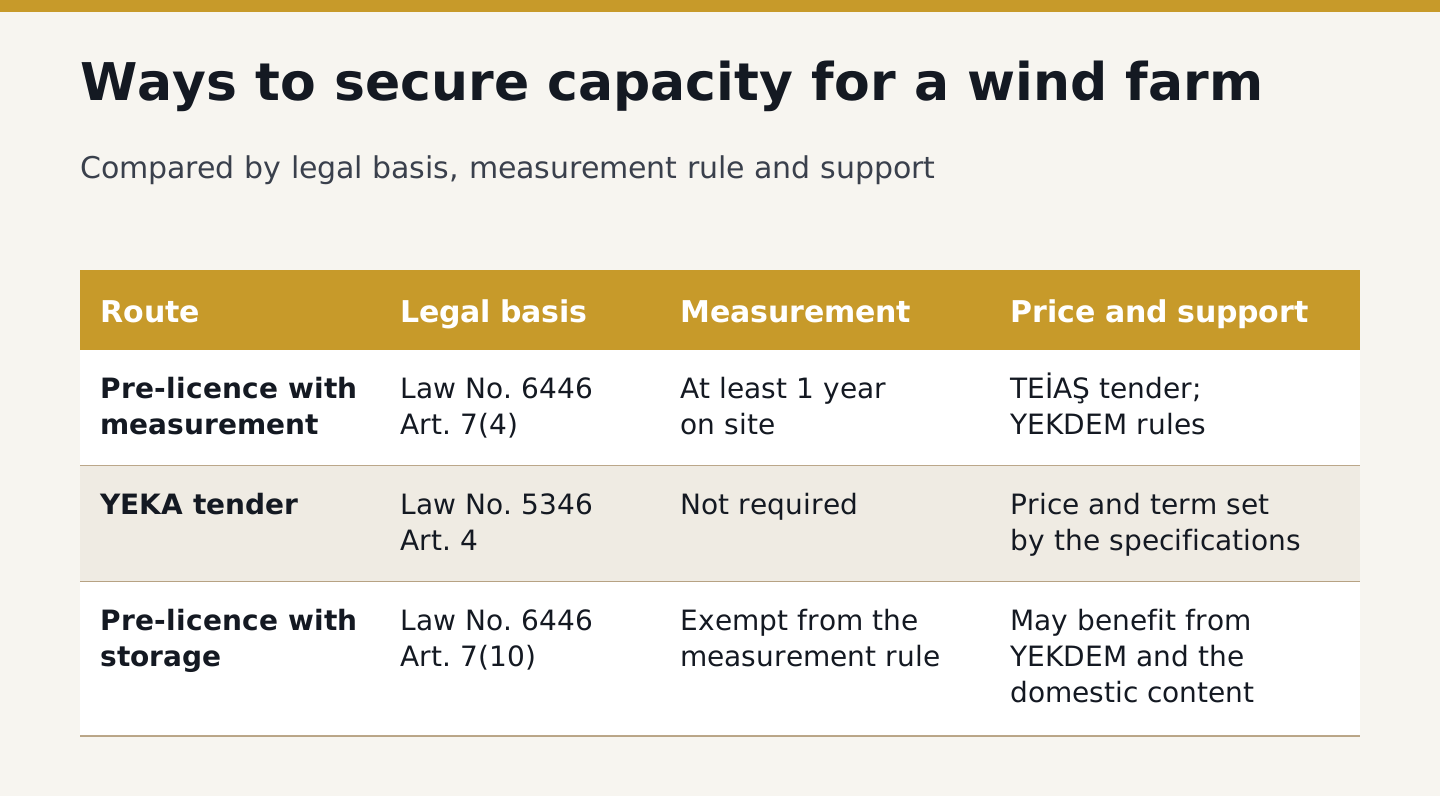
A wind farm project can obtain a capacity right in three ways: a pre-licence application backed by on-site measurement, a YEKA (Renewable Energy Resource Area) tender organised by the Ministry of Energy and Natural Resources, or a pre-licence tied to a commitment to build an electricity storage facility. The route chosen directly shapes the measurement obligation, the competition method and the sale price.
Under Article 7(4) of Law No. 6446, measurement-based applications are assessed only where TEİAŞ (the Turkish Electricity Transmission Corporation) or the relevant distribution company has issued a favourable grid connection opinion. If several applications compete for the same connection point or region, a tender held by TEİAŞ decides who will use the announced capacity. Where the owner of the site has applied, other applications for the same site are disregarded.
Route | Legal basis | Measurement requirement | Price and support |
|---|---|---|---|
Pre-licence application with measurement | Law No. 6446, Art. 7(4) | At least one year of on-site measurement within the last eight years | TEİAŞ tender; in operation, YEKDEM or the free market |
YEKA tender | Law No. 5346, Art. 4; YEKA Regulation | Not required (Law No. 6446, Art. 7(4)(b)) | Price and term set in the tender specifications |
Pre-licence with storage | Law No. 6446, Art. 7(10) | Exception under Art. 37(1) of the Licensing Regulation | May benefit from Arts. 6 and 6/B of Law No. 5346 |
What standards must wind measurement meet?
For a measurement-based application, the measurement station must stand within the plant site covered by the pre-licence application (Licensing Regulation, Art. 38). The wind measurement mast must be at least 60 metres tall, and readings must be taken at a minimum of two heights: one at 30 metres and the other at the top of the mast (Art. 39).
At least one full year of measurement is mandatory, and data loss during that year may not exceed 20 per cent (Art. 41).
The measurement start date is the date on which MGM (the Turkish State Meteorological Service) or an accredited body approves the installation report after an on-site inspection (Art. 40). In other words, the clock starts on the approval date of the report, not on the day the mast goes up.
How does YEKDEM apply to a wind farm?
YEKDEM is an optional support scheme that lets licensed plants already in operation and holding a YEK certificate (renewable energy resource certificate) sell electricity for a set period at a price fixed by law or by Presidential decision. Under Article 6 of Law No. 5346, wind plants commissioned between 18 May 2005 and 31 December 2020 receive the Schedule I price of USD 7.3 cents/kWh for ten years.
For plants commissioned after 30 June 2021, the President sets the price in Turkish lira and the rules for updating it. A licence holder wishing to join the mechanism in the following calendar year must hold a YEK certificate and apply by the deadline set by EPDK. Once in, a plant cannot leave the scheme during that year; plants that stay out may sell on the free market under their licence. Please verify the current price against the relevant Presidential decision in the Official Gazette (Resmî Gazete) and EPDK announcements.
Capacity increases at an operating plant call for caution: under Article 6/C of Law No. 5346, capacity added through a licence amendment after the 2019 amendment cannot benefit from YEKDEM, although such additions commissioned after 30 June 2021 may receive the domestic content price supplement. If you are weighing bilateral sales instead, the key clauses of a power purchase agreement (PPA) also deserve close attention.
What terms apply in the YEKA RES-2026 tenders?
The YEKA RES-2026 Specifications, issued under the announcement published in the Official Gazette of 11 July 2026, govern the allocation of grid connection capacity and site use rights for 49 years for seven wind farms with a total capacity of 1,500 MWe. Under the specifications, electricity is sold on the free market for 72 months from contract signature; if the market clearing price falls below EUR 4.75 cents/kWh during this period, that value applies.
After the free-market period, the unit price formed in the tender applies for 20 years. The ceiling price is EUR 5.50 cents/kWh and the floor price EUR 3.50 cents/kWh; if more than one bidder offers the floor price, the tender moves to an auction on a contribution fee per MW. Turbines must achieve a minimum local content score of 55, and the domestic product support under Law No. 5346 does not apply.
In its decision of 26 November 2025 (E. 2024/133, K. 2025/233), the Constitutional Court (Anayasa Mahkemesi) annulled the second sentence of Article 4(2) of Law No. 5346, which provided that the Ministry would set the tender procedures and principles in the specifications.
According to the note in the official legislation database, the annulment takes effect on 10 December 2026; for tenders held after that date, developers should monitor any new rules on the statutory basis.
How is land secured for a wind farm?
How land is secured for a wind farm depends on who owns the site. Privately owned sites are acquired through purchase, lease or easement agreements, while Treasury land, forest land and areas under the sovereignty and disposal of the State are used, for a fee, by way of a permit, lease, easement (servitude) or use permit under Article 8(1) of Law No. 5346.
For pasture, summer pasture and winter pasture land, the designated use is first changed and the land is then registered in the name of the Treasury (Art. 8(2)).
For plants commissioned by 31 December 2030, together with their access roads and the transmission lines up to the connection point, an 85 per cent discount applies to permit, lease, easement and use permit fees for ten years from the licence date; the Forest Villagers Development Levy and the Afforestation and Erosion Control Levy are not charged (Art. 8(3)).
How does a forest permit work for a wind farm?
Under the paragraph added to Article 8 of Law No. 5346 by Law No. 7554, a permit for forest land may be granted on the basis of the pre-licence and for the pre-licence term, including extensions. Once EPDK notifies the authority that the project has moved to a generation licence, the permit extends to the end of the licence term; if no licence is obtained, the permit lapses automatically when the pre-licence term ends.
Permits for measurement and drilling may be granted without a pre-licence, and permit applications must be decided within sixty days at the latest. In national parks, nature parks, protection forests and similar areas, the favourable opinion of the competent Ministry is required, and in natural protected sites that of the regional conservation board. If the wind project lies on a main bird migration route, ornithological observation is mandatory during the EIA or project description file process.
When does expropriation come into play?
Under Article 4 of Law No. 5346, privately owned land designated as a YEKA may be subject to urgent expropriation under Article 27 of the Expropriation Law No. 2942 (Kamulaştırma Kanunu). The YEKA decision is annotated on the land register; if no document showing that an action for determination of compensation and registration has been filed is submitted to the land registry within three years, the annotation is removed ex officio.
In addition, for facilities holding a pre-licence or licence, a decision on taking possession based on an urgent expropriation decision counts as a valid document in a building permit application (Additional Art. 1(4)).
Which permits must be completed during the pre-licence period?
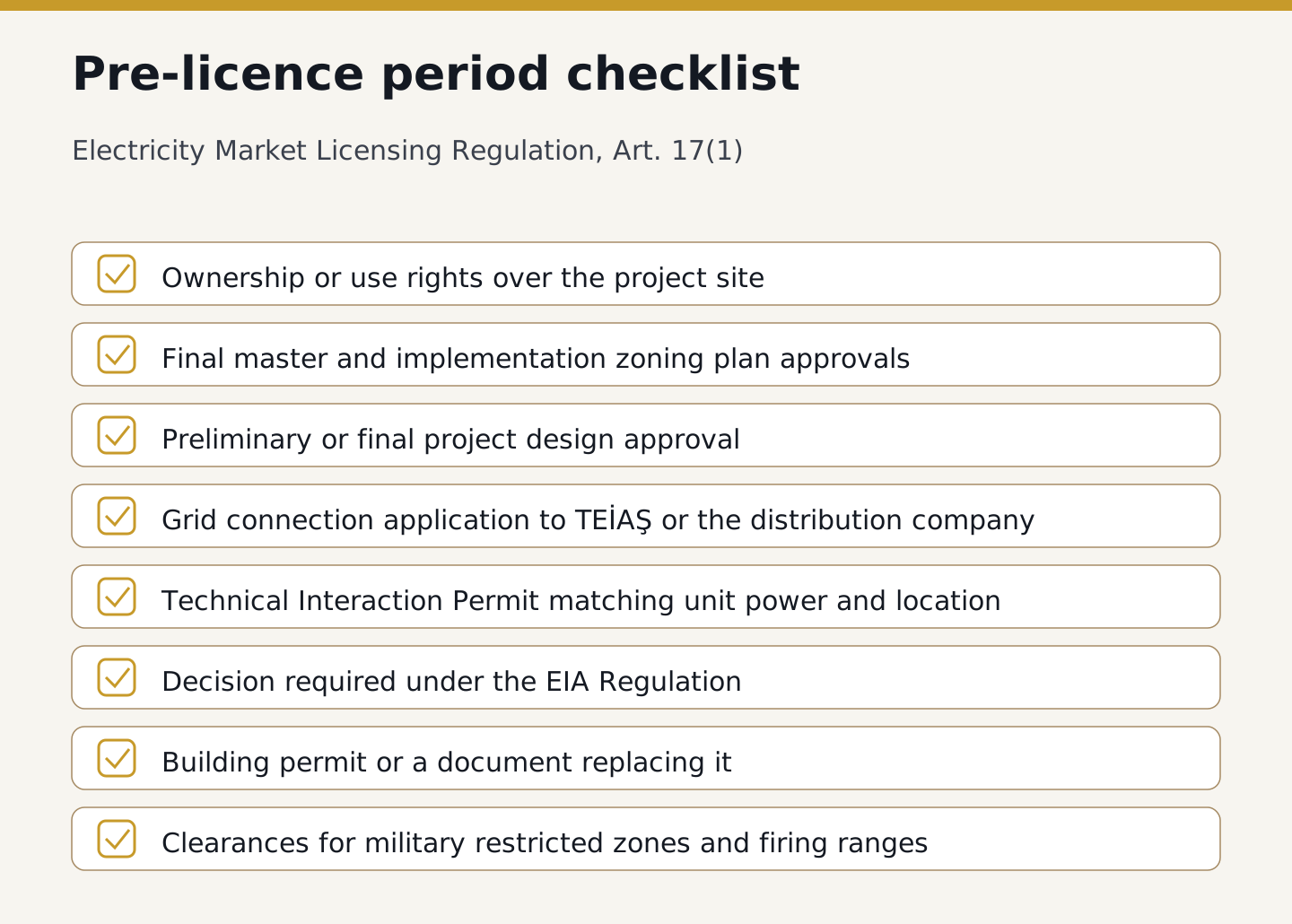
To be able to start investment, the pre-licence holder must complete the steps listed in Article 17(1) of the Licensing Regulation within the pre-licence term. Failing to meet these obligations on time may lead to forfeiture of the pre-licence security (Art. 45). The main items are:
- Acquiring ownership or use rights over the site
- Finalising approval of the master and implementation zoning plans
- Obtaining approval of the preliminary or final project design
- Applying to TEİAŞ or the distribution company for a grid connection agreement
- A Technical Interaction Permit consistent with unit capacities and coordinates
- Obtaining the decision required under the EIA Regulation, after applying within ninety days of service of the pre-licence decision
- The building permit and favourable opinions on military restricted zones and firing ranges
On zoning, Additional Article 1 of Law No. 5346 allows zoning plans for wind and solar plants holding a pre-licence or licence to be approved by the Ministry of Energy and Natural Resources as well; approved plans are published on the Ministry's website for fifteen days.
The Ministry published the implementing regulation based on this article in July 2026. The pre-licence term may be extended in cases of force majeure under Article 35 of the Licensing Regulation, and for YEKA pre-licences with the Ministry's favourable opinion (Art. 18(3)).
We explain the move from pre-licence to generation licence step by step in our article on how to obtain an EPDK generation licence.
How do EIA and zoning lawsuits affect a wind farm project?
Actions for annulment brought against a positive EIA decision or a zoning plan are among the risks that most often delay a wind farm project's pre-licence timetable. When reviewing EIA decisions, the Council of State (Danıştay) requires the project's environmental effects to be examined as a whole, by a panel of qualified court-appointed experts.
For this reason, investors should document from the outset the issues most likely to be challenged in the EIA file, such as bird migration, noise, shadow flicker and distance to settlements, and should also keep track of the option to intervene in any lawsuit. We discuss remedies against EPDK actions in our article on challenging administrative fines in the energy market.
How do you build a legal timetable for a wind farm project?
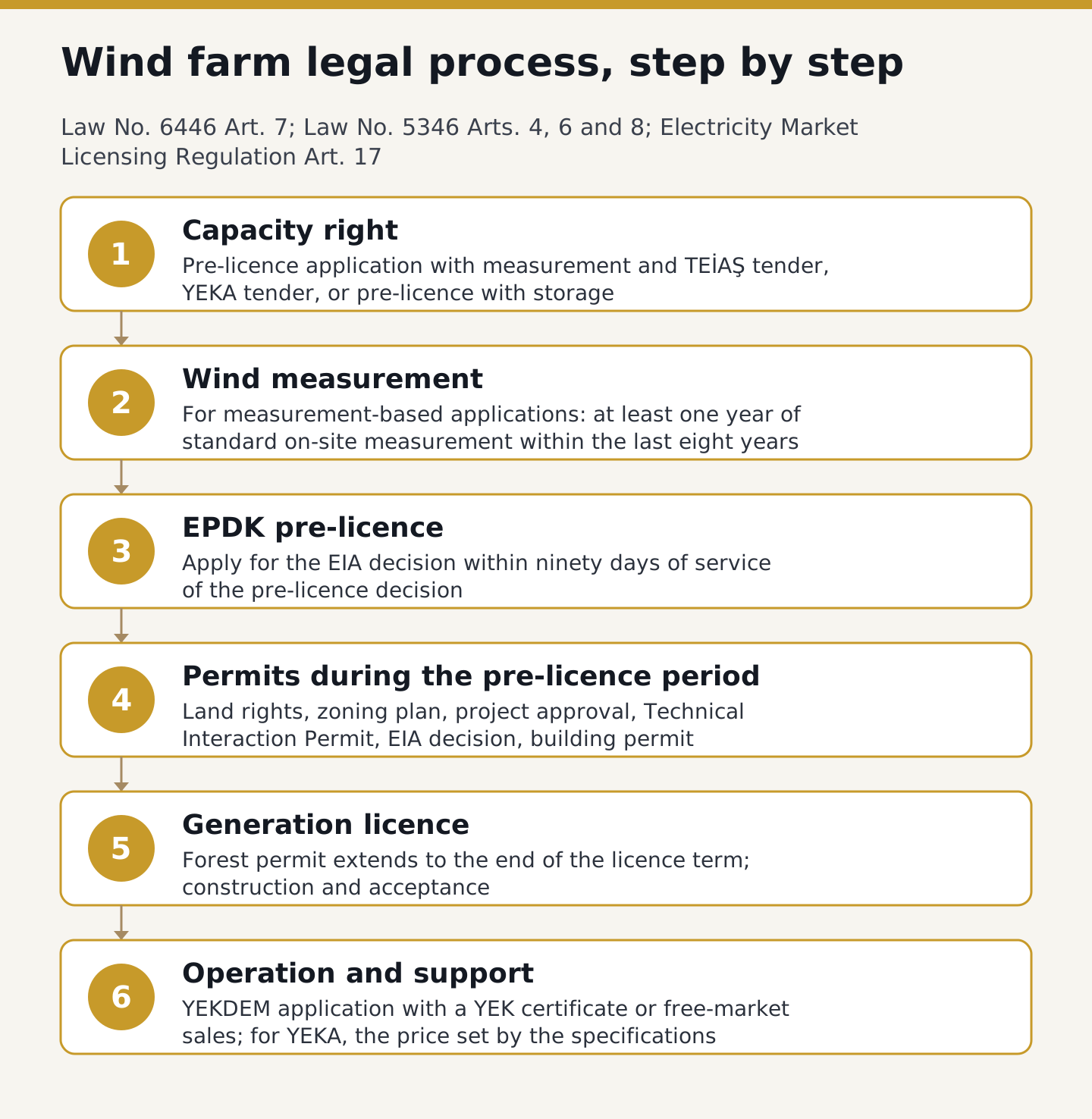
The legal timetable for a wind farm project should be planned backwards from the expiry date of the pre-licence. Land, zoning and EIA processes depend on one another, so a delay in one holds up the others. The sequence below reflects the flow most commonly followed in practice:
- Site selection and checks on title, cadastre, forest and pasture status
- Installing the measurement station, approval of the installation report and at least one year of measurement
- Choosing the capacity route: measurement-based application, YEKA tender or pre-licence with storage
- EIA application within ninety days of the pre-licence decision, plus land rights agreements
- Completing the zoning plan, project approval, Technical Interaction Permit and building permit
- Generation licence, construction, acceptance and the choice between YEKDEM and the free market
This order is not the same for every project; in YEKA sites, some land and measurement obligations may be regulated differently by the specifications. The legal due diligence report that the investor submits to its lenders should also show the legal basis and deadline of each step.
What are the common mistakes in wind farm projects?
- Counting the measurement start from the day the mast is erected, when the decisive date is the approval of the installation report.
- Failing to monitor the 20 per cent data loss limit and thereby invalidating the one-year measurement.
- Missing the ninety-day window after service of the pre-licence decision for the EIA application.
- Not aligning the Technical Interaction Permit with the unit capacities and coordinates in the licence application.
- Overlooking that the forest permit is tied to the pre-licence term and lapses automatically if no licence follows.
- Leaving the free-market period, purchase term and local content obligations of the YEKA specifications out of the financing model.
Where a wind farm project involves foreign shareholders, lenders or attorneys-in-fact, document formalities should be planned alongside the permit timetable. Türkiye, the United States and the United Kingdom are all parties to the 1961 Hague Apostille Convention (Türkiye since 1985), so foreign public documents bearing an apostille need no further consular legalisation in Türkiye. In the US, federal documents are apostilled by the U.S. Department of State Office of Authentications and state-issued documents, such as notarised powers of attorney, by the designated authority of the relevant state, usually the Secretary of State; in the UK, the FCDO Legalisation Office issues apostilles in paper or e-Apostille form. Documents in a foreign language generally also need a sworn Turkish translation, often notarised in Türkiye, so check the current requirements with the receiving authority before filing.
The legal soundness of a wind farm project depends on choosing the right capacity route, planning the measurement and permit timetable around the pre-licence term and securing land rights early. As the legislation changed significantly in 2025 and 2026, every project should be assessed against the current texts; for small-scale plants, see our article on unlicensed electricity generation. This article is for general information only; to explore our scope of services, visit our Energy Law page, and for questions, please use our Contact page.