An EPDK fine appeal is made by filing an action for annulment (iptal davası) before the competent administrative court within 60 days of notification of the decision of the Energy Market Regulatory Board (Enerji Piyasası Düzenleme Kurulu). The criminal judgeship of peace route does not apply here, because Article 12 of Law No. 4628 specifically provides that administrative sanctions imposed by the Energy Market Regulatory Authority (EPDK) are challenged before the administrative courts.
For companies active in the electricity, natural gas, petroleum and LPG markets, missing this deadline means the fine becomes final. Below we walk through the legal basis of the fine, the warning requirement, the litigation deadlines, the stay of execution and the routes of appeal in turn.
When does EPDK impose administrative fines?
In the electricity market, EPDK sanctions licence holders under Article 16 of the Electricity Market Law No. 6446 (6446 sayılı Elektrik Piyasası Kanunu). In the natural gas, petroleum and LPG markets, the sanction provisions of the relevant market laws apply; the examples in this article focus mainly on the electricity market.
- Providing false or incomplete information in response to an information request or on-site inspection, or preventing the inspection (Art. 16(1)(a))
- A breach of the law, secondary legislation, the licence or Board decisions that continues or is repeated despite a warning (Art. 16(1)(b))
- A fine without prior warning for breaches that cannot be remedied (Art. 16(1)(c))
- Untrue documents or misleading information during the licence application or the licence term (Art. 16(1)(ç))
- Activities outside the scope of the licence (Art. 16(1)(e))
- Market-distorting conduct (Art. 16(9), added by Law No. 7552)
For obligations before and during licensing, see our articles on the EPDK generation licence and unlicensed electricity generation; incomplete notifications at these stages can later lead to sanctions.
How are fine amounts set for 2026?
The amounts written in the law are fixed sums and are increased at the start of each calendar year by the revaluation rate (Misdemeanours Law Art. 17(7)). For 2026, the fines in Article 16 of Law No. 6446 were raised by 25.49% under a communiqué published in Official Gazette No. 33118 of 25 December 2025.
You should therefore look not at the figure in the statute but at the updated amount announced for the year in which the act was committed. Please confirm the current figure in the Official Gazette (Resmî Gazete) or in EPDK announcements.
Why does the written warning matter in an appeal?
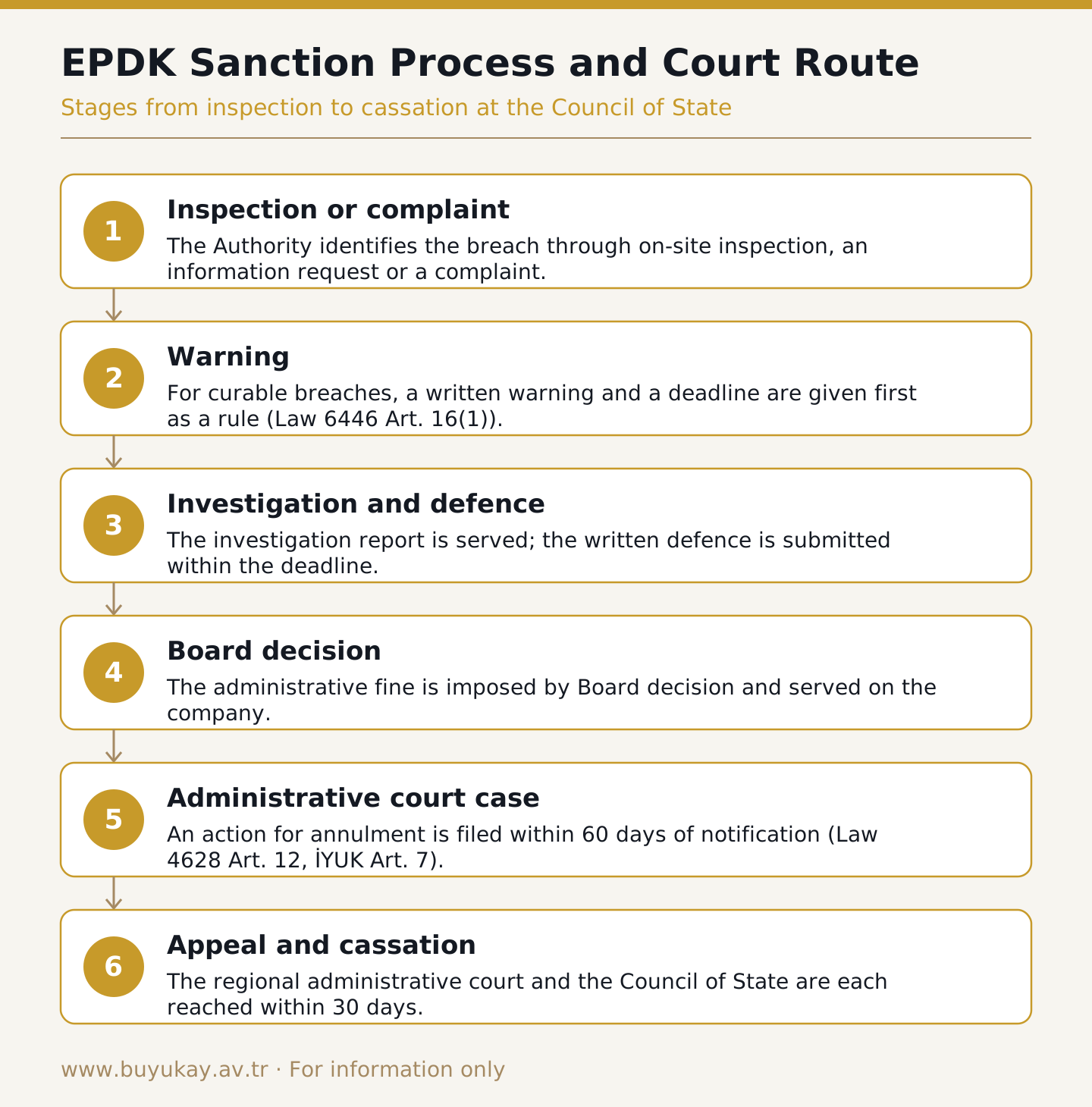
For curable breaches, a written warning (ihtar) must as a rule come first, and a fine may only follow if the breach continues or is repeated despite the warning. Article 16(1)(b) of Law No. 6446 requires a warning to remedy the breach within thirty days or not to repeat it; a fine without warning is accepted only for breaches that cannot be remedied (Art. 16(1)(c)).
The Council of State (Danıştay) treats the warning as a precondition that bars a fine being imposed directly. On the other hand, it has also held that where the same obligation is breached in different periods, a separate warning may not be needed for each period, so a warning-based argument has to be assessed according to the nature of the breach.
How does the fine increase for repeated breaches?
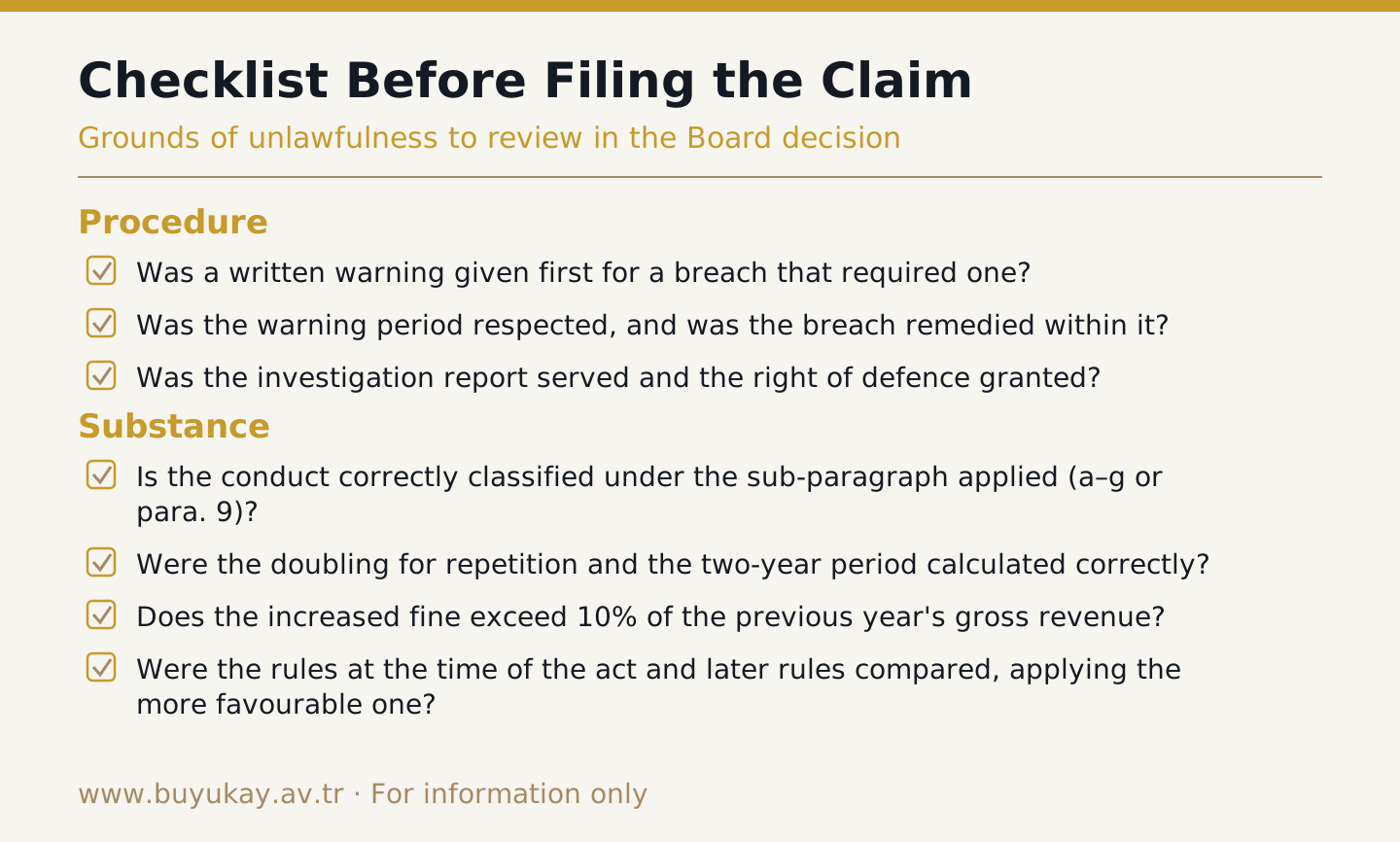
Where a breach is not remedied within the warning period or is repeated, each fine is doubled compared with the previous one (Law No. 6446 Art. 16(2)). If the same act is not committed within two years of the date of the fine, earlier fines are not counted for repetition.
The increased fine cannot exceed ten percent of the gross revenue shown in the company's balance sheet for the previous financial year; once that level is reached, the Board may revoke the licence. The statement of claim should separately examine whether this calculation is correct and when the two-year period started.
What should you watch during the investigation and defence stage?
The outcome of the court case depends largely on the file built during the investigation. When the investigation report is served, check the deadline for a written defence and any possibility of extension in the inspection and investigation regulation of the relevant market and in the notification letter itself.
The defence should include, in full, documents showing that the breach was remedied, the warning dates, system records and technical reports. A fact not raised at this stage is not entirely lost in court; however, submitting a document to the court for the first time that the Board never assessed can make proof harder.
The defence should address, under separate headings, which sub-paragraph the conduct was based on, whether it was curable and whether a more favourable later rule exists. These headings also form the skeleton of the future statement of claim. Keeping proof that the defence and its annexes were delivered to the Authority makes it easier to show any later breach of the right of defence.
Which court hears an EPDK fine appeal?
The action is filed with the administrative court (idare mahkemesi) where the authority that issued the Board decision is located. Article 12 of Law No. 4628 was amended in 2012 by Law No. 6352 to provide that administrative sanctions can be challenged before the competent administrative court and that cases against Board decisions are treated as priority matters.
After this amendment, the Council of State accepted that cases against Board decisions, other than regulatory acts applicable nationwide, cannot be heard by the Council of State at first instance. If annulment of a general regulatory Board decision is also sought, jurisdiction must be considered separately.
What is the deadline for an EPDK fine appeal?
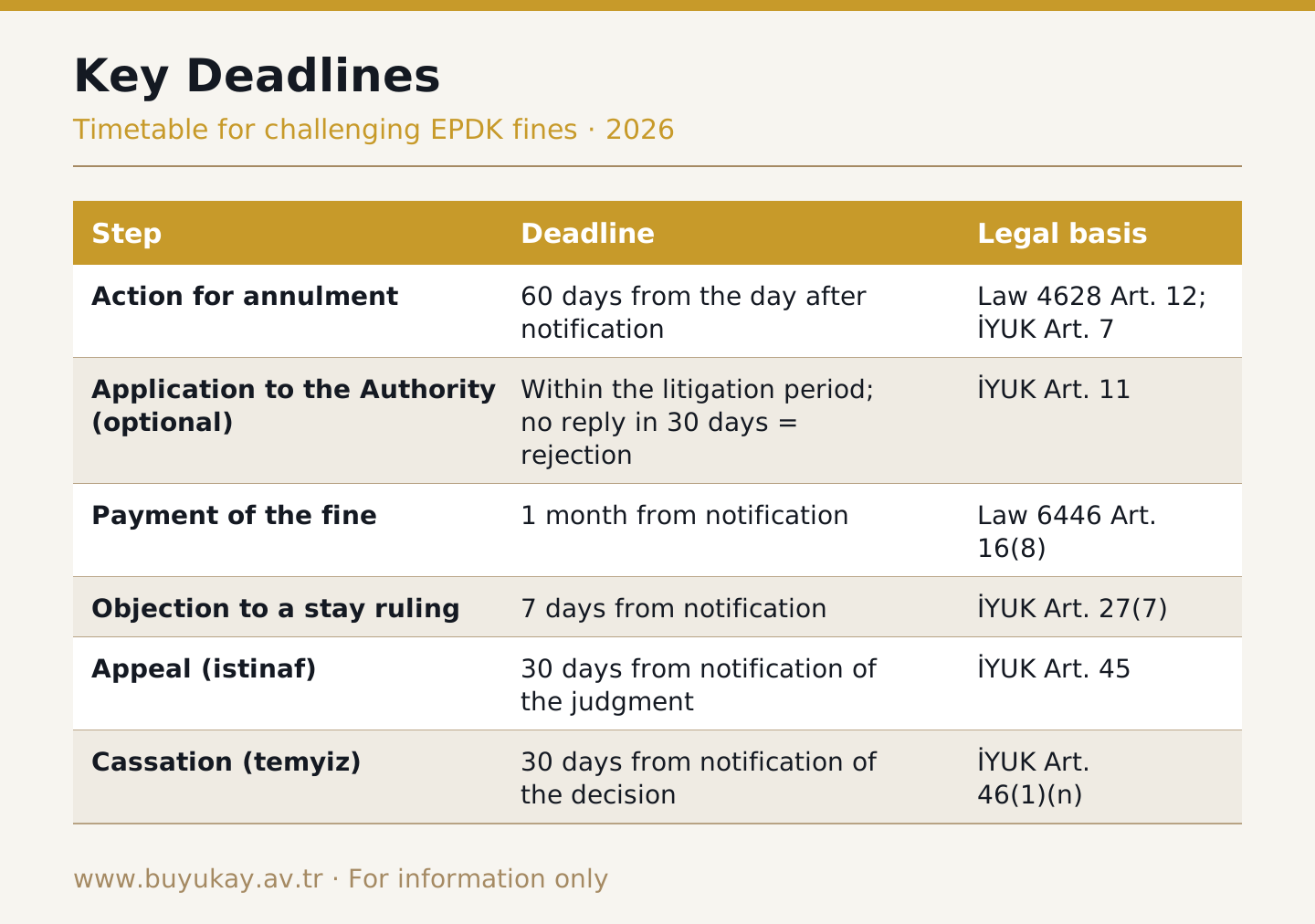
The deadline to sue is 60 days from the day after written notification of the decision (İYUK Art. 7). Since Law No. 4628 sets no separate period, this general deadline applies; the 15-day period for applying to the criminal judgeship of peace under the Misdemeanours Law is not used here because a special rule exists.
Before going to court, and within the litigation period, you may ask the Authority to withdraw or amend the decision; this application stops the running of the deadline (İYUK Art. 11). If the Authority does not reply within thirty days, the request is deemed rejected and the remaining period starts running again.
Does paying the fine waive the right to sue?
No; paying the fine does not waive the right to sue. Fines imposed under Law No. 6446 are payable within one month of notification (Art. 16, eighth paragraph), and under Article 17(6) of the Misdemeanours Law, payment does not affect the right to challenge the decision.
The same paragraph contains a general rule granting a twenty-five percent discount for payments made within the payment period. Whether the discount applies in your specific case should be checked against the Board decision served on you and the collection letter.
Does filing a lawsuit stop collection of the fine?
As a rule, filing an action does not suspend the administrative act (İYUK Art. 27(1)). To stop collection, a stay of execution (yürütmenin durdurulması) must be requested in the statement of claim and granted by the court.
The court may grant a stay if it finds that enforcing the act would cause harm that is difficult or impossible to remedy and that the act is manifestly unlawful, with both conditions met together. A decision on the stay request can be objected to once within seven days of notification (İYUK Art. 27(7)).
How do appeal and cassation work?
The administrative court's judgment can be appealed to the regional administrative court within thirty days of notification (İYUK Art. 45). In annulment cases below the statutory monetary threshold, the first-instance judgment is final; since this threshold is updated, confirm the amount in force on the date of application.
In cases concerning decisions of regulatory and supervisory boards relating to their market or sector, the regional administrative court's decision can be appealed on points of law to the Council of State within thirty days of notification (İYUK Art. 46(1)(n)). In practice, cassation review of EPDK decisions is carried out by the 13th Chamber of the Council of State.
Which arguments stand out in the statement of claim?
A strong statement of claim shows, with concrete documents, where the Board decision is unlawful in terms of procedure and substance. The issues most often argued in practice are:
- A fine imposed directly, without a warning, for conduct that required one
- A fine imposed before the warning period expired or after the breach had been remedied
- Conduct assigned to the wrong sub-paragraph, or the no-warning provision applied in error
- Miscounting the two-year period and earlier fines when applying the repetition rule
- Restriction of the right of defence or failure to serve the investigation report
- Failure to apply a more favourable rule that entered into force after the act
Is the route different for natural gas, petroleum and LPG fines?
No; the litigation route is the same. Article 12 of Law No. 4628 covers all administrative sanctions of the Authority, so fines in the natural gas, petroleum and LPG markets are also challenged before the competent administrative court.
The difference lies in the provisions on which the fine is based. For example, Article 9 of Law No. 4646 applies in the natural gas market and the sanction provisions of Law No. 5015 apply in the petroleum market; the warning requirement and amounts must be examined separately under these laws.
Can the warning decision itself be challenged?
The Council of State has stated that the warning is a precondition preventing a direct fine and, by that nature, qualifies as an administrative sanction. Bringing an action against Board decisions containing a warning can therefore be considered.
Failing to challenge a warning in time may make it harder to dispute its lawfulness in a later case against the fine itself. A strategy for an EPDK fine appeal should therefore be planned from the warning stage onwards.
What should US and UK parent companies know about documents?
If a Turkish licence holder is fined and documents such as a power of attorney (vekaletname) or a board resolution must be signed abroad, they should be notarised and apostilled, since the United States, the United Kingdom and Türkiye are all parties to the Hague Apostille Convention. In the US, a notarised document is apostilled by the Secretary of State of the relevant state, while federal documents go to the U.S. Department of State; in the UK, the FCDO Legalisation Office is the sole competent authority and also issues e-Apostilles. In Türkiye, a Turkish translation by a sworn translator, certified by a notary, is then generally required, so start early given the 60-day deadline.
Step-by-step case preparation
- Document the date the Board decision was served and diarise the 60-day deadline.
- Gather the warning, the investigation report and your written defence on which the decision is based.
- Compare the sub-paragraph applied, the fine imposed and the updated amount for that year.
- If the fine was increased for repetition, check the dates of earlier fines and the two-year period.
- Decide whether to pay and whether to request a stay of execution.
- Give reasons in the statement of claim for requesting a court-appointed expert on technical issues.
What happens if the fine is annulled?
If the court annuls the Board decision, the fine ceases to exist in law, and if payment was made, a refund can be claimed. An annulment may not prevent the authority from issuing a new, procedurally correct decision for the same act, so it matters whether the grounds are procedural or substantive.
Common mistakes
- Applying to the criminal judgeship of peace under the 15-day period of the Misdemeanours Law
- Counting the 60-day deadline from the date of the Board decision instead of notification
- Paying the fine and then missing the deadline to sue
- Not giving reasons for the stay of execution request
- Not considering whether to challenge the warning decision separately
An EPDK fine appeal calls for careful preparation because of the short deadlines and technical market rules involved. This article is for general information only and is not a substitute for legal advice. You can review our Energy Law practice page for the scope of our work in the energy market, and use the Contact page for your questions.