A power purchase agreement (PPA) is a long-term contract under which an electricity generator sells power to a buyer for a set period, on price and volume terms agreed in advance. Under Turkish law, a PPA rests on the concept of a “bilateral agreement” (ikili anlaşma) defined in Electricity Market Law No. 6446 (6446 sayılı Elektrik Piyasası Kanunu, “EPK”). As a result, it does not as a rule need the approval of EPDK (Energy Market Regulatory Authority), but it must still comply with the market rules.
This article explains the legal nature of a PPA, who can be a party to one, the clauses every agreement should contain and the risks that most often arise in practice. It is written for renewable energy producers looking for long-term offtake and for industrial users who want to fix their electricity costs over many years.
What is a power purchase agreement under Turkish law?
A power purchase agreement is a long-term form of the bilateral agreement defined in Art. 3(1)(j) EPK, usually linked to a renewable source. The Law describes bilateral agreements as “commercial agreements for the purchase and sale of electricity and/or capacity, concluded between natural and legal persons under private law and not subject to Board approval”, the Board being the Energy Market Regulatory Board (Enerji Piyasası Düzenleme Kurulu).
Three consequences follow from this definition. First, a PPA is a private law contract: disputes are governed by the Turkish Code of Obligations No. 6098 (Türk Borçlar Kanunu, “TBK”) and, where both parties are merchants (tacir), by the Turkish Commercial Code No. 6102 (Türk Ticaret Kanunu, “TTK”). Second, commercial terms such as price and duration are not submitted to EPDK for approval. Third, freedom of contract has limits: public-order rules such as the scope of each party's licence, market notifications and the ban on market-distorting conduct cannot be contracted out of.
In practice, the term “corporate PPA” describes a company buying power over the long term directly from a renewable energy plant. For legal classification, the label matters less than how the contract organises delivery of the electricity and payment for it.
Who can be a party to a PPA?
The seller is normally a company holding a generation licence (üretim lisansı) or a supply licence. Under Art. 7(2)(a) EPK, a generation company may, within the scope of its licence, sell electricity or capacity to supply companies, eligible consumers and persons to whom it has built a private direct line. We explain the wider framework for licensed activities in our article on the EPDK generation licence.
On the buyer side sits either an eligible consumer (serbest tüketici, a consumer entitled to choose its supplier) or a supply company. Under Art. 3(1)(cc) EPK, an eligible consumer is a person whose consumption exceeds the threshold set by the Board, who is connected directly to the transmission system, or who has the legal personality of an organised industrial zone. Because EPDK sets the eligible consumer threshold every year, please confirm the current figure with the authority.
- Direct PPA: the generator sells to an eligible consumer over the grid.
- Supplier-intermediated (sleeved) PPA: the generator sells to a licensed supplier, which sells the same energy on to the consumer.
- Financial (virtual) PPA: instead of physical delivery, the parties settle the difference between a fixed price and the market price.
- Self-consumption structures: unlicensed generation and self-consumption models follow a separate regime, covered in our article on unlicensed electricity generation.
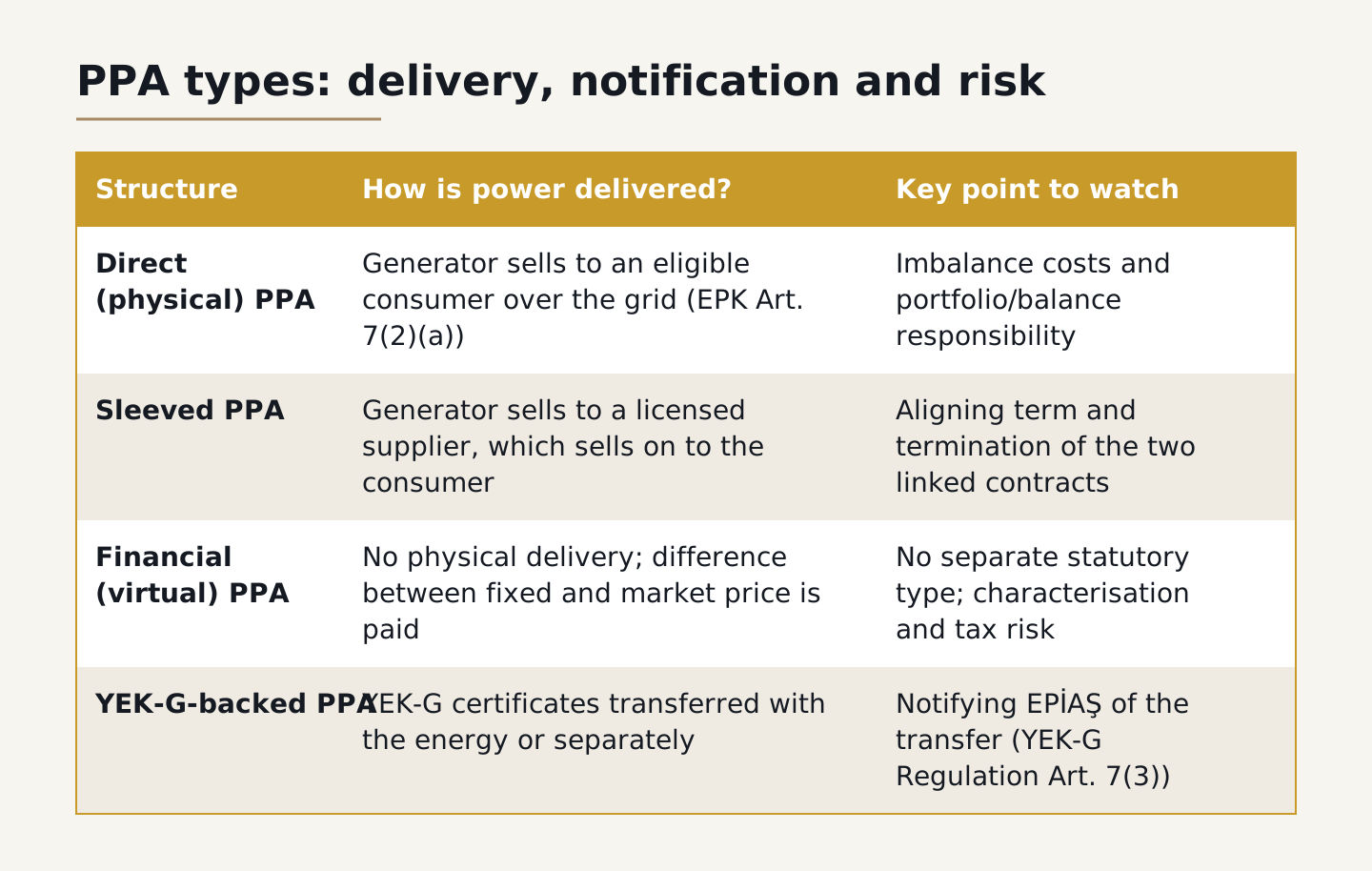
The financial (virtual) PPA is not regulated as a separate contract type in Turkish electricity market legislation. Its possible characterisation as a derivative, its tax treatment and its security package therefore need to be assessed separately for each structure.
How does a PPA work in the market, and why does the EPİAŞ notification matter?
For a PPA to take effect in the market, the buyer and the seller must enter the contracted volumes with the Market Operator, EPİAŞ (Energy Exchange Istanbul), as a bilateral agreement notification used for settlement. Under Art. 87(1) of the Electricity Market Balancing and Settlement Regulation (Elektrik Piyasası Dengeleme ve Uzlaştırma Yönetmeliği), this notification is made jointly by two licensed legal entities, both registered as market participants, one acting as buyer and the other as seller.
Art. 88(1) of the same Regulation requires the notification to be submitted through the Market Management System (Piyasa Yönetim Sistemi, PYS) by 16:00 on the day before the delivery day at the latest.
Under Art. 88(3) of the Regulation, a notification made by only one participant is not valid. This is why the notification clause deserves careful drafting: if one party does not take part, the energy does not change hands on paper and imbalance costs arise.
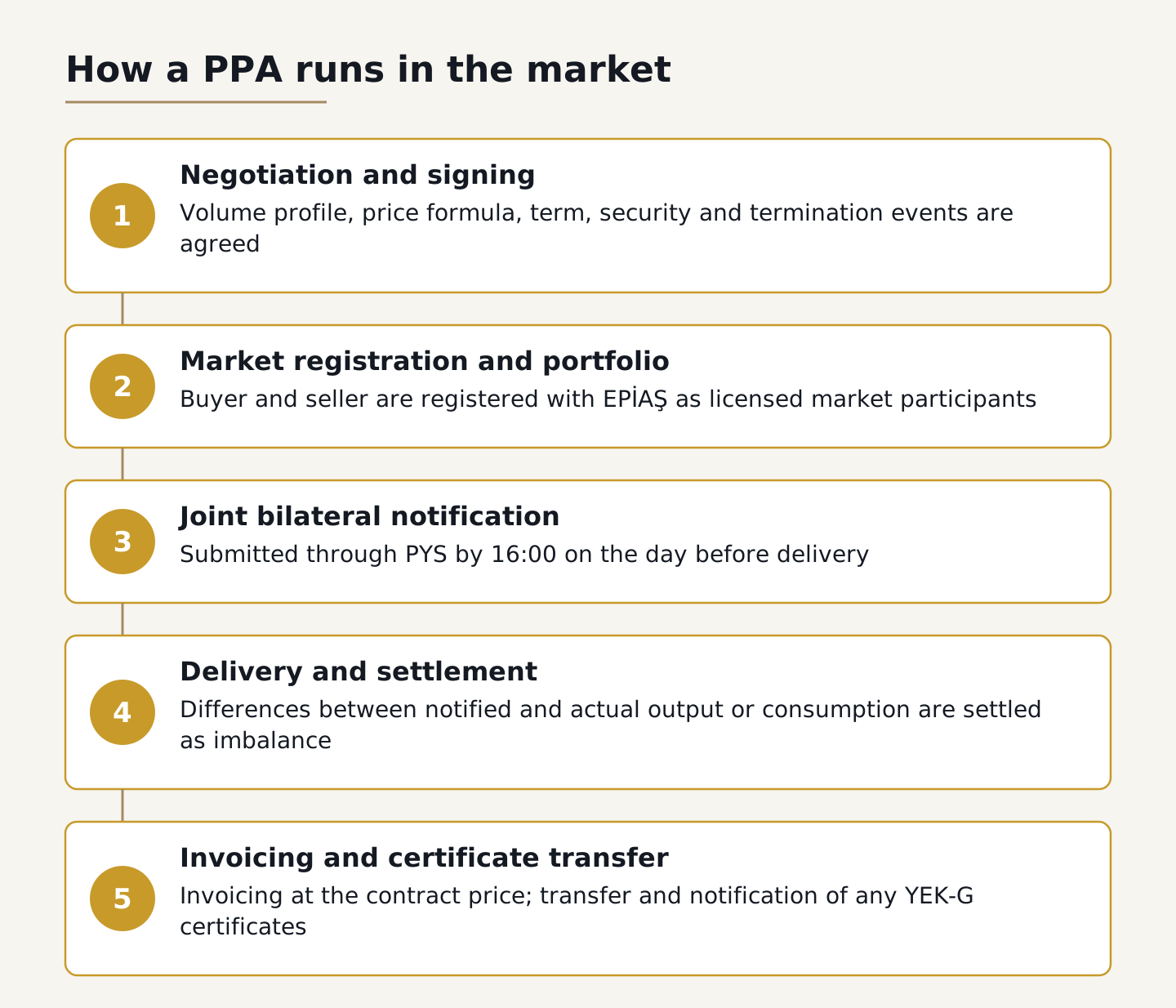
Because the consumer does not hold a licence, notification and balance responsibility in a direct PPA are in practice handled through the portfolio of the generator or the supplier. The contract should state clearly who is balance responsible and who bears imbalance charges.
Which clauses must a PPA contain?
A well-structured PPA treats price, volume, term, security, termination and dispute resolution as interlocking provisions. If one of them is left open, the general rules of the TBK fill the gap when a dispute arises, and the outcome may differ from what the parties had in mind.
Price and indexation
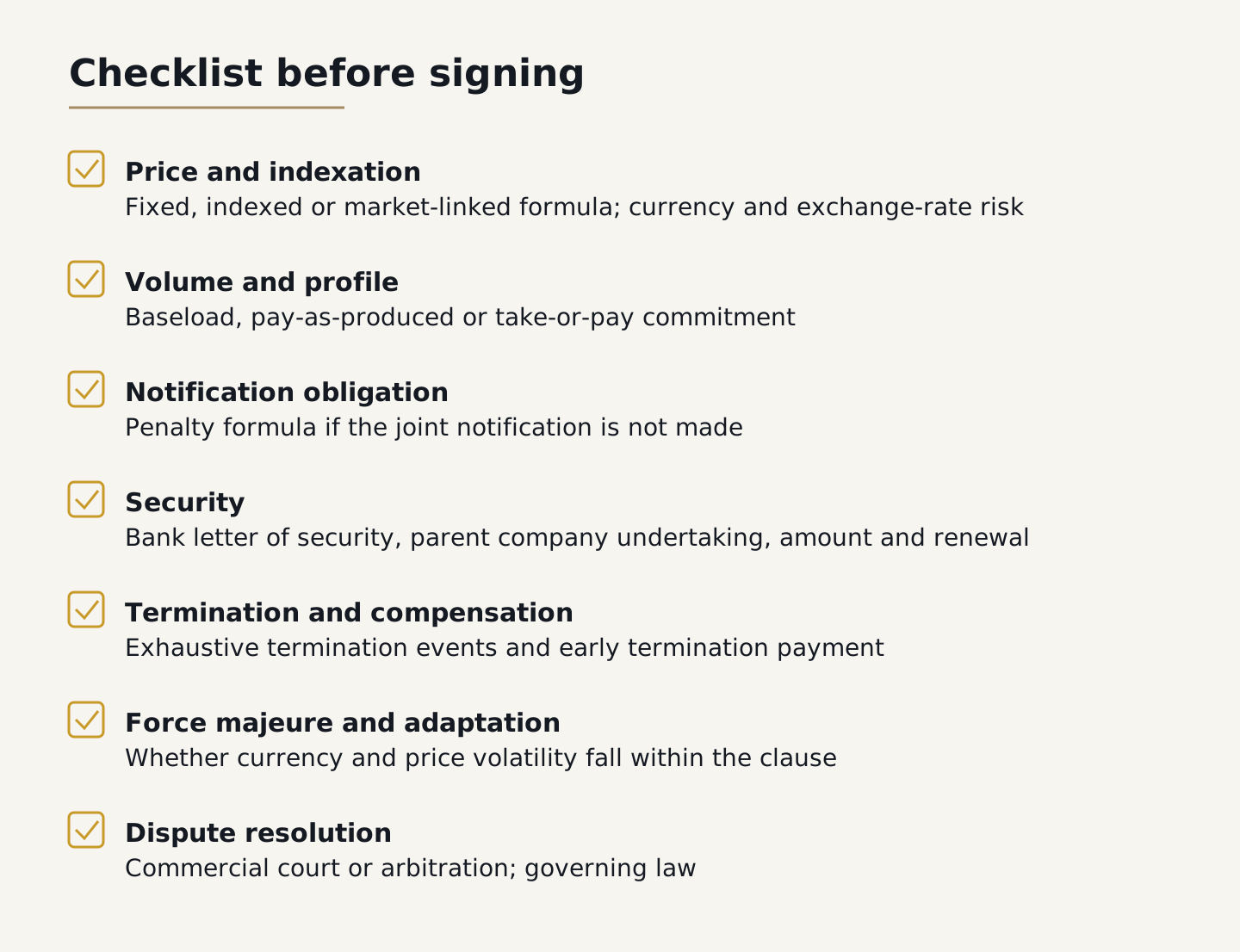
The price can be fixed, tied to an index or set by a formula based on the organised wholesale electricity market price. If the parties agree a foreign-currency price or link the price to an exchange rate, the contract should say expressly which party carries the risk of the exchange rate rising. The Court of Cassation decision discussed below shows that currency volatility has not been accepted as a sufficient reason to end the contract unilaterally.
Volume profile and take-or-pay
Volume can be set as a fixed hourly profile (baseload), as the quantity actually generated (pay-as-produced) or as a take-or-pay structure with a minimum purchase commitment. Since renewable output depends on the weather, the contract should also say who covers any shortfall and at what price.
Security and credit risk
Over a long contract term, the counterparty's ability to pay is one of the most significant risks. Whether the parties rely on a bank-issued letter of security (teminat mektubu), a parent company undertaking or cash collateral, the contract should set out the amount, duration, renewal dates and the conditions for calling the security.
Termination events and the early termination payment
Listing the termination events exhaustively, and spelling out what happens if a party terminates outside those events, is the area that generates the most disputes in practice. The early termination payment is usually calculated by a formula based on the remaining term and the remaining volume.
Is a currency or price spike enough to terminate a PPA?
As a rule, no. The Turkish Court of Cassation (Yargıtay) does not treat an unforeseeable rise in exchange rates as force majeure that justifies terminating an electricity supply contract. In a 2026 decision, its 11th Civil Chamber held that a termination based on grounds outside the exhaustive list in the contract was wrongful, that the contract was deemed to remain in force and that the contractual penalty (cezai şart) tied to the notification obligation could be claimed.
That said, Art. 138 TBK (excessive hardship) allows a party to ask the court to adapt the contract where an extraordinary event, unforeseeable when the contract was made, shifts the balance of performance against the debtor to a degree that offends good faith. Under the same article, in contracts involving continuing performance the debtor generally terminates rather than withdraws, and the rule also applies to foreign-currency debts. An adaptation request goes to the court; a unilateral termination notice is no substitute for it.
Can a contractual penalty be reduced?
A debtor who is a merchant cannot ask the court to reduce an agreed contractual penalty on the ground that it is excessive. Art. 182(3) TBK requires the judge to reduce a penalty considered excessive, but Art. 22 TTK provides that a debtor with merchant status cannot request that reduction.
Since PPA parties are usually merchants, the early termination payment and the notification penalty formulas should be worked through carefully before signing.
Can YEK-G certificates form part of a PPA?
Yes. Renewable energy certificates of origin (YEK-G belgesi) can be transferred under a PPA either together with the energy or separately from it. Art. 11(1) of the Regulation on Renewable Energy Resource Certificates of Origin in the Electricity Market (Elektrik Piyasasında Yenilenebilir Enerji Kaynak Garanti Belgesi Yönetmeliği) allows YEK-G certificates to be traded on the organised YEK-G market or on the YEK-G bilateral agreement market.
Under Art. 7(3) of the same Regulation, YEK-G system users must notify the Market Operator of certificate trades carried out through bilateral agreements.
Buyers that publish sustainability reports should make sure the contract names the plant, the period and the source type for which certificates will be issued. Otherwise, a buyer may pay for the electricity and still be unable to evidence its renewable consumption.
Which court hears PPA disputes?
If both parties are merchants and the contract relates to their businesses, the dispute is a commercial case under Art. 4 TTK and is heard by the commercial court of first instance (asliye ticaret mahkemesi) under Art. 5(1) TTK. Parties to long-term, high-value PPAs often agree on arbitration instead; in that case, the seat, the rules and the governing law should be stated expressly.
Separately from the PPA itself, EPDK sanctions relating to market activity fall under administrative jurisdiction. Art. 16 EPK provides for administrative fines where market-distorting conduct is found in any market, including bilateral agreements; the remedies available against such fines are covered in our article on challenging administrative fines in the energy market.
If a US or UK company signs a PPA or gives a parent company undertaking, documents issued abroad, such as board resolutions, certificates of incorporation or powers of attorney, may need to be used in Türkiye. Because Türkiye, the United States and the United Kingdom are all parties to the Hague Apostille Convention of 5 October 1961, these documents need an apostille rather than consular legalisation. In the UK, apostilles are issued by the Legalisation Office, including for Companies House certificates and documents certified by a UK notary or solicitor; in the US, documents issued or notarised under state authority are apostilled by the competent authority of the issuing state, and documents signed by federal officials by the US Department of State's Office of Authentications. A Turkish translation is usually needed as well, so confirm the receiving institution's requirements well before the signing date.
How is a power purchase agreement put together in practice?
Preparing a power purchase agreement starts with settling the commercial terms and ends when the contract is reflected in the market system. The steps below outline a typical negotiation between a renewable energy plant and an industrial buyer.
- Check each party's licence status, eligible consumer status and market registration.
- Establish the plant's commercial operation date, expected generation profile and the risk of construction delays.
- Put the price formula, the indexation method and the allocation of currency risk in writing.
- Allocate notification, imbalance and portfolio responsibilities between the parties.
- Agree the type, amount and renewal schedule of the security.
- List the termination events exhaustively and test the early termination formula with a worked example.
- Choose the governing law and the forum for disputes (court or arbitration).
If the plant is still under construction, the contract should also address who pays the buyer's replacement supply costs if the commercial operation date slips. The effect of administrative events such as the expiry, revocation or amendment of the licence should be anticipated at this stage too, because a power purchase agreement depends on the seller continuing to operate within its licence.
Common mistakes
- Relying on a general “just cause” clause instead of an exhaustive list of termination events.
- Leaving out the penalty formula for a missed joint notification and the question of who bears the imbalance cost.
- Treating exchange-rate or market-price volatility as force majeure without assessing adaptation and its limits.
- Assuming, as a merchant, that a contractual penalty can be reduced later.
- Failing to align the term, price and termination provisions of the two contracts in a sleeved structure.
- Leaving the transfer of YEK-G certificates and the related notification duty outside the contract.
A power purchase agreement offers long-term price certainty, but a poorly structured one can lock the parties into obligations for years. When the price formula, the notification obligation, the termination events and the security package are assessed together, the risks become far more predictable. You can review our energy law scope of services for contract and licensing work on energy projects, or reach us through our Contact page.