An EPDK generation licence is, as a rule, obtained in two stages: first a time-limited pre-licence, and then, once the permits and approvals have been completed within the pre-licence period, the generation licence itself. Only joint-stock companies and limited companies may carry out licensed electricity generation, and every facility needs its own pre-licence and licence.
This guide explains how an application for an EPDK generation licence is prepared under the Electricity Market Law No. 6446 (6446 sayılı Elektrik Piyasası Kanunu, EPK) and the Electricity Market Licensing Regulation (Elektrik Piyasası Lisans Yönetmeliği): which documents are required, how the deadlines run and which mistakes most often cost applicants their security. For small installations that need no licence, see our guide to unlicensed electricity generation.
What are the EPDK generation licence and the pre-licence, and who needs them?
A generation licence is the permit that entitles a legal entity to build and operate a specific power plant; a pre-licence (önlisans) is a temporary permit granted to prepare for that licence. Art. 4(1)(a) EPK lists generation among the activities that require a licence, and under Art. 5(2)(a) EPK a separate licence is needed for each facility where the activity is carried out at more than one site.
Art. 6(1) EPK states the purpose of the pre-licence plainly: it gives the company time to obtain the permits, approvals and licences required for the investment and to acquire ownership of, or a right to use, the plant site. Under Art. 6(2) EPK, a company that fails to complete these obligations within that period is not granted a licence.
Under Art. 4(3) EPK and Art. 12(3) of the Regulation, the applicant must be a joint-stock company (A.Ş.) or a limited liability company (Ltd. Şti.) incorporated under the Turkish Commercial Code (Türk Ticaret Kanunu). In a joint-stock company, all shares other than those traded on the stock exchange must be registered shares. For structures with foreign shareholders, our article on setting up a limited company with foreign partners helps with the groundwork.
If the project company has a UK or US parent, documents signed abroad for the formation or the licensing file, such as board resolutions, certificates of incorporation or powers of attorney, generally need an apostille rather than consular legalisation, because Türkiye, the United Kingdom and the United States are all parties to the 1961 Hague Apostille Convention. In the UK, the FCDO Legalisation Office issues apostilles, including for documents certified by a UK notary or solicitor. In the US, state-issued records such as company documents are apostilled by that state's Secretary of State, while federal documents go to the U.S. Department of State's Office of Authentications. A Turkish translation is usually needed as well, so confirm the current format requirements with the relevant Turkish authority before filing.
How do you apply for a pre-licence and which documents are required?
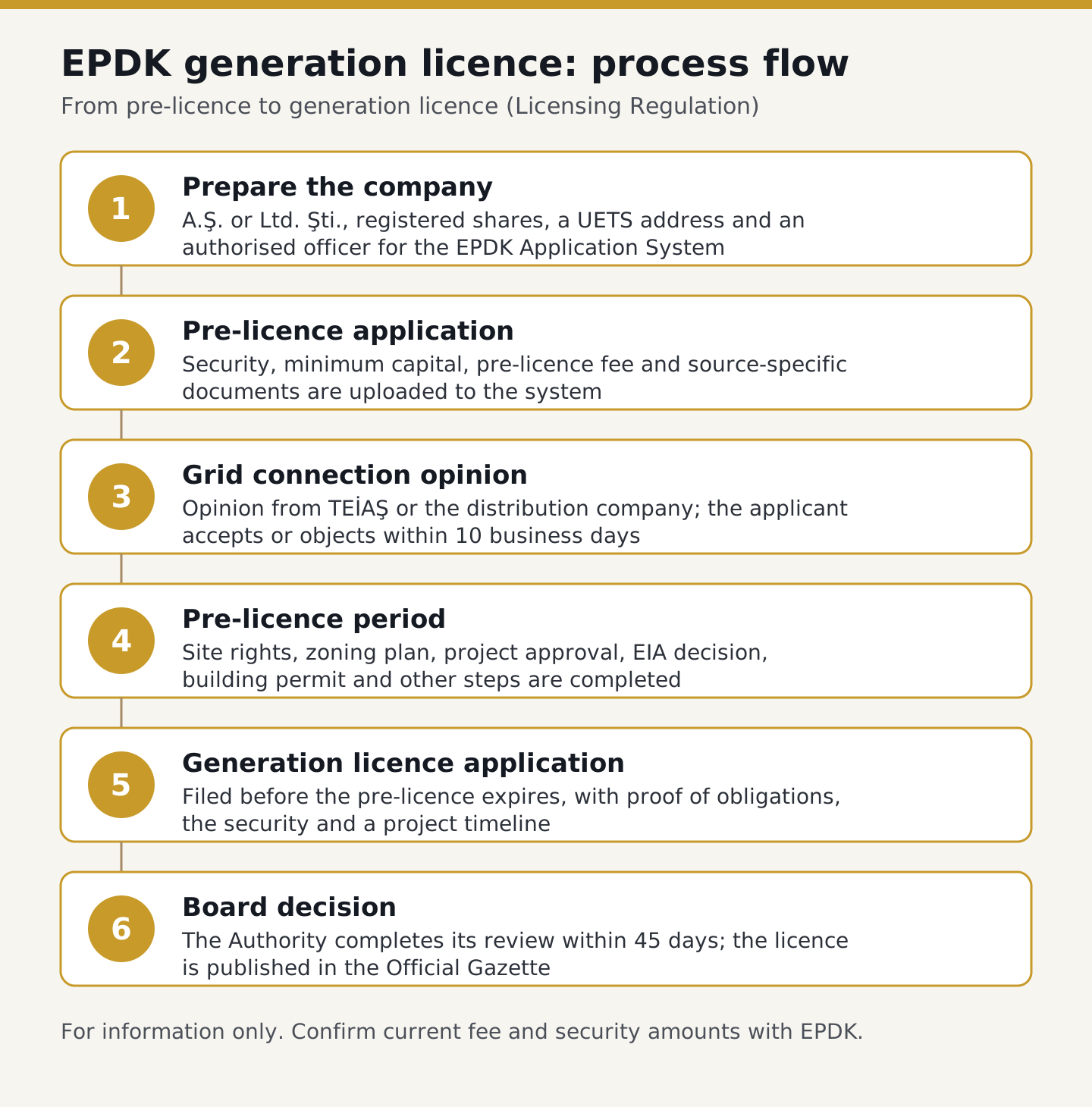
The first formal step towards an EPDK generation licence is the pre-licence application, made by uploading the documents listed in the Board-approved "Procedures and Principles for Pre-Licence and Licence Applications" (Önlisans ve Lisans İşlemleri ile İlgili Başvurulara İlişkin Usul ve Esaslar) to the EPDK Application System (Art. 12(1) of the Regulation). The company first notifies the Energy Market Regulatory Authority (EPDK) in writing of its authorised e-application officer, and the Authority sets up this authorisation within five business days (Art. 12(2)). The company must also hold an address on UETS, the National Electronic Notification System (Ulusal Elektronik Tebligat Sistemi).
Under Art. 12(5) and 12(6) of the Regulation, the key elements of the application are:
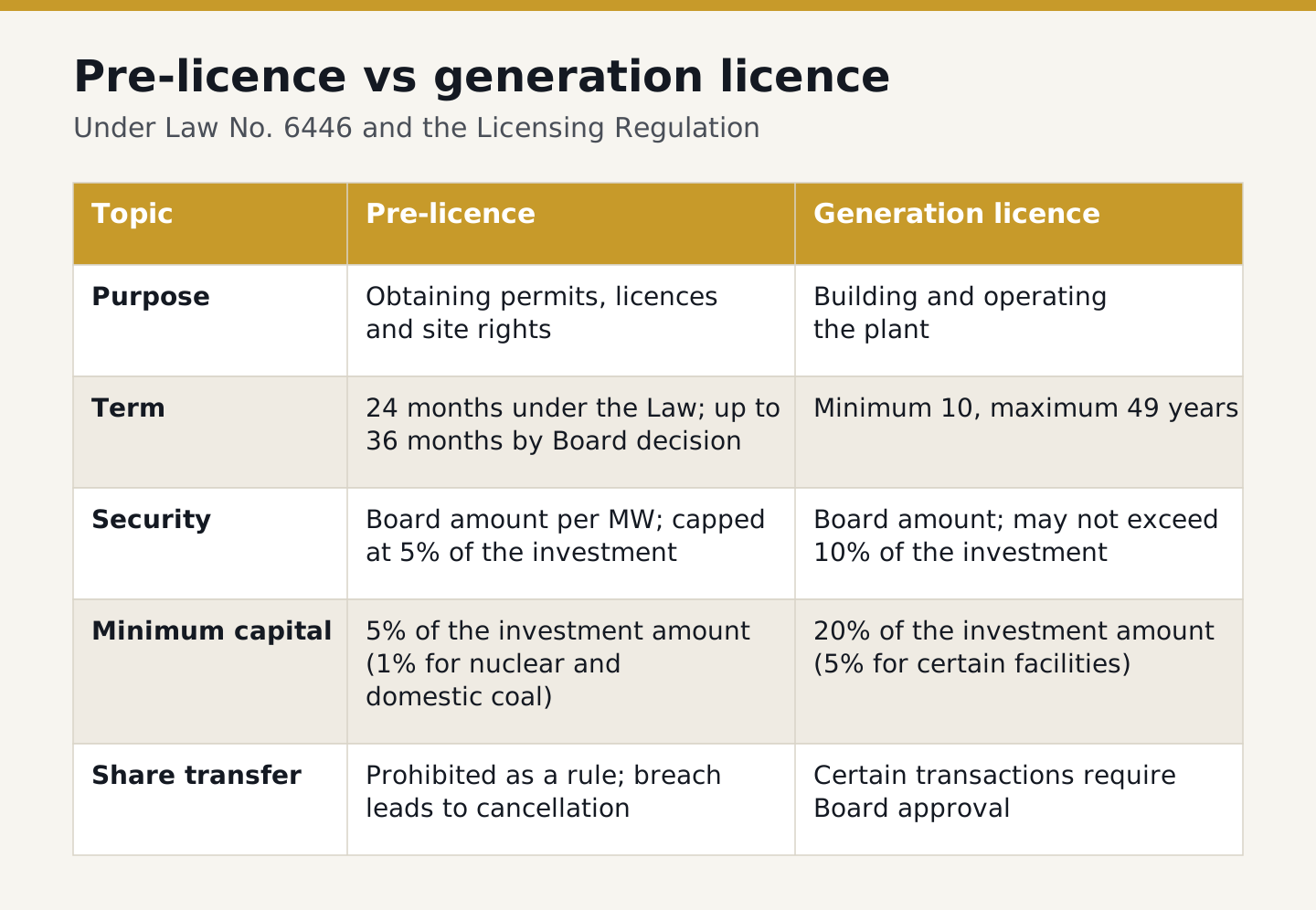
- Security: an amount per MW set by decision of the Energy Market Regulatory Board (Kurul), capped so that it does not exceed 5% of the total investment amount estimated by the Authority. The security letter issued by the bank (teminat mektubu) must reach the Authority's records office within five business days of the application.
- Minimum capital: the articles of association must show that the share capital has been increased to 5% of the total investment amount (1% for nuclear and domestic coal).
- Pre-licence fee: for domestic natural resource and renewable energy applications, only 10% of the fee is charged.
- Articles of association: a joint-stock company's articles must state that the shares are registered and that no bearer shares may be issued.
- Source-specific documents: for wind and solar, a title document if the site is owned by the company; for hydro, a Water Use Rights Agreement with State Hydraulic Works (DSİ) or proof of entitlement to one; for mining and geothermal, a document on the right to use the resource.
- EIA decision: for sources other than wind, solar, hydro, geothermal, biomass and domestic mining, the decision under the EIA Regulation (ÇED Yönetmeliği) is submitted with the application.
The security, capital and fee amounts are set by Board decisions and change from time to time. Please confirm the current figures on the EPDK website on the date of your application; this is why no amounts are given in this guide.
Why is grid capacity decisive for wind and solar applications?
Wind and solar applications can only be filed up to the connectable capacity announced by the Turkish Electricity Transmission Corporation (TEİAŞ). Under Art. 12(7) of the Regulation, TEİAŞ publishes its regional capacity report by 1 October each year, and the application dates are set by Board decision. Where applications for the same connection point or region exceed the announced capacity, TEİAŞ holds a competition (Art. 15(3)(ç)).
For these sources, the provisions of the articles of association and certain documents required by the Board are completed within the ninety-day period granted after the grid connection opinion has been accepted (Art. 12(11)). Applications for generation facilities with storage are subject to separate rules and minimum and maximum capacity limits (Art. 12(14)).
How does EPDK assess the application?
A complete application is taken into assessment, and the Authority asks TEİAŞ and/or the relevant distribution company for an opinion on grid connection and system use (Art. 15(1)-(2) of the Regulation). These bodies submit their opinions within forty-five days of the request, and the opinions are forwarded to the applicant within ten business days.
The applicant must submit, within ten business days, either an undertaking accepting the connection opinion or a reasoned objection; otherwise it is deemed to have accepted the opinion (Art. 15(2)(c)). The Regulation also states expressly that being taken into assessment does not mean the applicant is entitled to a pre-licence (Art. 15(5)).
Wind and solar applications go through an extra stage. They are first reviewed for objections based on personal rights (objections by third parties whose rights over the site are affected) and then sent to the General Directorate of Energy Affairs (Enerji İşleri Genel Müdürlüğü) for technical assessment (Art. 15(3)). Applications that pass the technical assessment are forwarded to TEİAŞ or the relevant distribution company for a connection opinion. These bodies determine the connection point and voltage level; where the plant site spans more than one connection region, the region containing more than half of the site is used (Art. 15(9)(ç)).
How long is the pre-licence period and can it be extended?
The pre-licence period is set by Board decision according to the energy source and installed capacity; Art. 9(1) of the Regulation provides that, excluding force majeure, it may not exceed thirty-six months. Art. 6(5) EPK limits the period to twenty-four months and allows the Board to extend it by up to half; read together, the two provisions set a ceiling of 36 months.
For anyone planning an EPDK generation licence, the key date is the effective date recorded on the pre-licence, from which the period runs (Art. 11 of the Regulation). In the event of force majeure (an event that could not be prevented or foreseen), the obligations may be postponed or suspended by Board decision upon a written or electronic application to the Authority (Art. 35(1) and 35(4)). The application must state when the force majeure began, its nature and its effect on the obligations.
An amendment published in the Official Gazette (Resmî Gazete) No. 33405 of 19 October 2026 added a sixth paragraph to Art. 35. Under it, an event previously accepted as force majeure no longer falls within that article once it becomes permanent in a way that prevents the investment from being completed. Projects that have been running on extensions for a long time should be reviewed separately in light of this change.
What must be completed during the pre-licence period?
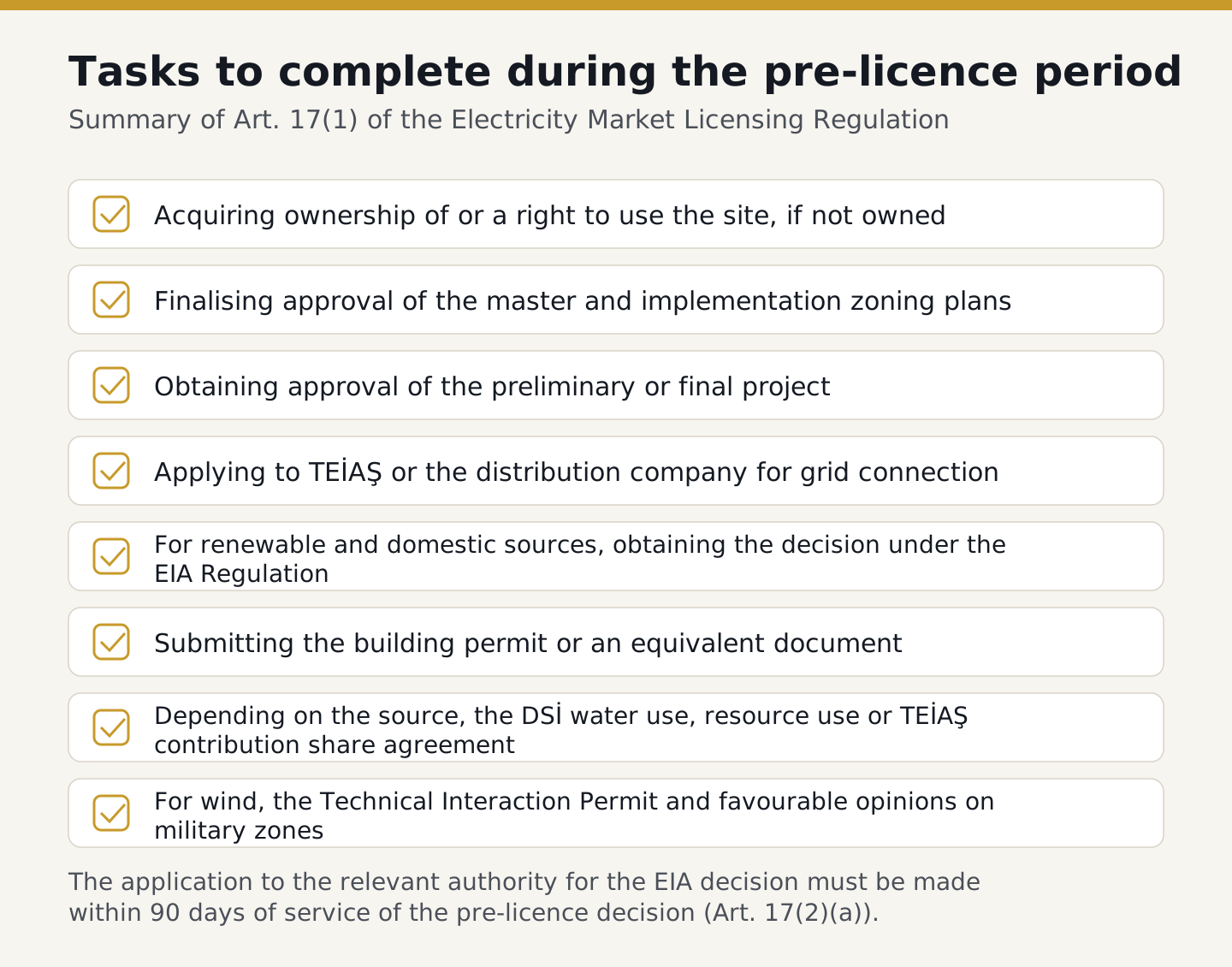
To qualify for an EPDK generation licence, the company must, during the pre-licence period, finish the site, zoning, project, grid connection, environmental and permit work needed to start the investment; the list is set out in Art. 17(1) of the Regulation. When acquiring land, it also helps to know what to check in a title deed transfer.
- Acquiring ownership of, or a right to use, the site if the company does not already own it (Art. 17(1)(a)).
- Finalising approval of the master and implementation zoning plans (Art. 17(1)(b)).
- Obtaining approval of the preliminary or final project (Art. 17(1)(c)).
- Applying to TEİAŞ or the distribution company for a grid connection agreement (Art. 17(1)(ç)).
- For renewable and domestic sources, obtaining the decision under the EIA Regulation (Art. 17(1)(e)).
- Submitting the building permit or an equivalent document (Art. 17(1)(f)); this does not apply to hydro plants.
- Signing, depending on the source, the DSİ, resource use or TEİAŞ contribution share agreements (Art. 17(1)(g)).
Wind projects also need a Technical Interaction Permit and favourable opinions on military restricted zones and firing ranges. The application to the relevant authority for the EIA decision must be made within ninety days of service of the pre-licence decision (Art. 17(2)(a)).
What is submitted with an EPDK generation licence application?
The application for the EPDK generation licence must be filed after the pre-licence obligations have been completed and before the pre-licence period expires; a company that does not apply in time is deemed not to have completed its obligations (Art. 20(5) of the Regulation). Under Art. 20(6), the application includes:
- Documents showing that the Art. 17(1) steps under the pre-licence have been completed.
- A security set by Board decision that does not exceed 10% of the total investment amount (consistent with Art. 5(7) EPK).
- A project timeline showing the work up to the completion date of the facility.
- Proof of payment of the licence fee; for renewable and domestic natural resources, 10% of the fee is charged.
- Articles of association showing that the share capital has been increased to 20% of the investment amount (5% for nuclear, domestic coal and YEKA facilities above 100 MW).
The Authority completes its review within forty-five days and submits it to the Board (Art. 23(1)). If any obligation was not completed in time, the application is rejected; otherwise the licence is granted, and the company name, licence type and term are published in the Official Gazette (Art. 23(2) and 23(4)). The construction period and the facility completion date are also recorded on the licence.
Under Art. 5(2)(c) EPK, an EPDK generation licence is granted for a minimum of ten and a maximum of forty-nine years. Art. 20(8) of the Regulation also allows a company that documents all of the Art. 17 obligations at the application stage to apply directly for a generation licence without first holding a pre-licence.
When does a pre-licence end and what happens to the security?
A pre-licence ends automatically at the end of its term if it is not extended, or on the company's request or bankruptcy (Art. 6(7) EPK). Until the licence is granted, any direct or indirect change in the shareholding structure, or any share transfer, leads to cancellation of the pre-licence, except for the exemptions in the Regulation (Art. 6(3) EPK).
If the pre-licence ends for reasons not attributable to the company, the security is returned (Art. 6(6) EPK); if the obligations are not completed in time, the security is forfeited (taken as revenue by the Authority). Art. 5(8) EPK imposes a three-year ban on applications and shareholdings for shareholders holding 10% or more of a company whose licence has been cancelled, and for its directors.
Board decisions can be challenged before the administrative courts. As no special time limit applies, the time limit for filing an action under Art. 7 of the Law on Administrative Procedure (İdari Yargılama Usulü Kanunu, İYUK) is sixty days from service, and an application under Art. 11 İYUK must also be made within that period.
Common mistakes
Most of the mistakes that cost applicants for an EPDK generation licence their security relate to deadlines:
- Assuming the pre-licence period starts when the Authority's notification letter is served; it runs from the effective date on the pre-licence.
- Missing the ninety-day deadline for the EIA application.
- Changing the shareholding structure or transferring shares before the licence is granted.
- Raising force majeure only after the deadline has passed; the application must be made promptly and with supporting documents.
- Failing to object to the connection opinion within ten business days and thereby being deemed to have accepted it.
- Missing the sixty-day time limit for challenging a forfeiture decision and objecting only afterwards.
Obtaining an EPDK generation licence is a multi-stage process that involves zoning, environmental, expropriation and company law as well as energy regulation, and each project's energy source and grid connection position can lead to different outcomes. This guide is for general information only and is not a substitute for legal advice on a specific project. For an overview of our work on energy projects, see our energy law practice page, and for questions, please use the Contact page.