A title deed transfer in Türkiye is completed when the seller and buyer sign an official deed at the land registry office (tapu müdürlüğü) and ownership is registered in the buyer's name in the land register. Any other route – for example a "sales contract" signed before a notary or privately – does not pass ownership and is usually invalid.
This guide walks through a title deed transfer in Türkiye step by step: the Web Tapu application, the documents you need, the fees and other costs, and the land register entries to check before you sign. The aim is to help you spot common loss-of-rights and fraud risks in advance.
Why must the transfer take place at the land registry office?
Because the law makes the validity of a property sale conditional on official form. Under Art. 237/1 of the Turkish Code of Obligations (Türk Borçlar Kanunu – TBK), "For a sale of immovable property to be valid, the contract must be made in official form." Art. 706 of the Turkish Civil Code (Türk Medeni Kanunu – TMK) imposes the same requirement on contracts aimed at transferring ownership of land.
For registered property, the power to draw up this official deed belongs to the land registry director and registry officers under Art. 26 of the Land Registry Law (Tapu Kanunu). Even after the deed is signed, ownership does not pass automatically: under TMK Art. 705, ownership of real estate is acquired by registration (entry in the land register).
Private agreements, known in practice as "harici satış" (off-register sales), therefore do not make the buyer the owner. The Court of Cassation accepts that, where a sale ignores the official form, the parties may only reclaim what they paid each other under the rules on unjust enrichment.
The same applies to preliminary agreements made before the sale. Under TBK Art. 237/2, a promise to sell real estate is not valid unless made in official form.
A promise-to-sell agreement drawn up by a notary may be annotated on the land register at either party's request; if the sale is not completed within five years of the annotation, the land registry office removes it of its own motion (Land Registry Law Art. 26). Knowing this matters before you pay any deposit.
How does a title deed transfer work? Step by step
In practice, a title deed transfer in Türkiye starts with an online application and ends with signing at the land registry office. A sale normally involves an application through Web Tapu, a document check, payment of the fee, an appointment and signing. The application can be made by either party, their attorney-in-fact or an authorised real estate agency; after reviewing it, the land registry office notifies the fee amount and gives an appointment.
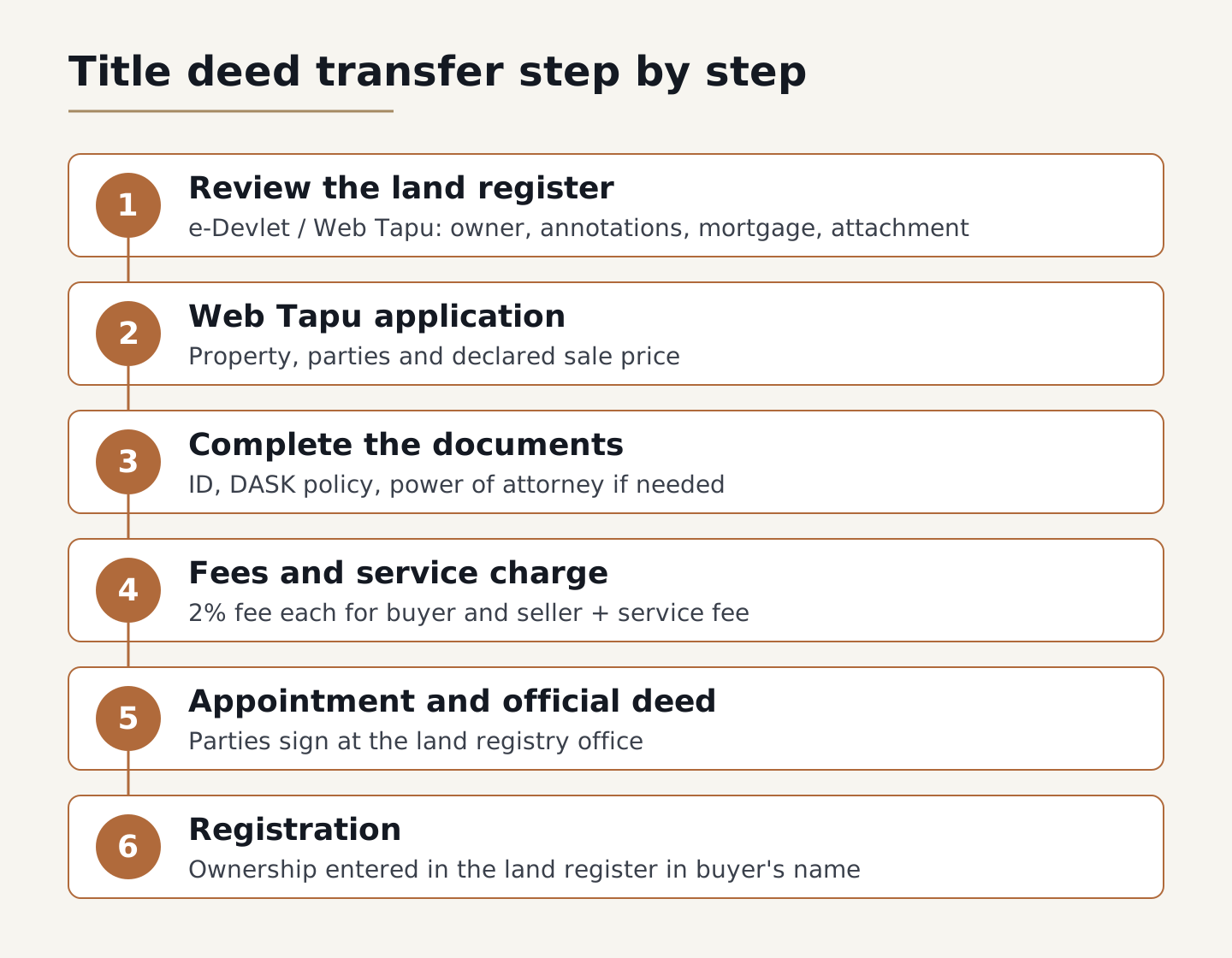
- Review the land register entry: through e-Devlet or Web Tapu, check the owner, the shares and the encumbrances (restrictions such as annotations, declarations, mortgages or attachments).
- Create a sale application on Web Tapu: enter the property details, buyer and seller details and the sale price to be declared.
- Upload or prepare the documents: identity documents, a valid compulsory earthquake insurance policy and, if an attorney-in-fact acts, the power of attorney.
- Pay the fee and the service charge: once the land registry office notifies the amount, pay through a bank or electronic channels.
- Attend the land registry office on the appointment day: the parties' identities are checked and the official deed is read out and signed.
- Confirm that registration is complete: the new owner is entered in the land register, and you can view the updated record on e-Devlet.
On the appointment day, the official deed is read to the parties and signed. Under Land Registry Law Art. 26, the deed records the parties' identity details and tax identification numbers; if there is doubt about a party's identity, witnesses may be requested.
Before signing, check the property details, the share and the sale price in the deed one by one; correcting a wrong entry later requires a separate procedure.
If the parties are in different cities or abroad, everything does not have to happen at the same table. Land Registry Law Art. 26/2 allows the contract to be completed by taking each party's declaration separately where they are at different land registry offices or at offices abroad.
Which documents are needed for a title deed transfer?
The basic document is a valid identity document for each party, plus a compulsory earthquake insurance policy valid on the transaction date and, if an attorney-in-fact is used, a power of attorney. The office may ask for more, depending on the property and the parties.
- Identity document: an ID card for Turkish citizens; a passport or valid identity document for foreign nationals.
- Compulsory earthquake insurance (DASK policy): under Art. 11/2 of the Disaster Insurance Law No. 6305, registration of insurable buildings cannot proceed unless the policy is shown to be valid on the transaction date.
- Power of attorney: for a sale through an attorney-in-fact, a notarised power of attorney that expressly authorises the transfer of the property.
- Additional documents for foreign nationals: conditions such as a valuation report or a sworn translator may also apply; confirm the current list with the land registry office before the transaction.
- Municipal letter showing the property tax value: this shows the minimum base for calculating the fee; ask the office whether it is required.
For a title deed transfer in Türkiye, take particular care with the power of attorney. Under TBK Art. 504/3, an attorney-in-fact cannot transfer real estate or encumber it with a right unless specifically authorised. A sale under a general power of attorney may be stopped, so read its scope, date and the property it covers before signing.
For readers in the United States or the United Kingdom: if you will sign a power of attorney at home rather than travel, it can be executed at a Turkish consulate or before a local notary followed by an apostille. Türkiye, the US and the UK are all parties to the 1961 Hague Apostille Convention, so consular legalisation is not needed for an apostilled document. The document must then be translated into Turkish by a sworn translator, and Turkish consulates advise that the apostille itself is translated as well. Make sure the wording expressly covers selling or buying the specific property, as TBK Art. 504/3 requires.
How much are the fees and costs of a title deed transfer?
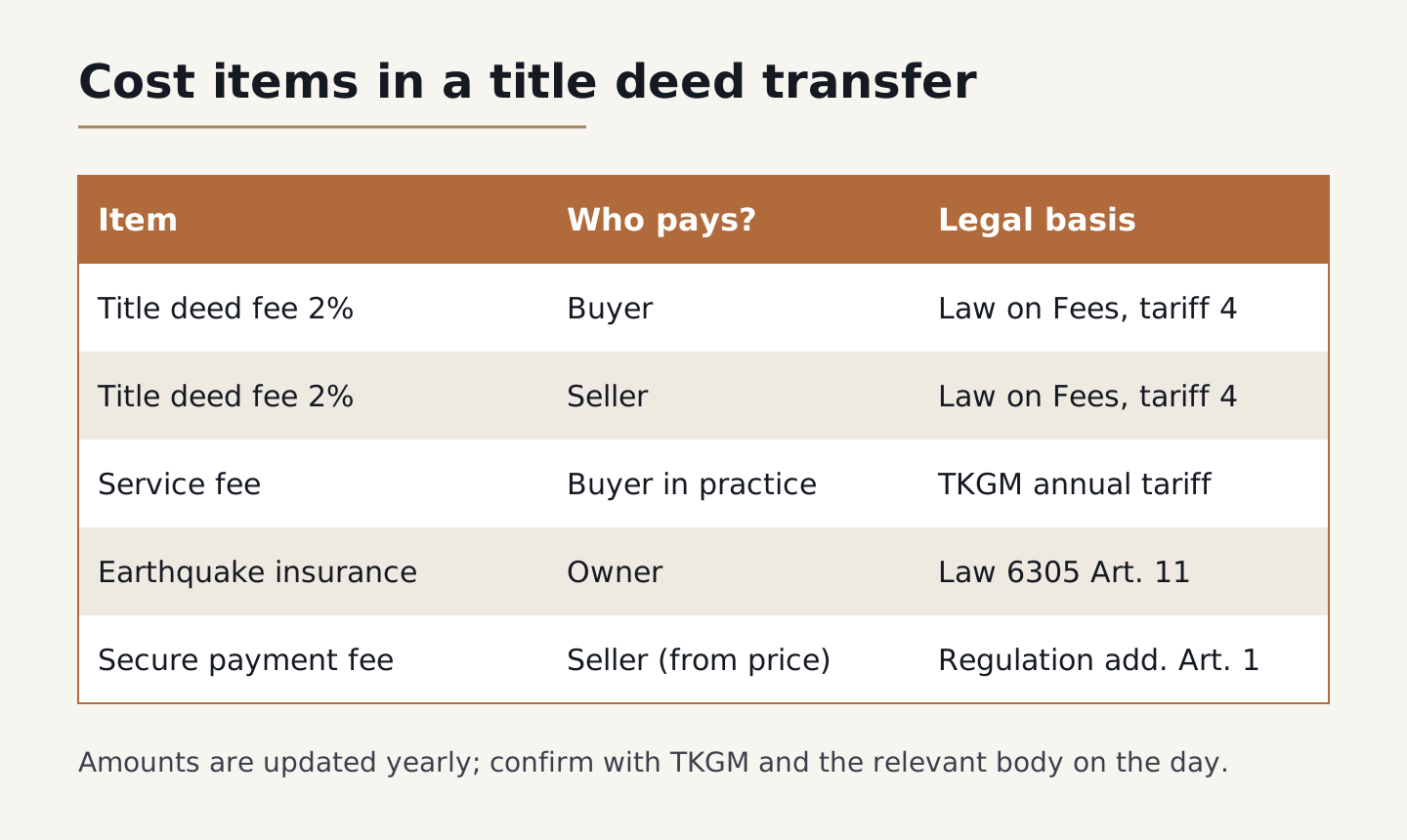
In property sales, the title deed fee is charged separately to the buyer and the seller at 20 per mille (2% each), so the total burden is 4% of the sale price. This rate comes from tariff (4) annexed to the Law on Fees (Harçlar Kanunu) and continues to apply in 2026.
The fee base (the amount the fee is calculated on) is the declared sale price; however, under Law on Fees Art. 63/2, this amount cannot be lower than the property tax value. If the declared price is later found not to reflect reality, fee is assessed on the difference and a tax loss penalty is imposed (Art. 63/4).
Cost item | Who pays? | Note |
|---|---|---|
Title deed fee (2%) | Buyer | Declared price cannot be below the property tax value |
Title deed fee (2%) | Seller | A private agreement does not change the statutory liability towards the tax office |
Revolving fund service fee | Usually the buyer in practice | Amount set each year by the General Directorate of Land Registry and Cadastre |
Compulsory earthquake insurance | Owner | A policy valid on the transaction date is required |
Secure payment usage fee | Deducted from the sale price | Applies once the system becomes mandatory |
The revolving fund service fee varies by location and year. Confirm the current 2026 amount with the General Directorate of Land Registry and Cadastre (TKGM) or the land registry office you apply to; online calculators show differing figures.
The parties may agree among themselves who bears the fee, but that agreement cannot be relied on against the tax authority. Under-declaring the price creates more than a tax risk: in a later dispute, it also makes it harder to prove the real price that was paid.
What should you check in the land register before signing?
Before signing, you should confirm that the seller really is the owner and that no entry blocks the transfer or would bind you as buyer. Under TMK Art. 1020, the land register is open to the public and nobody can claim to be unaware of an entry in it; this rule works against buyers who do not inspect the records.
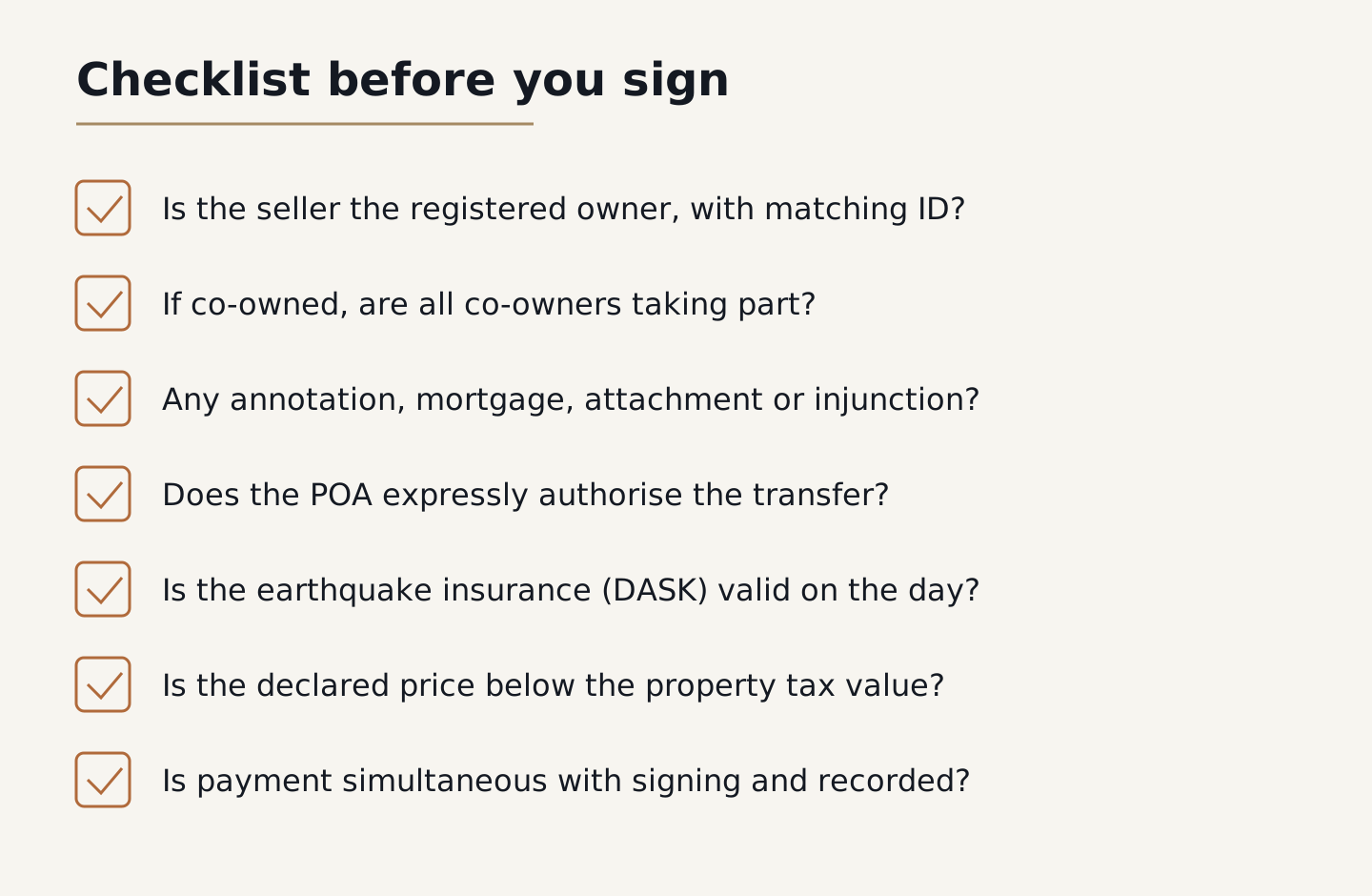
- Owner and shares: is the seller the sole owner, or is there co-ownership in shares or joint ownership?
- Mortgage: where the property is mortgaged to a bank, agree in advance how the debt will be paid off and when the mortgage will be released.
- Attachment and interim injunction: entries made because of enforcement proceedings or a lawsuit may stop the sale or affect the buyer.
- Annotations: entries such as a lease, a promise to sell or a pre-emption right may also bind later owners.
- Declarations: entries on a condominium management plan, construction servitude or zoning status determine how the property may be used.
- Physical condition: visit the property and check that its registered nature (for example "land" or "dwelling") matches reality.
A third party who acquires ownership relying in good faith on the land register is protected under TMK Art. 1023. However, a person who knew or should have known that the entry was unlawful cannot benefit from this protection (TMK Art. 1024).
Buying without seeing the property, far below market value or in unusual haste can therefore call a claim of good faith into question.
How and when should the purchase price be paid?
The safest approach is for the price to change hands at the same time as ownership, and on the record. Sending the full price to the seller before signing at the land registry may mean going to court to recover it if the transfer does not happen.
Additional Article 1, added to the Regulation on Real Estate Trade (Taşınmaz Ticareti Hakkında Yönetmelik) by the Official Gazette of 29 April 2026, provides that in sales paid in cash, by bank transfer or by electronic funds transfer, the price is to be paid through a payment system that ensures ownership and price change hands simultaneously. Where a bank loan is used, the system also applies to the part not covered by the loan.
Under provisional Article 1/10 of the Regulation, use of the system is not mandatory for sales made until 1 December 2026, and the Ministry of Trade may extend this date by up to three months. Because implementation has been postponed before, check the latest announcements of the Ministry of Trade and TKGM before your sale date.
What are the most common mistakes in a title deed transfer?
The most frequent mistakes are payments made outside the official form, inadequate powers of attorney and failing to inspect the land register. The following list sums up the problems seen most often in practice:
- Signing a "sales contract" before a notary or privately and assuming ownership has passed.
- Sending the full price to the seller before signing at the land registry.
- Relying on a general power of attorney that does not expressly authorise the sale.
- Not checking mortgages, attachments or annotations on the register before signing.
- Declaring a price below the property tax value or otherwise untrue.
- In co-ownership, agreeing with only one co-owner and overlooking the others.
- Discovering at the last minute that the earthquake insurance has expired on the transaction day.
What people researching a title deed transfer in Türkiye often overlook is that most problems surface before signing day. Many of these mistakes can be prevented by checking the register and documents a few days before the transaction. When a dispute does arise, remedies such as an action for cancellation of title and registration, recovery of the price or damages come into play; these cases take time and carry a burden of proof.
Who is liable for errors in the land register?
The State is liable for all damage arising from keeping the land register (TMK Art. 1007). For example, a person harmed by a transfer made with a forged ID or forged power of attorney, owing to a lack of checks by officials, can bring an action for damages against the State; the case is heard by the court where the land register is located.
If a right in rem has been registered unlawfully, the person whose right is harmed may sue to correct the land register under TMK Art. 1025. However, rights acquired by third parties in good faith relying on that registration are preserved, so it is important to act quickly and, where necessary, seek an interim injunction.
What is different for foreign nationals and special cases?
For foreign buyers, additional conditions such as reciprocity, area limits and military security zones apply, and the transaction may take longer as a result. If the purchase will also be used for a residence permit application, it should be planned together with the process for obtaining residence in Türkiye.
Land registry procedures also follow separate rules in cases such as divorce or inheritance. For example, if an uncontested divorce settlement provides for transferring a property to one spouse, registration is based on the final court judgment; in inheritance, ownership passes to the heirs before registration under TMK Art. 705/2, but registration is needed to dispose of the property.
For the general framework of property purchases, register checks, contract preparation and the land registry process, review our real estate law practice area. For questions about your specific transaction, reach us via the Contact page. This article is for general information only and is not a substitute for legal advice.