
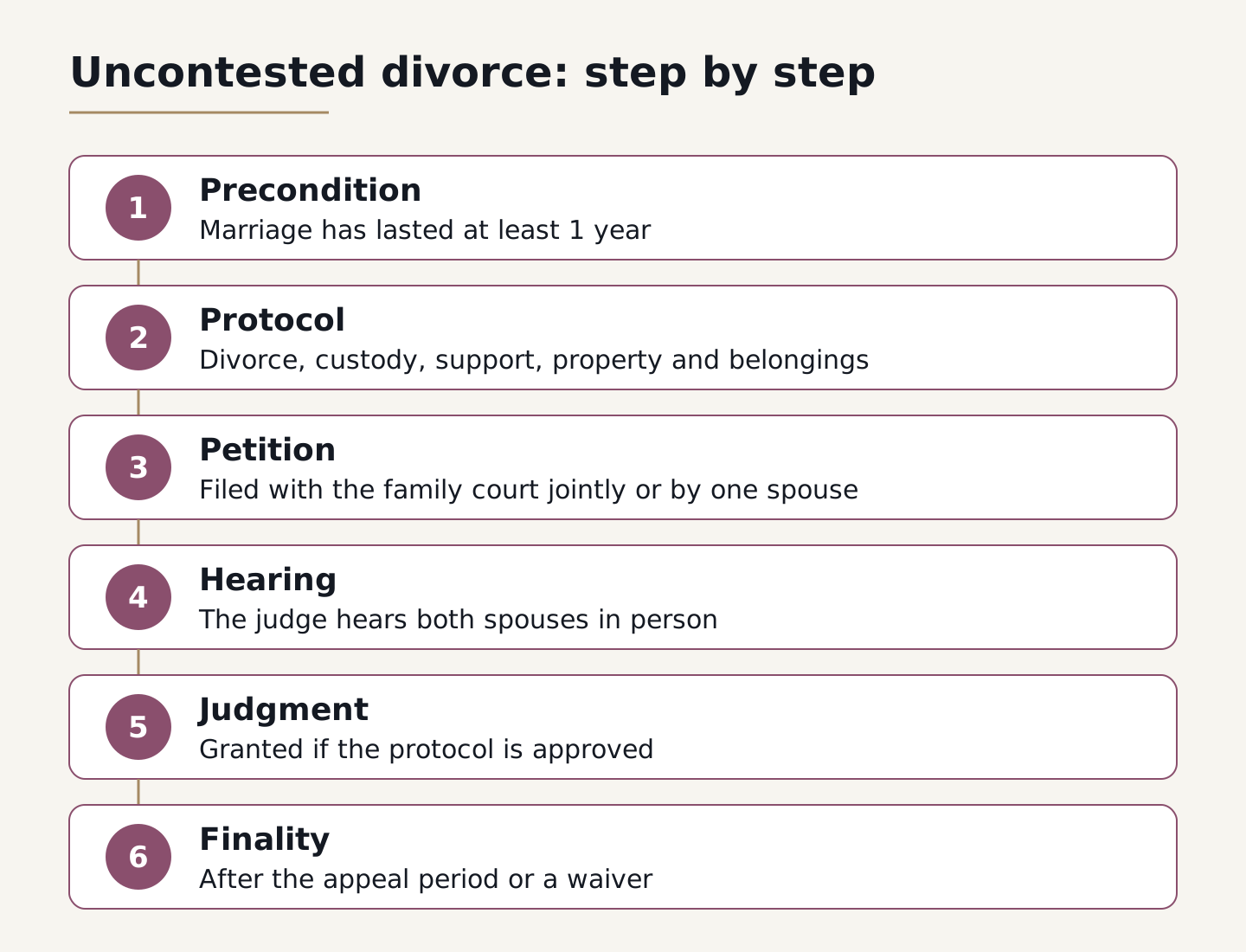
An uncontested divorce in Turkey is possible when the marriage has lasted at least one year, the spouses file together (or one spouse accepts the other's petition), and the judge hears both spouses in person and approves their settlement protocol. These conditions are set out in Article 166(3) of the Turkish Civil Code (Türk Medeni Kanunu, TMK). Once they are met, the marriage is deemed by law to have irretrievably broken down, and neither spouse has to prove fault.
In practice, most problems arise from an incomplete protocol or from one spouse changing their mind at the hearing. This guide explains the requirements for an uncontested divorce, the points the protocol must cover, how the case and the hearing work, and when the judgment becomes final. It is general information and does not replace legal advice on your specific situation.
What are the requirements for an uncontested divorce in Turkey?
The law requires four elements: a marriage of at least one year, a joint will to divorce, a personal hearing of both spouses by the judge, and the judge's approval of the arrangements for the financial consequences and the children. If any of these is missing, the court cannot grant an uncontested (consensual) divorce. The requirements are assessed together; a document signed by both spouses is not enough on its own.
The marriage must have lasted at least one year
The one-year period runs from the date of marriage to the date the case is filed. If the petition is filed before the first anniversary, the court cannot grant an uncontested divorce; the spouses must either wait or pursue a fault-based contested divorce. The marriage date is taken from the civil registry record.
A joint petition or acceptance of the case
The spouses may file the case together, or one spouse files and the other accepts it. In the second scenario, the acceptance must be clearly repeated before the judge at the hearing. A case that starts as contested can also turn into an uncontested divorce if the spouses reach an agreement during the proceedings.
The judge must hear both spouses in person
To be satisfied that each spouse is expressing their will freely, the judge must hear both of them personally (TMK m. 166/3). Both spouses therefore have to attend the hearing in person; a lawyer may accompany them but cannot make the statement on their behalf. The judge checks whether the statements were given under pressure or by mistake.
What should an uncontested divorce protocol include?
The protocol (the spouses' written agreement on the divorce and its consequences) must fully regulate the financial consequences of the divorce and, where relevant, the children's situation. The judge cannot grant the divorce unless they approve these arrangements, and agreements on the ancillary consequences of divorce are not valid without the judge's approval (TMK m. 184/5). Any point left vague can become the subject of a new lawsuit later.
- Custody: which parent will hold custody (parental authority) of the children.
- Visitation (contact arrangements): the days and hours the non-custodial parent spends with the child, including religious holidays and school breaks.
- Child support: the amount, payment date, method of annual increase and the account it is paid into.
- Spousal support (poverty alimony): whether it is claimed, how much and for how long; if no claim is made, this should be stated expressly.
- Pecuniary and non-pecuniary damages: either a waiver of claims or the amount to be paid.
- Property and belongings: acquired assets, cars, the home, wedding jewellery and household goods.
- Costs of proceedings and attorney fees: which spouse will bear them.
The non-custodial parent must contribute to the child's care and education costs according to their means (TMK m. 182). When setting the visitation schedule, the judge focuses on the child's welfare, particularly health, education and moral development. You can read more about our work in this field in our family and inheritance law practice area.
Can the judge change the protocol?
Yes. Taking into account the interests of the spouses and the children, the judge may make the changes they consider necessary. However, both spouses must accept those changes; if they do, the divorce is granted. If either spouse rejects a change, the agreement falls away and the case continues as a contested divorce.
How do you file for an uncontested divorce?
The case is filed with the family court (aile mahkemesi); where there is no family court, the civil court of first instance (asliye hukuk mahkemesi) handles it. Family courts hear cases and matters arising from the family law book of the Turkish Civil Code (Law No. 4787, Article 4). The signed protocol, a civil registry extract and copies of identity documents are attached to the statement of claim.
Which court has jurisdiction?
The competent court is the court of either spouse's place of residence, or of the place where the spouses lived together for the last six months before the case (TMK m. 168). For example, if one spouse lives in Istanbul and the other in Ankara, the case may be filed in either city. Choosing the correct venue avoids the file being transferred to another court.
Court fees and advance on costs
When filing, the spouses pay the application fee, the advance court fee and an advance on costs for items such as service of documents. These amounts are updated every year under the Law on Fees (Harçlar Kanunu) tariffs and the Code of Civil Procedure (Hukuk Muhakemeleri Kanunu, HMK) advance-on-costs tariff. Please confirm the current amounts with the front office of the courthouse where you will file or via the National Judiciary Informatics System (UYAP).
What happens at the uncontested divorce hearing?
At the hearing, the judge verifies the spouses' identities and asks each of them separately whether they wish to divorce and whether they signed the protocol of their own free will. The terms of the protocol are then read out one by one, and the spouses' acceptance is recorded in the minutes. If the judge approves the arrangements for the children, the judgment can, as a rule, be announced in the same session.
Under the case law of the Court of Cassation (Yargıtay), a judgment given without hearing one of the spouses is a ground for reversal. The Court also requires that, where a protocol is submitted at a later stage of the proceedings, the spouses be summoned and heard in person.
What if one spouse withdraws from the protocol?
Either spouse may withdraw from the protocol until the judgment becomes final; the conditions for an uncontested divorce then disappear and the case is heard as a contested divorce. According to the Court of Cassation, no statutory provision prevents spouses from going back on their statements about the financial consequences and the children. In that situation, the court gives the parties time to present their facts and evidence and conducts the proceedings under the general rules.
In contested proceedings, the ground for divorce and fault must be proven with evidence. The judge cannot treat the facts underlying the divorce as proven unless convinced of them, and the parties' admissions do not bind the judge (TMK m. 184). That is why genuine agreement on every term before the protocol is signed is the most effective way to keep the process short.
When does an uncontested divorce judgment become final?
The judgment becomes final once the two-week period for appeal (istinaf) has expired after the reasoned judgment is served on both spouses (HMK m. 345). After service, the spouses may waive their right to appeal; a waiver before service is not possible (HMK m. 349/1).
The judgment bearing the certificate of finality (kesinleşme şerhi) is notified to the civil registry office, and the spouses' marital status is updated. From that point on, the terms of the protocol are binding as part of the judgment.
The law sets a 300-day waiting period for the woman. It ends on childbirth, and the court lifts it if it is established that the woman is not pregnant from the previous marriage or if the former spouses wish to remarry each other (TMK m. 132). Lifting the waiting period requires a separate application.
What is the difference between uncontested and contested divorce?
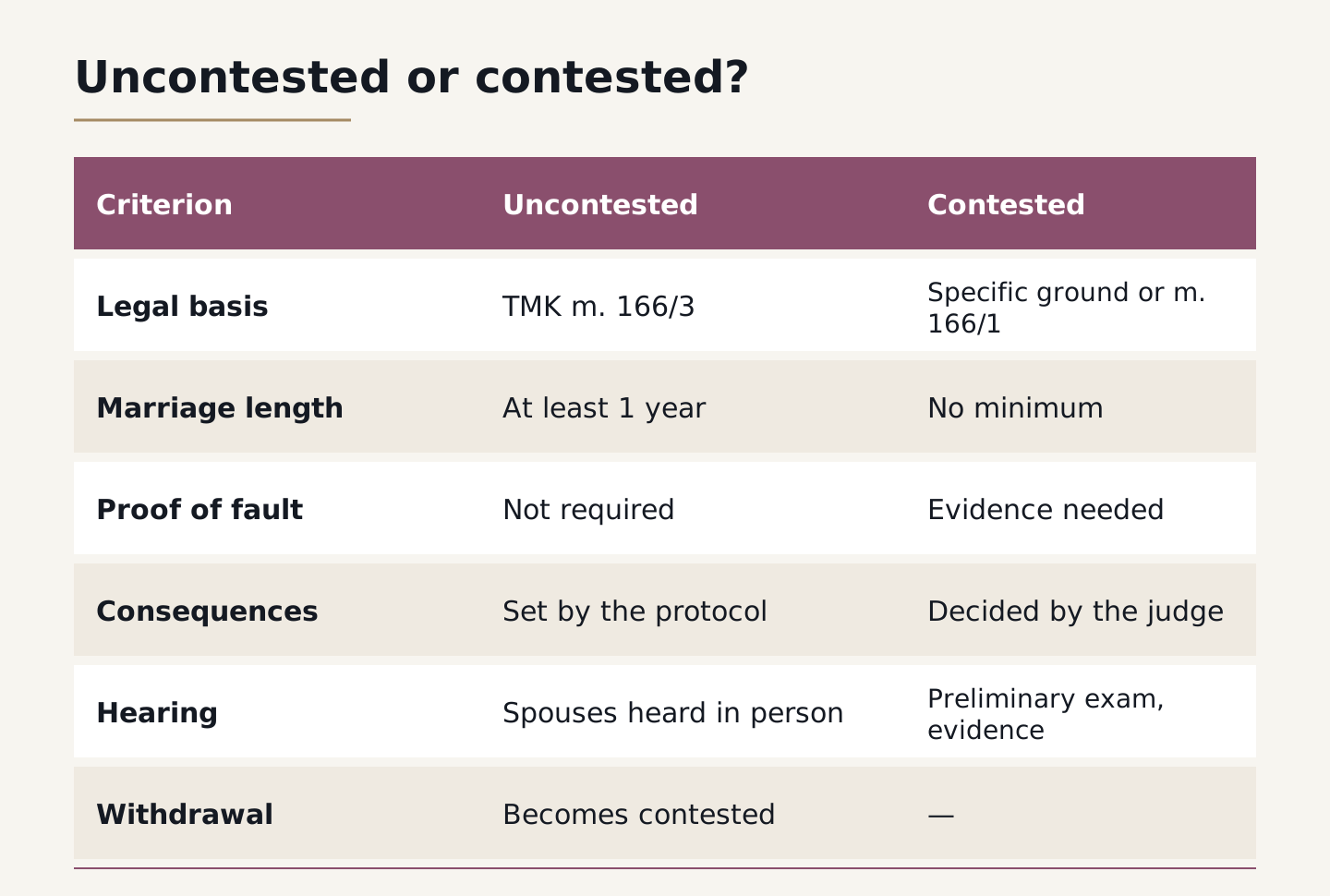
The key difference is that an uncontested divorce does not require proof of fault, and the ancillary consequences are set by the spouses' protocol. In a contested divorce, the ground for divorce and fault are proven with evidence, and the judge decides on support, damages and custody.
Issue | Uncontested divorce | Contested divorce |
|---|---|---|
Legal basis | TMK m. 166/3 | Specific grounds for divorce or TMK m. 166/1 |
Minimum length of marriage | At least one year | No minimum |
Fault and proof | Not required | Must be proven with evidence |
Support, damages, custody | Set in the protocol, approved by the judge | Decided by the judge on the claims made |
Proceedings | Hearing where both spouses are heard in person | Written pleadings, preliminary examination, taking of evidence |
The concepts governing the ancillary consequences of divorce are the same in both routes. A spouse who is not at fault, or less at fault, may claim pecuniary damages, and a spouse whose personality rights were violated may claim non-pecuniary damages (TMK m. 174). A spouse who would fall into poverty because of the divorce may claim spousal support, provided their fault is not greater (TMK m. 175).
The requirements for an uncontested divorce also include settling these claims expressly in the protocol; otherwise the judge may find the arrangement incomplete.
If one spouse is a foreign national, the divorce may also affect residence rights such as a family residence permit; for the general framework, see our article on residence permit types for foreigners in Türkiye.
How should you prepare for an uncontested divorce?
Preparation starts with checking the length of the marriage and ends with both spouses reading the protocol in detail. The sequence below helps to put together a complete file; each step should be adapted to the family's specific circumstances.
- Check the marriage date in the civil registry and confirm that one year has passed.
- List the children's school, health and daily care needs and discuss custody and visitation.
- Prepare an inventory of joint assets, bank accounts, vehicle and property records.
- Set the support amount, payment date and annual increase method in writing.
- Have each spouse read the protocol separately and sign every page; submit one copy to the court.
- Track the hearing date and make sure both spouses attend in person with their identity documents.
The protocol should use plain, measurable language. Writing figures, dates and payment methods instead of phrases such as "a reasonable amount" or "within a reasonable time" avoids disputes when the judgment is enforced. If one spouse lives abroad, plan their attendance at the hearing in advance.
For spouses who married in the United States or the United Kingdom, documents issued there, such as a marriage certificate or children's birth certificates, generally need an apostille and a sworn translation into Turkish before use in a Turkish court. According to the Hague Conference (HCCH), the Apostille Convention has been in force for the United States since 15 October 1981, for the United Kingdom since 24 January 1965 and for Türkiye since 29 September 1985. In the UK, apostilles are issued by the FCDO Legalisation Office; in the US, state-issued vital records are apostilled by the designated authority of the issuing state. If you need the divorce recognised abroad, the receiving authority will usually ask for the Turkish judgment bearing the certificate of finality, apostilled and translated; confirm its exact requirements in advance.
Common mistakes
- Filing for an uncontested divorce before the marriage has lasted one year.
- Stating the support amount in the protocol without the increase method or payment date.
- Leaving out jewellery, cars or the home altogether, or glossing over them with a general phrase such as "the property has been divided".
- Leaving visitation days vague, e.g. "as the parties will agree".
- One spouse not attending the hearing in person.
- Accepting changes proposed by the judge without first assessing their consequences.
When the requirements are properly met, an uncontested divorce is a more predictable route for the spouses; however, every term of the protocol becomes binding within the final judgment. If you would like the scope of your protocol reviewed before starting the process, review our scope of services in family and inheritance law; for related articles, visit our publications, and for questions, use the Contact page.