Turkish citizenship by investment means that a foreign national who does not work in Türkiye makes an investment of the type and amount set by the President, obtains an investor residence permit and then acquires Turkish citizenship by Presidential decision. As of 2026, the legislation recognises seven investment routes: the minimum is USD 400,000 for real estate and USD 500,000 (or the equivalent in another foreign currency) for capital, bank deposits, funds and the other monetary routes.
This article looks at the investment options, the eligibility requirements, the position of family members and the risks that may later lead to withdrawal of citizenship, based on Art. 12 of Turkish Citizenship Law No. 5901 (Türk Vatandaşlığı Kanunu, TVK) and Art. 20 of the Regulation on the Implementation of the Turkish Citizenship Law (Türk Vatandaşlığı Kanununun Uygulanmasına İlişkin Yönetmelik, the Regulation).
What is the legal basis for Turkish citizenship by investment?
The legal basis is Art. 12(1)(b) TVK: foreigners holding a residence permit under Art. 31(1)(j) of Law No. 6458 on Foreigners and International Protection (Yabancılar ve Uluslararası Koruma Kanunu, YUKK) and Turquoise Card holders may acquire citizenship by exceptional naturalisation, together with their spouses and minor or dependent children. This route is separate from naturalisation by ordinary procedure, which requires, among other things, five years of residence.
Art. 31(1)(j) YUKK provides that a short-term residence permit (ikamet izni, i.e. a residence permit) may be granted to foreigners who do not work in Türkiye but will invest within the scope and amounts determined by the President. Under Art. 31(5) YUKK, this permit may be issued for periods of up to five years at a time. The scope of qualifying investments and the amounts are set out in Art. 20(2) of the Regulation.
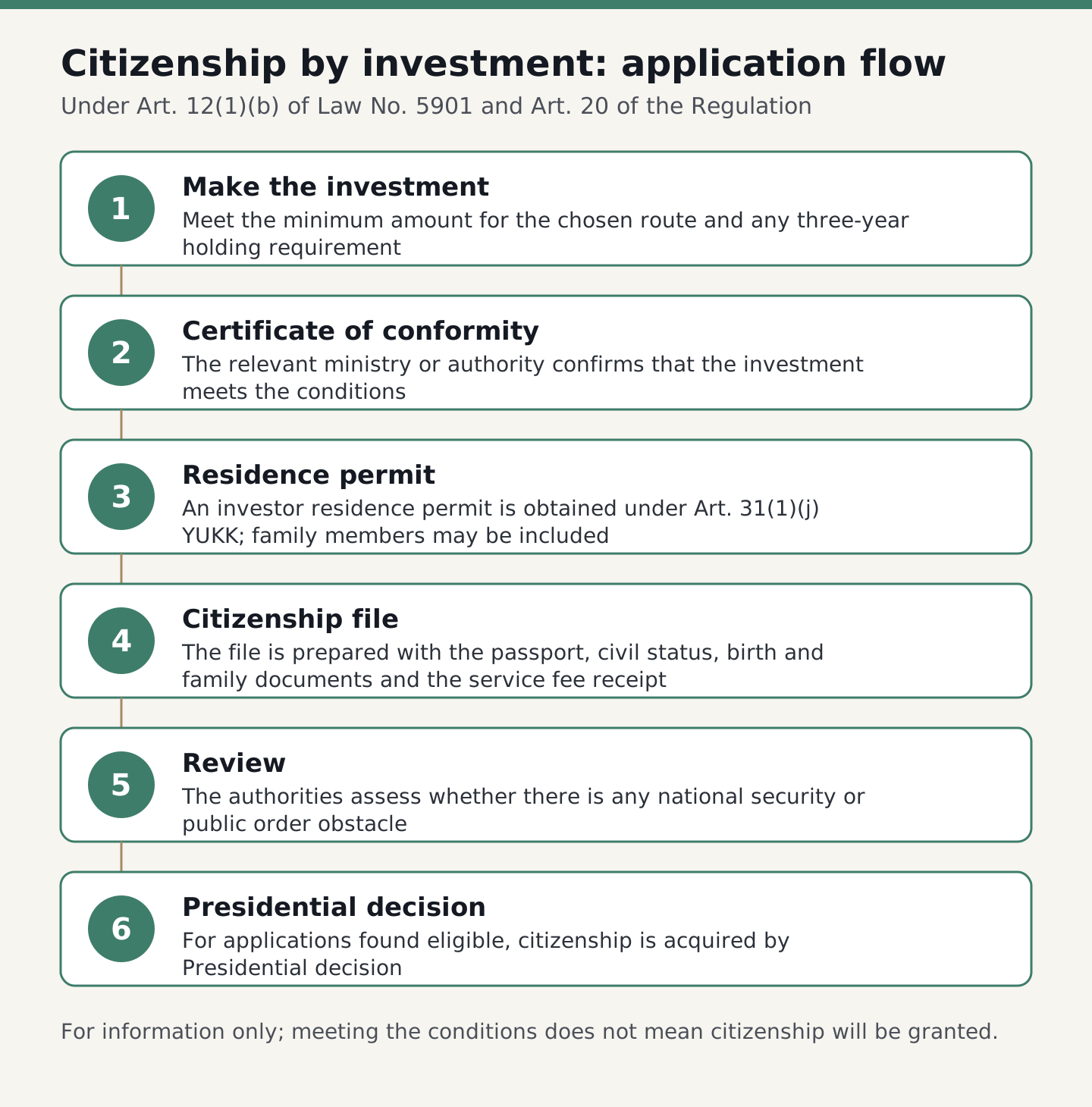
There is also an important limit. Art. 12(1) TVK makes citizenship conditional on the applicant having "no situation constituting an obstacle in terms of national security and public order". Under Art. 12(2) TVK, the Ministry refuses applications where such an obstacle exists, so meeting the investment requirement alone does not mean that citizenship will be granted.
Which investments qualify for Turkish citizenship?
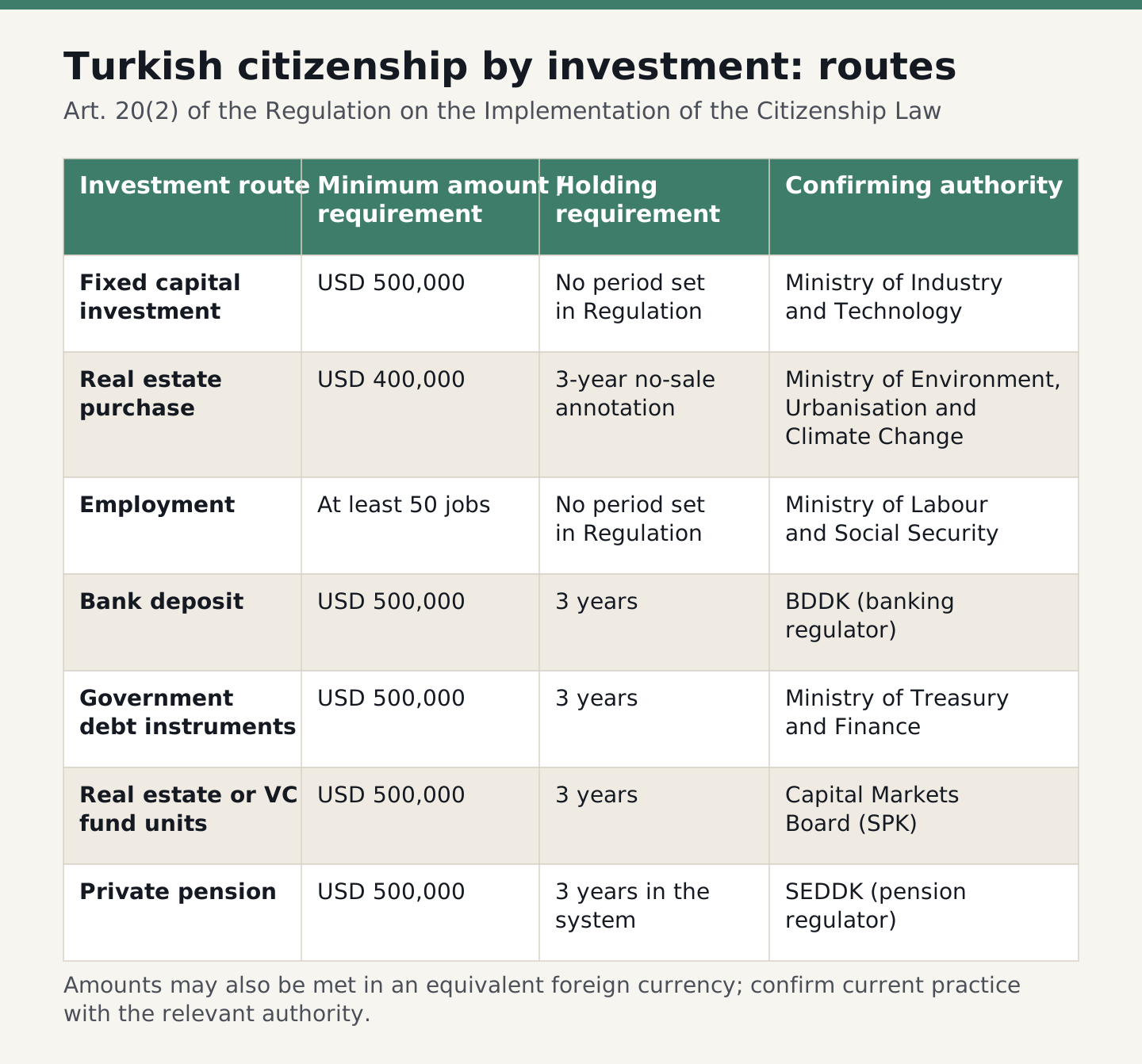
Art. 20(2) of the Regulation lists seven investment routes, and satisfying any one of them is enough. A different authority confirms compliance for each route; the amounts below are the current figures set by the Presidential decisions of 6 January 2022 and 13 May 2022:
- Fixed capital investment: at least USD 500,000 or the equivalent in foreign currency, confirmed by the Ministry of Industry and Technology (Art. 20(2)(a)).
- Real estate: property worth at least USD 400,000, purchased with a three-year no-sale annotation on the title deed, confirmed by the Ministry of Environment, Urbanisation and Climate Change (Art. 20(2)(b)).
- Employment: creating jobs for at least 50 people, confirmed by the Ministry of Labour and Social Security (Art. 20(2)(c)).
- Bank deposit: keeping a deposit of at least USD 500,000 in banks in Türkiye for three years, confirmed by the Banking Regulation and Supervision Agency (BDDK) (Art. 20(2)(ç)).
- Government debt instruments: at least USD 500,000, held for three years, confirmed by the Ministry of Treasury and Finance (Art. 20(2)(d)).
- Fund participation shares: at least USD 500,000 in a real estate investment fund or venture capital investment fund, held for three years, confirmed by the Capital Markets Board (SPK) (Art. 20(2)(e)).
- Private pension: contributions of at least USD 500,000 remaining in the system for three years, confirmed by the Insurance and Private Pension Regulation and Supervision Agency (SEDDK) (Art. 20(2)(f)).
Art. 20(8) of the Regulation allows switching between investment types (moving from one route to another) in order to complete the required holding period. How this works in practice depends on the procedures of the confirming authorities, so it is advisable to check with the relevant authority before planning a switch.
In which currency are deposits, debt instruments and pension contributions held?
For these three routes, the foreign currency is sold to a bank and the resulting amount is held in Turkish lira. Under Art. 20(10) of the Regulation, the three-year holding requirement applies to Turkish lira deposits for the deposit route, to lira-denominated government debt instruments for the debt route and to funds designated by SEDDK for the pension route. The implementing rules are set by the Central Bank of the Republic of Türkiye.
How should you choose a route for Turkish citizenship by investment?
The right route depends on whether the investor can keep the funds committed for three years and can handle the documentation involved. On the deposit, debt instrument, fund and pension routes, the money stays in the system for three years and is held in Turkish lira, so exchange rate movements may affect the foreign currency value of the investment.
On the real estate route, the land register entry, zoning status, building status and dealings with the seller need separate scrutiny. The fixed capital and employment routes require a company structure and confirmation of the investment by the relevant ministry. Whichever route is chosen, making payments through banks and keeping full records tends to be decisive in later reviews.
What are the requirements for citizenship through real estate?
For citizenship through real estate, the investment must be at least USD 400,000 and must be made in a property of a qualifying type. Under Art. 20(2)(b) of the Regulation, the property must be an independent unit with condominium ownership (kat mülkiyeti) or a construction servitude (kat irtifakı), or land with a building on it. This restriction was introduced by the Presidential decision of 12 December 2023.
A three-year no-sale annotation on the title deed is mandatory. For buildings that are not yet completed, a notarised promise-to-sell agreement is also accepted, provided condominium ownership or a construction servitude has been established, the price has been paid in full and an undertaking not to transfer or deregister the property for three years has been annotated on the land register. For details of the land registry procedure, see our guide to title deed transfers.
Under Art. 20(10) of the Regulation, for the real estate, deposit, debt instrument, fund and private pension routes, the foreign currency must be sold to a bank in Türkiye before the transaction, and the bank in turn sells it to the Central Bank. In practice, this sale is evidenced by a foreign currency purchase certificate (döviz alım belgesi), and the accuracy of that certificate may be checked later.
Which exchange rate is used to calculate the amounts?
Under Art. 20(6) of the Regulation, monetary values are determined using the Central Bank of the Republic of Türkiye's effective selling rate and/or cross rate on the date of the assessment. Because of exchange rate movements, an investment planned just above the threshold may fall below it at the assessment stage, so it is sensible to leave a safety margin.
How does the Turkish citizenship by investment application work?
The process has three main stages: confirmation of the investment, the investor residence permit and preparation of the citizenship file. Once the investment is completed, a certificate of conformity confirming that the conditions are met is obtained from the relevant authority, followed by an application for a residence permit under Art. 31(1)(j) YUKK. Our guide to getting a residence permit in Türkiye covers the residence stage, and if the application is refused, our article on appealing a residence permit refusal explains the next steps.
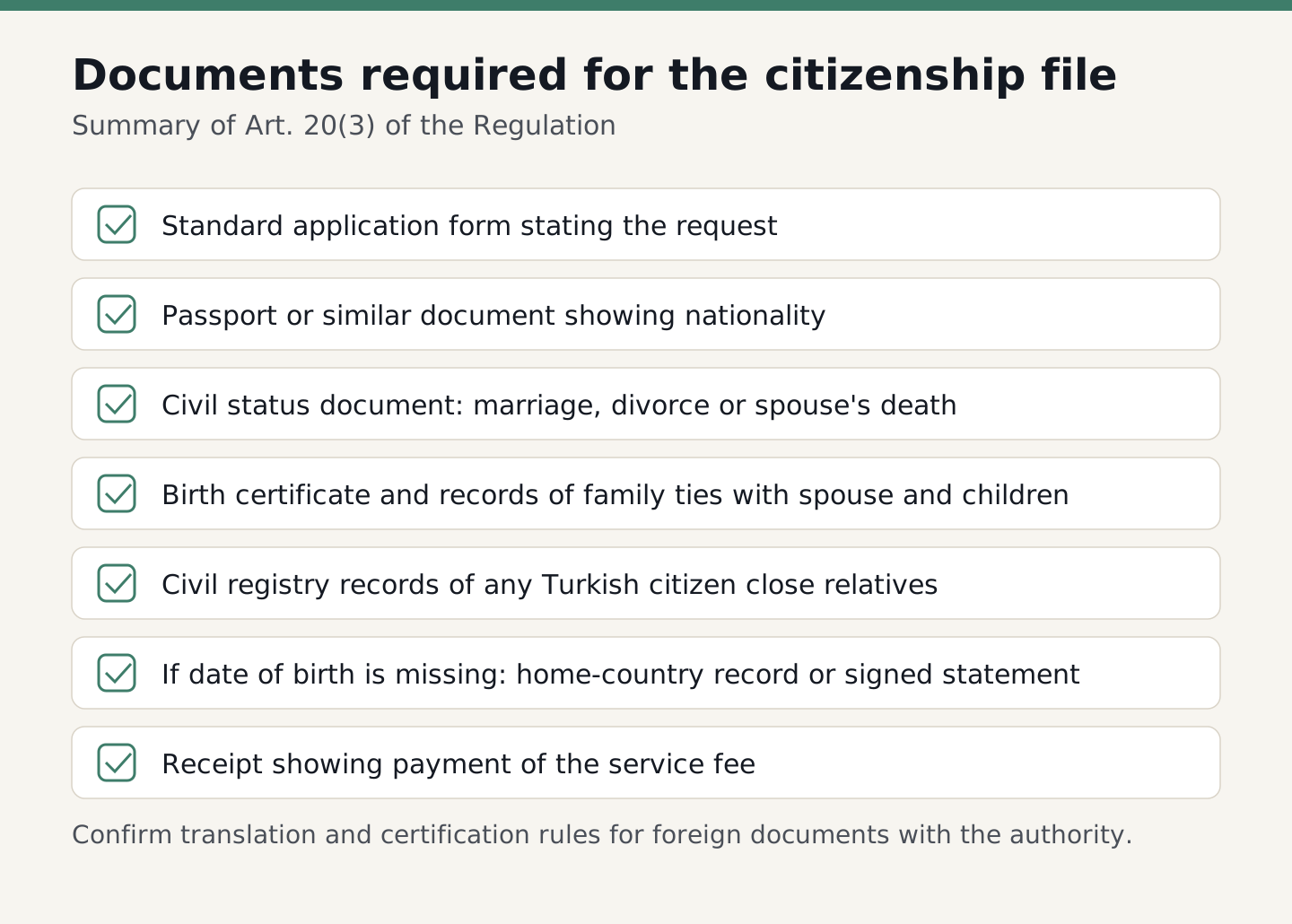
Under Art. 20(3) of the Regulation, the citizenship file is prepared by the application authorities on the Ministry's instructions, and the completed file is sent to the Ministry for a decision (Art. 20(4)). The main documents required are:
- A standard application form stating the request.
- A passport or similar document showing the applicant's nationality.
- A civil status document: a marriage certificate if married, a divorce document if divorced, or the spouse's death certificate if widowed.
- A birth certificate and, if married, records showing the family relationship with the spouse and children.
- Civil registry records of any first- and second-degree relatives who are Turkish citizens.
- A receipt showing payment of the service fee.
Applicants from the United States and the United Kingdom should note that Türkiye, the US and the UK are all parties to the 1961 Hague Apostille Convention, so civil status documents issued there are generally authenticated with an apostille rather than consular legalisation. In the US, state-issued records such as birth and marriage certificates are usually apostilled by the Secretary of State of the issuing state, while federal documents go to the US Department of State's Office of Authentications. In the UK, apostilles are issued by the FCDO Legalisation Office. Translation and certification requirements should be confirmed with the application authority in Türkiye.
Art. 20(7) of the Regulation provides that a commission of representatives from the relevant ministries may be set up within the Ministry of Interior to monitor these applications. The legislation does not set a fixed number of days for a decision, so please confirm current processing times with the application authority.
How do spouses and children acquire citizenship?
Art. 12(1)(b) TVK also covers the investor's foreign spouse and the minor or dependent foreign children of the investor and the spouse. Family members can therefore be included in the application file together with the investor on the basis of the same investment, which is why documenting the family relationship matters.
The details of family applications deserve a separate article, but it should be noted here that a national security and public order assessment is carried out separately for each family member. The position of adult children may vary depending on how their dependency is documented.
Can Turkish citizenship be cancelled or withdrawn later?
Yes. Citizenship may be withdrawn if the conditions were not met from the outset, and it may be cancelled in cases of false statements or concealment of material facts. Art. 40 TVK provides that citizenship decisions later found to have been made without the legal conditions being met, or made more than once, are withdrawn. Art. 31 TVK provides for cancellation of a decision made as a result of false statements or the concealment of material facts relevant to citizenship.
What is the difference between cancellation and withdrawal?
The two measures differ in the date from which their effects begin. Under Art. 32 TVK, a cancellation decision takes effect from the date of the decision and also applies to the spouse and children who acquired citizenship through the person concerned. Art. 66 of the Regulation, by contrast, provides that a withdrawn decision becomes void from the date of the original decision, so withdrawal operates retroactively.
This distinction matters for family members and for transactions carried out while the person held citizenship. When a notice of cancellation or withdrawal is received, its legal basis, reasoning and date of service should therefore be examined carefully, and a legal assessment should be made before any deadline expires.
The Council of State (Danıştay) treats a genuine and lawful investment as a precondition for Turkish citizenship by investment. In the decision below, after it emerged that the foreign currency purchase certificates were untrue, the title deed certificate of conformity was cancelled and the withdrawal of citizenship was found lawful.
The decision also stresses that, for withdrawal, the obstacle must have existed on or before the date of naturalisation, and that facts arising afterwards cannot, as a rule, be taken into account for this purpose. Citizenship decisions can be challenged before the administrative courts; the time limit for filing a case and the competent court should be assessed according to the specific decision.
Common mistakes
Many problems in Turkish citizenship by investment files stem from mistakes made at the investment stage that are difficult to correct later:
- Planning the investment exactly at the threshold without a margin for exchange rate movements.
- Not checking before purchase whether the property has condominium ownership, a construction servitude or qualifies as land with a building.
- Failing to document the currency sale or using unrecorded payment methods.
- Disposing of the investment before the three-year holding or no-sale period ends.
- Submitting family members' documents (marriage, birth, dependency) incomplete or without proper certification.
- Assuming that meeting the investment requirement is enough on its own to obtain citizenship.
Turkish citizenship by investment is a process in which investment, land registry, banking, residence and citizenship rules apply together, and the accuracy of documents matters at every stage. This article is for general information only and is not a substitute for legal advice on a specific case. If you plan to invest through a company, you may also read our article on setting up a limited company with foreign shareholders, review our practice area for foreign investors or reach us via the Contact page.