A limited company with a foreign shareholder is formed under exactly the same rules as one set up by Turkish citizens: the articles of association are signed at the trade registry directorate (ticaret sicili müdürlüğü), registration must be filed within 30 days of signing, and since 1 January 2024 the minimum share capital is TRY 50,000. What sets company formation in Türkiye apart for foreigners is the paperwork: documents issued abroad must be legalised and translated into Turkish, and the foreign shareholder needs a Turkish tax identification number.
The Foreign Direct Investment Law No. 4875 (Doğrudan Yabancı Yatırımlar Kanunu) provides that foreign investors are treated equally with domestic investors and that direct investment in Türkiye is, as a rule, free (Art. 3/a). This article walks through the steps, the documents, the capital rules and the filings that follow incorporation.
Can a foreigner be a shareholder in a Turkish limited company?
Yes. A limited company (limited şirket, Ltd. Şti.) may be formed by one or more natural persons or legal entities, and the law places no restriction on the shareholders' nationality (Turkish Commercial Code No. 6102, Türk Ticaret Kanunu, "TTK" Art. 573). The number of shareholders may not exceed fifty, and a single-shareholder company is permitted (TTK Art. 574). A foreign individual can hold shares directly, and a company incorporated abroad can also be a corporate shareholder.
Under Law No. 4875, foreign direct investment includes setting up a new company with assets brought from abroad, such as cash capital, machinery and equipment or intellectual property rights (Art. 2/b). Company formation in Türkiye by a foreign shareholder therefore also triggers the reporting obligations under that Law.
Limited company, joint-stock company or branch?
For small and medium-sized investments, the limited company is a common choice in company formation in Türkiye because of its lower minimum capital and simpler management structure. Presidential Decision No. 7887 (Cumhurbaşkanı Kararı) set the minimum share capital from 1 January 2024 at TRY 250,000 for joint-stock companies (anonim şirket, A.Ş.) and TRY 50,000 for limited companies. A joint-stock company may suit investors who plan frequent share transfers or a future public offering.
A company incorporated abroad can instead open a branch office (şube) in Türkiye without creating a separate legal entity. In that case, the head office's registry records, the decision to open the branch and the decision appointing a fully authorised representative resident in Türkiye are filed with the registry together with Turkish translations (TSY Art. 122). A liaison office (irtibat bürosu) may be opened only with the permission of the Ministry of Industry and Technology and only if it carries out no commercial activity in Türkiye (Law No. 4875 Art. 3/h; Implementing Regulation Art. 6).
Structure | Legal personality | Commercial activity | Main legal basis |
|---|---|---|---|
Limited company | Yes | Yes | TTK Art. 573 et seq. |
Joint-stock company | Yes | Yes | TTK Art. 329 et seq. |
Branch office | Part of the head office | Yes | TSY Art. 122 |
Liaison office | No | No | Law No. 4875 Art. 3/h |
Which decisions must be made before incorporation?
The mandatory content of the articles of association (esas sözleşme) should be settled before you approach the registry; otherwise corrections may be needed at the registration stage. Under TTK Art. 576, the articles must expressly state:
- The trade name and the place of the company's registered office
- The scope of business (işletme konusu), with its essential points clearly defined
- The nominal amount of the share capital, the number and nominal value of the shares and any privileges
- The names, surnames, titles and nationalities of the managers
- The form in which the company will make its public announcements
The management structure also deserves early thought. In a limited company, management and representation are governed by the articles of association, and at least one shareholder must hold management and representation authority (TTK Art. 623/1). If a manager is a legal entity, it must designate a natural person to perform that role on its behalf (TTK Art. 623/2).
What documents are required from a foreign shareholder?
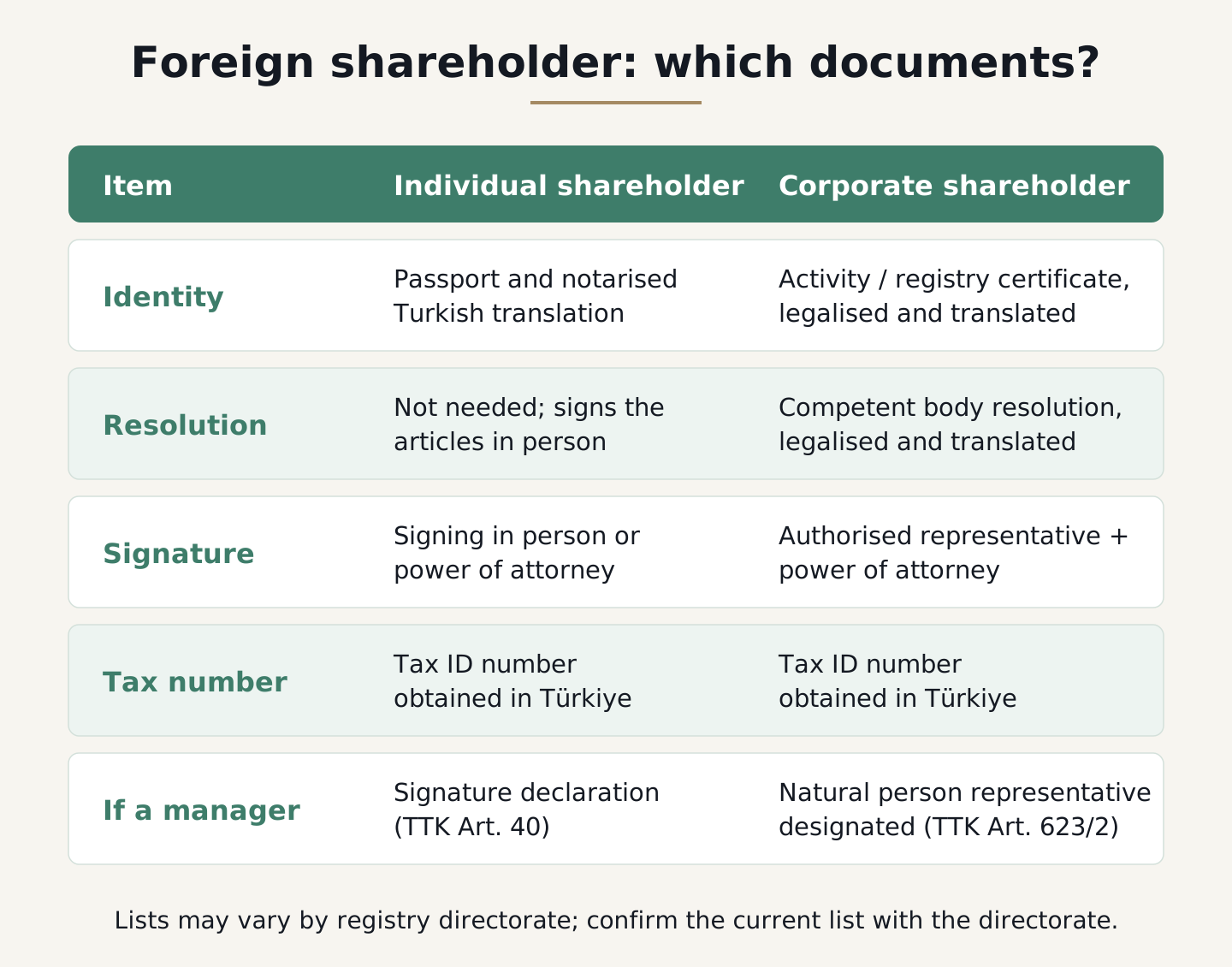
Every document filed with the trade registry must be in Turkish (Trade Registry Regulation, Ticaret Sicili Yönetmeliği, "TSY" Art. 32/1). Documents issued in another country must be legalised either by a Turkish consulate or with an apostille under the Hague Apostille Convention, and then submitted with a notarised Turkish translation (TSY Art. 32/2).
In practice, a foreign individual shareholder is asked for a notarised Turkish translation of their passport. If the shareholder is a foreign company, a certificate of activity or registry extract showing that the company exists and who represents it, together with the competent body's resolution to form a company in Türkiye, is prepared in legalised and translated form. Because document lists can differ between registry directorates, you should confirm the current list with the directorate where you will apply.
Documents issued in the United States or the United Kingdom
Türkiye, the United States and the United Kingdom are all parties to the Hague Apostille Convention, so documents from either country are legalised with an apostille rather than at a consulate. In the US, federal documents are apostilled by the Department of State's Office of Authentications, while documents issued at state level are apostilled by the Secretary of State of the issuing state. UK public documents are apostilled by the FCDO Legalisation Office, which cannot legalise documents issued outside the UK; in both cases the apostilled document still needs a notarised Turkish translation under TSY Art. 32.
Why does a foreign shareholder need a tax identification number?
For trade registry purposes, the identification number is the Turkish ID number for Turkish citizens and, for foreign nationals, either the foreigner identification number or the tax identification number (vergi kimlik numarası) (TSY Art. 4/1-f). A foreign shareholder without a Turkish residence permit will not have a foreigner identification number, so obtaining a tax number is in practice one of the first steps for the MERSİS record and registry filings.
How should the relationship between shareholders be set out?
Where foreign and Turkish shareholders invest together, share transfers and additional obligations are best addressed at the formation stage to reduce the risk of later disputes. Privileges, additional contribution and ancillary performance obligations, and pre-emption, repurchase and purchase rights provided for in the articles are among the matters registered and announced in the trade registry (TTK Art. 587/1-j).
Drafting these provisions clearly and in an enforceable form reduces uncertainty if a shareholder later wants to exit or transfer shares to a third party. It is also advisable to put in writing, at formation, the agreed shareholding ratios, the right to appoint managers and expectations on profit distribution.
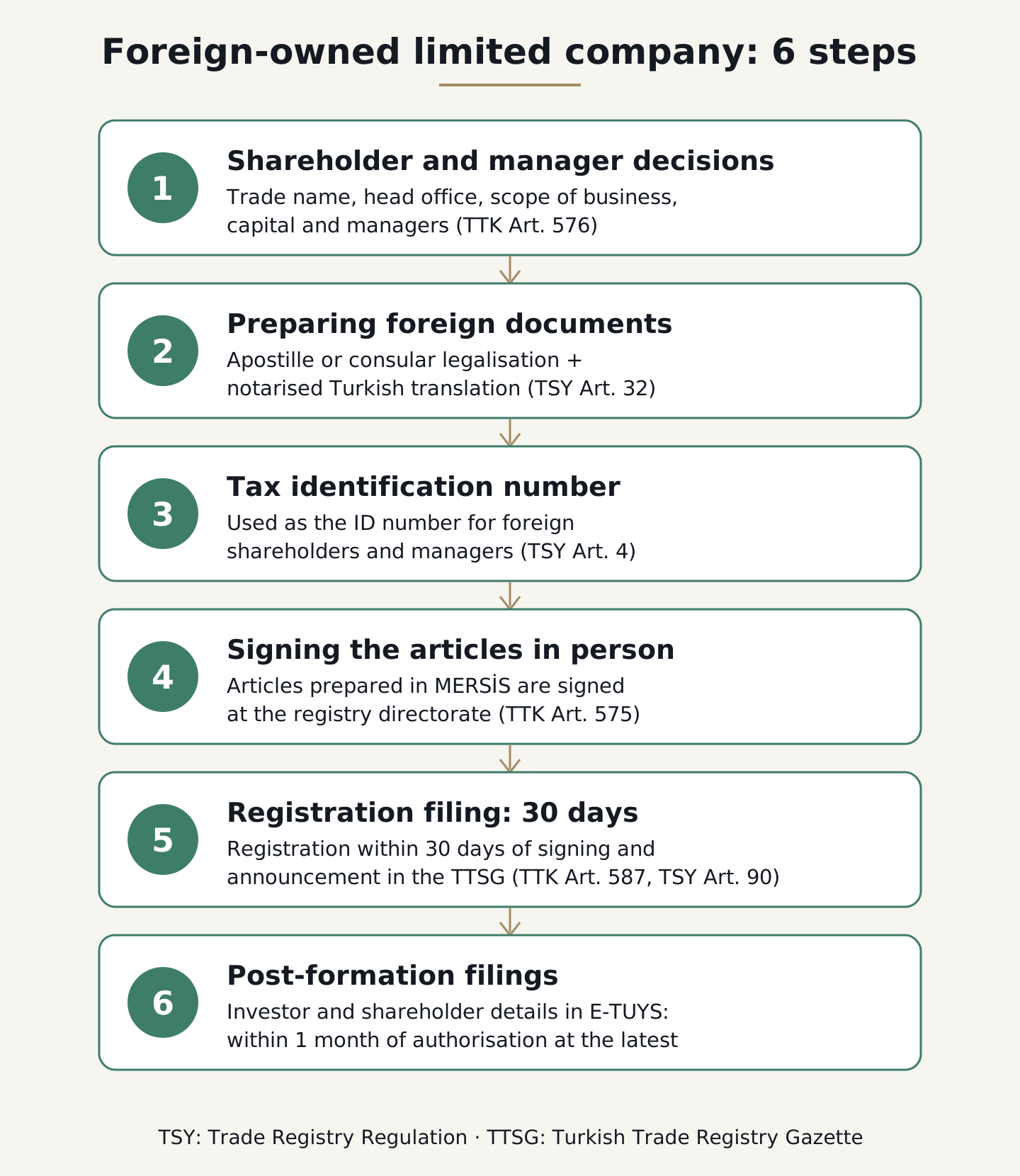
How does incorporation work step by step?
Company formation in Türkiye with a foreign shareholder is completed by signing the articles of association prepared in MERSİS (Central Registry Record System) at the registry directorate and then filing for registration. The law requires the articles to be in writing and to be signed by the founders in the presence of authorised trade registry staff (TTK Art. 575).
The company is formed when the founders sign the articles, in which they unconditionally undertake to pay the entire capital, and thereby declare their intention to incorporate (TTK Art. 585/1). The articles are registered with the trade registry where the head office is located and announced in the Turkish Trade Registry Gazette (Türkiye Ticaret Sicili Gazetesi) within thirty days of signing (TTK Art. 587/1; TSY Art. 90/1).
The application for registration is signed by all managers (TTK Art. 586/2). Under TSY Art. 90, the main documents submitted to the directorate are:
- The articles of association signed by the founders in person at the directorate
- Written declarations of acceptance from managers who are not shareholders
- If a manager is a legal entity, a notarised copy of its body's resolution designating the natural person who will act for it
- The managers' signature declarations
- If the articles provide for payment before registration, a bank letter confirming the deposit
- Proof of the payment due under Art. 39/1-c of the Law No. 4054 on the Protection of Competition (Rekabetin Korunması Hakkında Kanun)
If capital is contributed in kind (assets other than cash), the directorate also requires a valuation report by a court-appointed expert, a letter from the relevant registry confirming that there is no restriction on the asset, and evidence that an annotation has been entered in that registry (TSY Art. 90/1-d, e, f). A formation with in-kind capital may therefore need more preparation time than one with cash capital.
How much capital is required and when must it be paid?
Under Presidential Decision No. 7887, the minimum share capital of a limited company has been TRY 50,000 since 1 January 2024; the decision raised the TRY 10,000 figure written in TTK Art. 580/1. Before applying, check with the relevant registry directorate whether the amount has changed again for 2026.
For limited companies, the rule that at least twenty-five per cent of cash contributions must be paid before registration does not apply (TTK Art. 585/1). Because the joint-stock company rules on paying for shares apply by analogy, cash capital is to be paid within twenty-four months of registration (TTK Art. 585/1, 344/1). If the articles require payment before registration, the deposit with a bank must be documented.
If a foreign investor contributes capital in a form other than cash, its value is determined under the TTK (Law No. 4875 Art. 3/f). Where shares of a company incorporated abroad are contributed, valuations by the competent authorities under the law of the country of origin, by experts appointed by courts of that country or by international valuation firms are taken as the basis. In such structures, the valuation documents must also meet the legalisation and translation rules.
Topic | Rule | Legal basis |
|---|---|---|
Number of shareholders | 1 to 50 | TTK Art. 573–574 |
Minimum capital | TRY 50,000 (from 1 January 2024) | TTK Art. 580; Presidential Decision No. 7887 |
Registration deadline | 30 days after signing | TTK Art. 587; TSY Art. 90 |
Cash capital payment | No 25% pre-registration rule; within 24 months of registration | TTK Art. 585, 344 |
Foreign documents | Apostille or consular legalisation + notarised translation | TSY Art. 32 |
Which filings are due after incorporation?
Companies with foreign shareholders must report information electronically to the Ministry of Industry and Technology under Law No. 4875. Under Art. 5 of the Implementing Regulation of the Foreign Direct Investment Law, the company enters investor and shareholder details in the E-TUYS system, through a user it has authorised, no later than one month after that authorisation.
- Activity information form: every year by the end of May at the latest
- Capital increase or decrease: shareholder list updated within one month at the latest
- Payments for a capital increase or share transfer: capital information form within one month of payment
- Share transfers: shareholder list updated within one month of the transfer at the latest
A work permit (çalışma izni) becomes relevant for any foreign manager or employee who will actually work in Türkiye; for companies established under Law No. 4875, work permits for foreign staff are issued by the Ministry of Labour and Social Security (Art. 3/g). A short-term residence permit (kısa dönem ikamet izni) is also available to foreigners who will set up a business in Türkiye (Law No. 6458 on Foreigners and International Protection, Yabancılar ve Uluslararası Koruma Kanunu, "YUKK" Art. 31/1-c). For permit types, see our guide to residence permits in Türkiye; if a permit is refused, our article on challenging a residence permit refusal explains the next steps.
Common mistakes
- Submitting foreign documents with a translation only, without an apostille or consular legalisation
- Leaving the foreign shareholder's tax identification number until the last stage
- Drafting the scope of business too broadly or too narrowly and later needing to amend the articles
- Failing to designate the natural person who will act for a corporate manager
- Missing the 30-day registration deadline after signing at the registry
- Not tracking the E-TUYS authorisation and the one-month reporting deadlines
Company formation in Türkiye with a foreign shareholder requires Turkish commercial law and foreign investment rules to be applied together, and the documents and the wording of the articles also shape the shareholder relationship after incorporation. This article is for general information only and does not constitute legal advice. You can review our scope of services for foreign investors and our publications, or use the Contact page for your questions.