
If your application for an ikamet izni (residence permit) in Türkiye has been refused, you can challenge the refusal by filing an action for annulment before the administrative court. The general time limit is 60 days, counted from the day after the decision was notified to you in writing. Within the same period you may instead apply to the authority that issued the decision or to its superior authority, which stops the clock. If the refusal concerns a renewal, a separate ten-day period to leave the country also comes into play, so the first days after a residence permit refusal matter most.
This article explains how a residence permit refusal is served, the grounds on which it may be based, the routes for objection and court action, why a request for a stay of execution matters, and which criteria the Danıştay (Council of State, Türkiye's highest administrative court) applies. For the permit types and first-time application requirements, see our residence permit guide for foreigners in Türkiye.
How is a residence permit refusal served, and what must it contain?
A refusal of an application made inside Türkiye is decided by the valilik (governorship), acting through the Provincial Directorate of Migration Management, and served on the foreign national, their legal representative or their lawyer (Law on Foreigners and International Protection, Yabancılar ve Uluslararası Koruma Kanunu – YUKK, Art. 25). The law requires the notice to explain how the person can exercise their right to object, together with their other legal rights and obligations (YUKK Art. 25/2).
Applications lodged abroad through a consulate are also refused by a decision served on the applicant (YUKK Art. 21/6). Because the date of service determines when the time limit for filing an action starts, keep the notification document, the electronic notification record or the signed service report.
YUKK Art. 25/1 expressly requires the governorship, when refusing, not renewing or cancelling a permit, to take into account the person's family ties in Türkiye, the length of their residence, the situation in their country of origin and the best interests of the child. A refusal that ignores these factors entirely gives you an important argument in court.
On what grounds can a residence permit be refused?
The grounds for a residence permit refusal depend on the type of permit; most often, the authority concludes that one of the statutory conditions has not been met. Separate grounds for refusal, cancellation and non-renewal are listed for the short-term residence permit (YUKK Art. 33), the family residence permit (YUKK Art. 36) and the student residence permit (YUKK Art. 40).
For a short-term residence permit, the law lists the following grounds (YUKK Art. 33/1):
- Failure to meet, or loss of, one or more of the conditions in YUKK Art. 32 – for example, missing supporting documents or incomplete accommodation or address details
- A finding that the permit is being used for a purpose other than the one for which it was granted
- An existing removal decision or entry ban against the person
For a family residence permit, the authority examines the income, health insurance and criminal record conditions relating to the sponsor (the family member you will live with), and whether the marriage was concluded solely to obtain a permit (YUKK Arts. 35–37). The refusal letter should show which provision was applied; if the reasoning is vague, that defect can be raised separately in the statement of claim.
Is there a difference between a first-application refusal, a renewal refusal and a cancellation?
Yes. All three can be challenged in court, but your status in Türkiye and the level of risk differ. After a first-application refusal, you are usually still within a visa or visa-exemption period, and you need to work out when that period ends. After a renewal refusal, the law provides a ten-day period to leave; if you overstay it, a removal decision may follow (YUKK Art. 54/1-j).
Cancellation of a permit has the most serious consequences: holders of cancelled permits are expressly listed among those against whom a removal decision may be issued (YUKK Art. 54/1-f). When planning a challenge to a cancellation, factor in from the outset the seven-day time limit for suing against any removal decision that may follow.
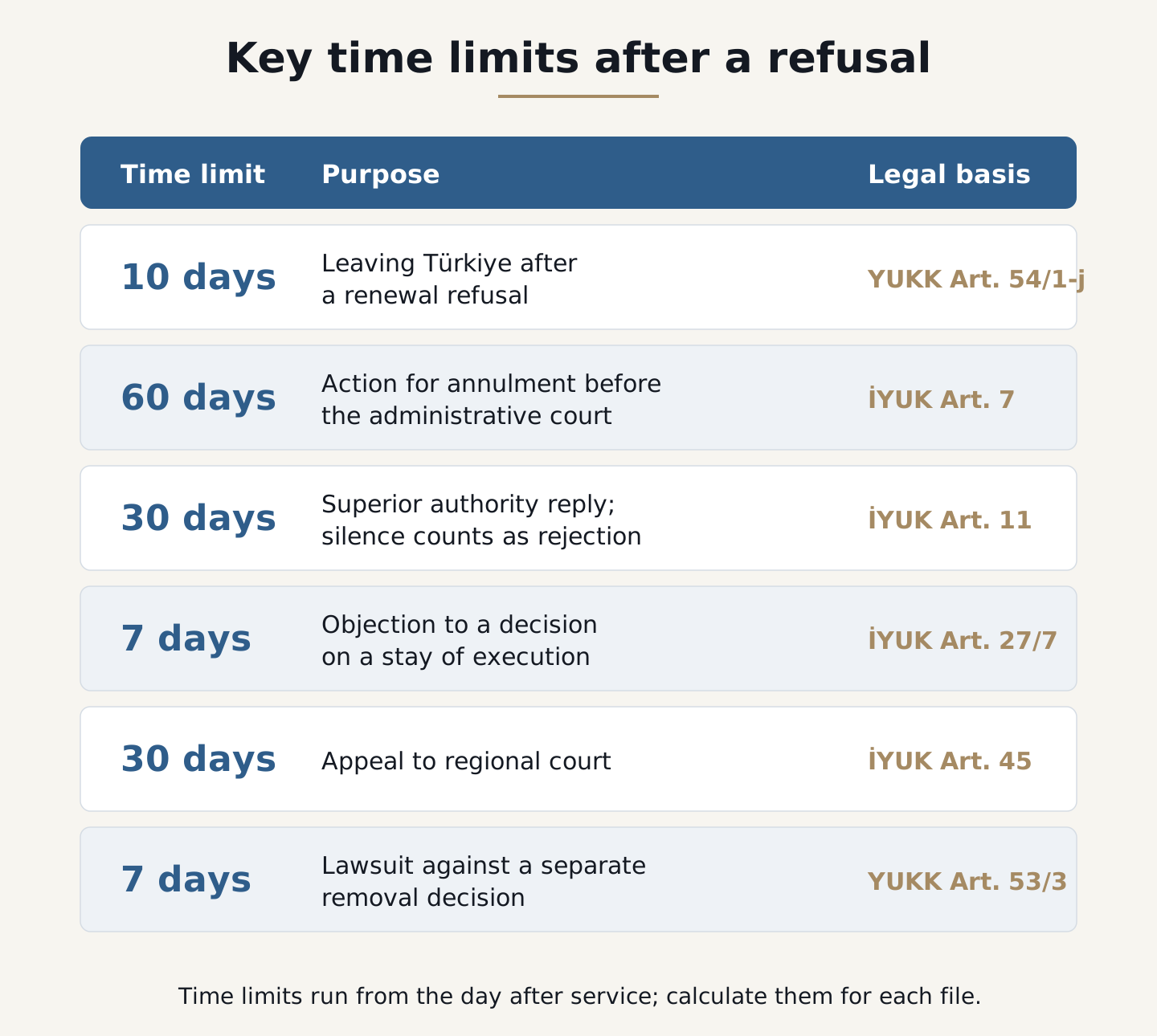
Which time limits apply after a residence permit refusal?
The key deadline is generally the 60-day period for filing an action, plus the ten-day exit period where a renewal was refused. Under Art. 7 of the Law on Administrative Procedure (İdari Yargılama Usulü Kanunu – İYUK), unless a special law provides otherwise, an action before the administrative courts must be filed within sixty days, starting on the day after written notification.
Where a renewal is refused and the person does not leave Türkiye within ten days, they fall within the cases in which a removal decision may be taken (YUKK Art. 54/1-j). Filing a lawsuit does not, on its own, suspend the refusal (İYUK Art. 27/1). Rather than waiting until the end of the 60 days, it is therefore advisable to have the situation assessed promptly.
Time limit | Purpose | Legal basis |
|---|---|---|
10 days | Leaving Türkiye after a renewal refusal | YUKK Art. 54/1-j |
60 days | Action for annulment before the administrative court | İYUK Art. 7 |
30 days | No reply to an application to the superior authority counts as rejection | İYUK Art. 11 |
7 days | Objection to a decision on a stay of execution | İYUK Art. 27/7 |
30 days | Appeal to the regional administrative court | İYUK Art. 45 |
7 days | Lawsuit against a separate removal decision | YUKK Art. 53/3 |
Should you file an administrative objection or go straight to court?
After a residence permit refusal, you do not have to apply to the administration first; you can file an action for annulment directly. Under İYUK Art. 11, you may, within the time limit for filing an action, ask the superior authority – or, if there is none, the authority that made the decision – to withdraw or amend it. This application stops the running of the time limit; if no reply is given within thirty days, the request is deemed rejected and the remaining period starts running again.
An administrative application can make sense where the refusal rests on a missing document that can be supplied quickly. Where an exit period is already running after a renewal refusal, or removal is a real risk, a lawsuit combined with a request for a stay of execution may offer better protection. The right route depends on the grounds of refusal and your circumstances in Türkiye.
Which court hears the case, and how is it filed?
As a rule, the action for annulment against a residence permit refusal is filed with the administrative court for the place where the governorship that issued the refusal is located (İYUK Art. 32/1). The statement of claim should clearly set out the date and number of the refusal, the date of service, the reasons why the refusal is unlawful and, where relevant, the request for a stay of execution.
Special procedural rules were added in 2024 for lawsuits against the refusal or cancellation of a short-term residence permit. Under YUKK Art. 31/7, the case file is deemed complete once the defence has been submitted or the time for it has expired, and holding a hearing is at the court's discretion. If notification cannot be served at the address given by the claimant, the period in İYUK Art. 26/3 applies as two months, so keeping your address up to date is essential.
Why does a request for a stay of execution matter?
Filing a lawsuit does not automatically suspend the refusal (İYUK Art. 27/1). The court may order a stay of execution only if implementing the decision would cause damage that is difficult or impossible to remedy and the decision is clearly unlawful – both conditions together (İYUK Art. 27/2). If the request is rejected, a single objection may be lodged with the regional administrative court within seven days (İYUK Art. 27/7).
What happens if a removal decision follows the refusal?
If a removal decision is issued after the refusal, a separate and much shorter time limit applies: seven days from service of that decision (YUKK Art. 53/3). Unless the person consents to leave, they will not be removed during the time limit for filing an action or until the case is decided. This is one of the most time-critical procedures in immigration law.
What should the statement of claim cover?
The statement of claim should identify the ground on which the refusal is based and show, with concrete documents, why that ground is unlawful. Responding to each reason in the refusal letter separately, rather than relying on general statements, makes the court's review easier. The following documents are useful in most residence permit refusal cases:
- The refusal decision and proof of service
- Passport, previous residence permits and entry–exit records
- Lease agreement, title deed or other proof of accommodation
- Marriage, birth and school records showing family ties
- Documents on income, health insurance and any work permit
- Proof of documents submitted with the application but not considered
Submitting sworn translations of foreign-language documents with the statement of claim helps the court assess the file in full. By contrast, if a document required by law was never submitted at the application stage, the court may treat that as a gap that is hard to cure in litigation.
For readers from the United States or the United Kingdom: Türkiye, the US and the UK are all parties to the 1961 Hague Apostille Convention, so a public document from either country is generally accepted in Türkiye with an apostille instead of consular legalisation. In the US, records issued by a state (such as birth or marriage certificates) are apostilled by that state's Secretary of State, while federal documents such as an FBI background check are apostilled by the US Department of State. In the UK, apostilles are issued by the FCDO Legalisation Office. The apostilled document is then usually translated into Turkish and notarised in Türkiye; confirm the current requirements with the Provincial Directorate before filing.
What criteria do the courts apply when reviewing refusals?
In Council of State case law on residence permit refusal cases, the administration's reasons must rest on concrete information and documents and be linked to the statutory conditions. At the same time, where a document required by law was not submitted in time, the administration is regarded as acting under bound authority (no discretion) – in other words, it must refuse the application.
Read together, these decisions point to two conclusions: a refusal can be annulled if the administration's findings are not concrete, but the prospects in court drop considerably if a document expressly required by law is missing. Completing your documents at the application stage is therefore often more decisive than any lawsuit after a residence permit refusal.
Is there any further remedy after the regional administrative court?
An appeal against the administrative court's judgment may be lodged with the regional administrative court within thirty days of service (İYUK Art. 45/1). A further appeal on points of law to the Council of State is, as a rule, not available in cases arising from the application of YUKK: under İYUK Art. 46/2-d, this applies even where the regional court overturns the first-instance judgment and rules afresh. The regional court's decision then becomes final (İYUK Art. 45/6).
Common mistakes
- Not recording the date of service and missing the 60-day time limit
- Ignoring the ten-day exit period after a renewal refusal and not requesting a stay of execution
- Reapplying with the same missing documents without reading the grounds of refusal
- Confusing the separate seven-day time limit for a removal decision with the residence permit lawsuit
- Not reporting a change of address, which increases the risk of the case being struck out if notices cannot be served
- Not documenting the YUKK Art. 25/1 factors – family ties, length of residence and the children's situation – in the statement of claim
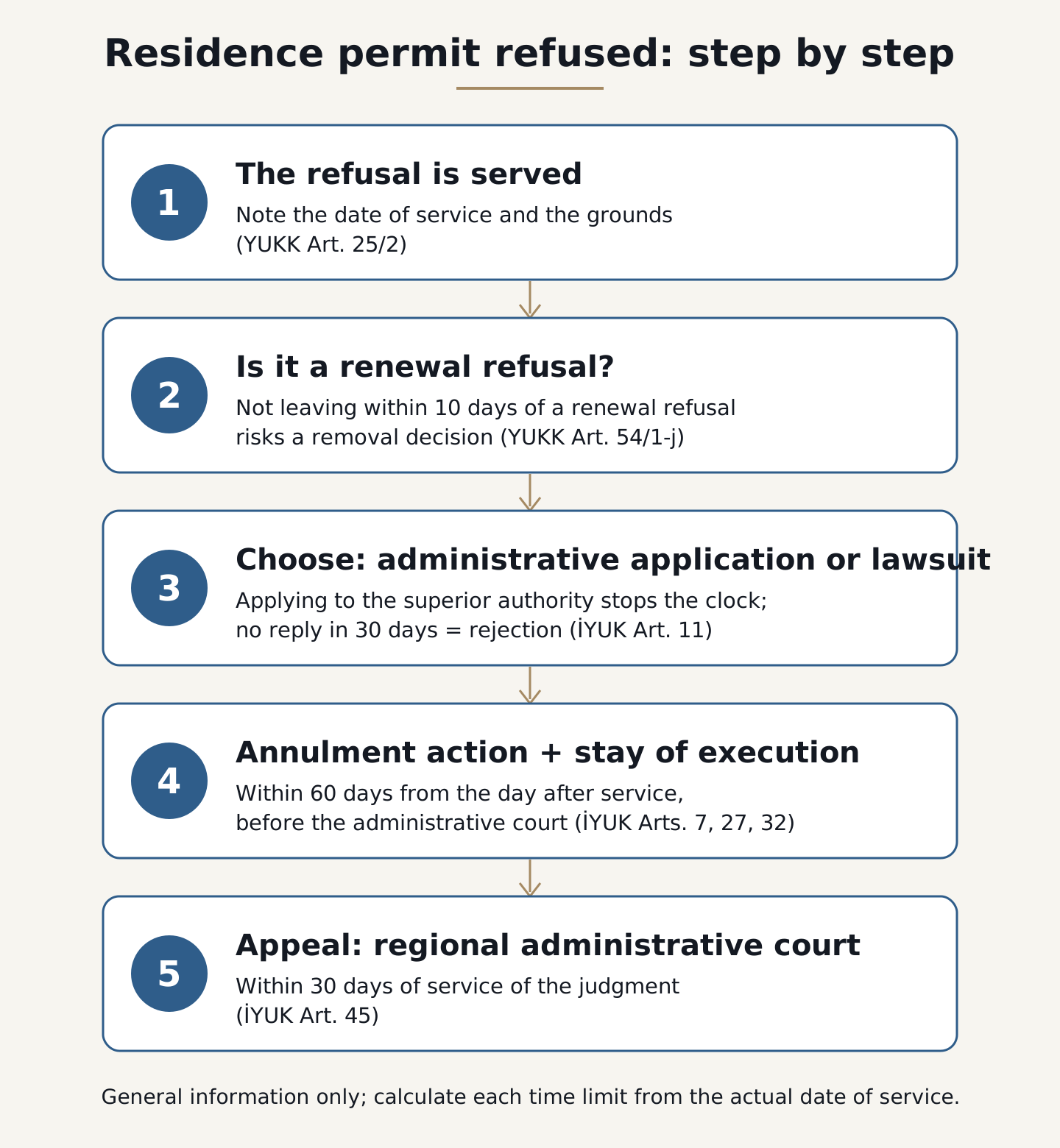
Step by step: what to do after a residence permit refusal
- Keep the proof of service and the refusal letter, and note the date of service.
- Identify the statutory provision on which the refusal is based.
- If the refusal concerns a renewal, take the ten-day exit period into account.
- Choose between an administrative application and a direct lawsuit based on the grounds.
- If you go to court, include the request for a stay of execution in the same statement of claim.
- Add documents on family ties, work, studies and health to the file.
- After the judgment, keep track of the thirty-day appeal period.
Challenging a residence permit refusal demands care with deadlines and documents, and every file differs in its grounds and personal circumstances. This article is for general information only and is not legal advice. For our work in this field, see our Immigration Law practice area; for our other publications, visit our publications, and for questions, please use the Contact page.