
Unlicensed electricity generation allows the facilities listed in Article 14 of the Electricity Market Law (Elektrik Piyasası Kanunu, Law No. 6446) to generate power without a licence from EPDK (Energy Market Regulatory Authority) and without setting up a company. For renewable plants the Law sets a general installed capacity limit of one megawatt, while plants built at the same point as the consumption they serve, or capped by the contracted capacity in their connection agreement, follow different rules.
The application is filed electronically with the relevant distribution company, acting as network operator, and moves through document review, technical assessment, a call letter for the grid connection agreement and, finally, the agreement itself. Below we explain the capacity limits, the application steps and the points where applicants most often lose their rights in practice, based on the Regulation on Unlicensed Electricity Generation in the Electricity Market (Elektrik Piyasasında Lisanssız Elektrik Üretim Yönetmeliği, the Regulation).
What is unlicensed electricity generation?
Unlicensed electricity generation is power production that is exempt from both the licensing requirement and the obligation to set up a company. The exemption covers only the facility types listed in Article 14(1) of Law No. 6446. If your project is not one of them, you will need to go through the pre-licence and licence process.
The main facilities listed in the Law are emergency generator sets and off-grid installations, renewable plants with an installed capacity of up to one megawatt, municipal solid waste and sewage sludge facilities, micro-cogeneration plants and cogeneration plants of a set efficiency, and renewable plants whose entire output is consumed at the same metering point. Amendments made in 2020 and 2022 added renewable plants tied to contracted capacity to this list.
How does it differ from licensed generation?
In licensed generation, the investor applies to EPDK first for a pre-licence and then for a generation licence, and as a rule carries on the activity through a company. Unlicensed generation removes the pre-licence, licence and incorporation requirements, and the process runs through the distribution company instead. In return, an unlicensed plant is confined to the capacity, location and consumption-link conditions defined in the Law and the Regulation.
This difference also shapes the financing and ownership structure of a project. An unlicensed plant is, in principle, linked to a consumption facility; projects designed only to sell power on the market should generally be assessed under the licensed regime. Before making the investment decision, it should be clear which regime the plant falls under.
What is the installed capacity limit for unlicensed generation?
The general rule is that the installed capacity of a renewable plant may not exceed one megawatt. The Law authorises the President to raise this ceiling up to five times on a source-by-source basis. The Regulation likewise refers to 'one megawatt or the installed capacity ceiling set by the President'; confirm the ceiling currently in force against EPDK's latest announcements.
Which facilities have no upper limit?
Under the Regulation, the installed capacity ceiling does not apply to certain facility types. Chief among them are self-consumption plants whose generation and consumption share the same metering point, off-grid installations and efficient cogeneration plants. Having no ceiling does not mean unlimited capacity, however: the plant is still bound by its consumption need and by the technical capacity of the grid.
Plants tied to contracted capacity
Municipalities and their affiliates, industrial facilities and agricultural irrigation facilities may build renewable plants of up to twice the contracted capacity stated in their connection agreement. For everyone else, the limit is the contracted capacity itself. A plant in this category may sit at the same metering point as the consumption facility or at a different one.
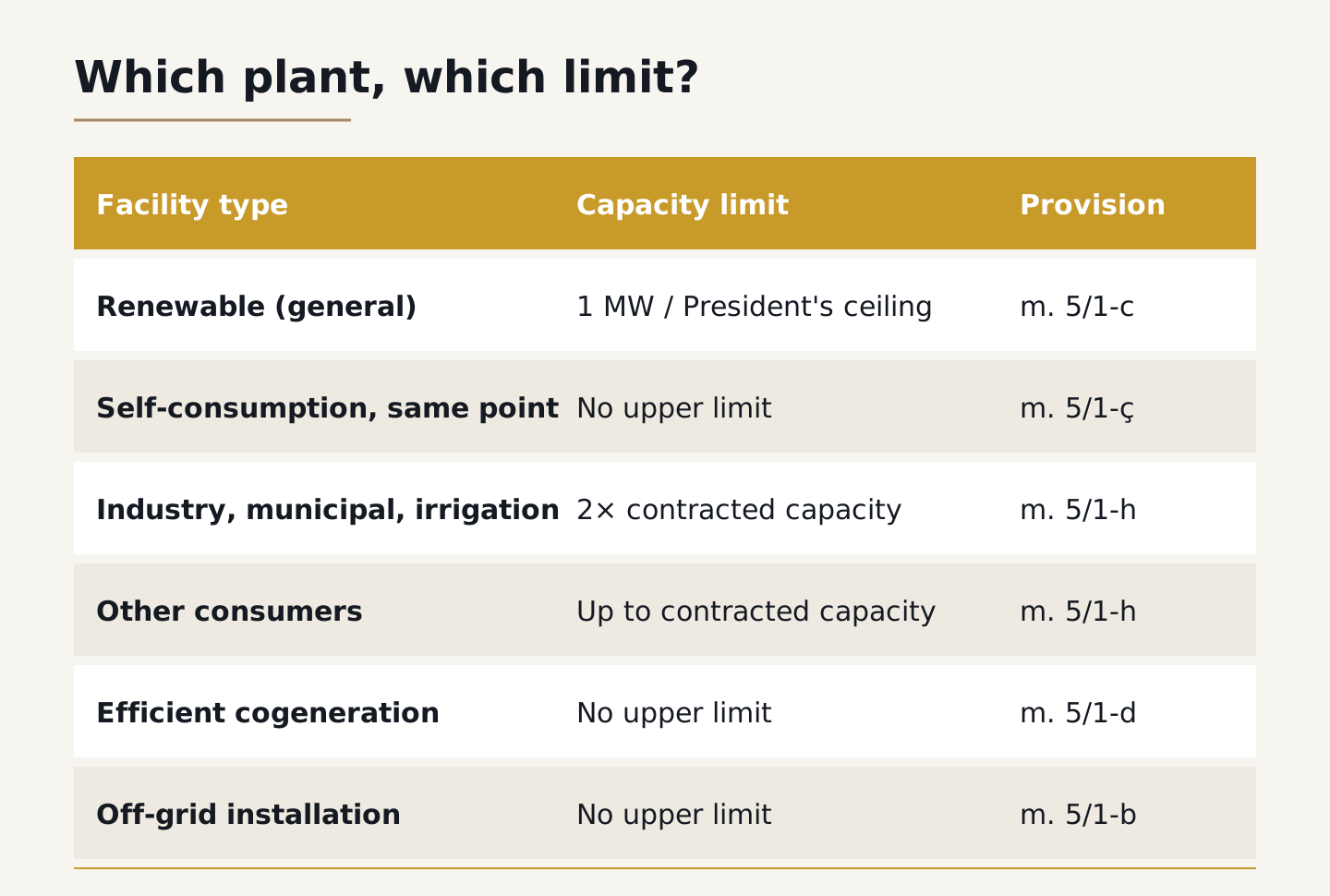
Facility type | Capacity limit | Legal basis |
|---|---|---|
Renewable energy plant (general) | 1 MW or the ceiling set by the President | 6446 s.K. m. 14/1-b; Yönetmelik m. 5/1-c |
Self-consumption at the same metering point | No upper limit | Yönetmelik m. 5/1-ç ve 5/6 |
Municipal, industrial, agricultural irrigation | Twice the contracted capacity | 6446 s.K. m. 14/1-g; Yönetmelik m. 5/1-h |
Other consumers (tied to contracted capacity) | Up to the contracted capacity | 6446 s.K. m. 14/1-g |
Off-grid installation | No upper limit | Yönetmelik m. 5/1-b ve 5/6 |
Where must the generation and consumption facilities be located?
As a rule, the generation facility and the consumption facility must be located in the same distribution region. For plants tied to contracted capacity, however, the Regulation allows the generation facility to be built outside the distribution region where the consumption facility is located. Check this distinction before you choose the land.
Where the grid has enough capacity, more than one renewable plant with the same support structure may be permitted for a single consumption facility. A person may, however, build only one micro-cogeneration plant for each consumption facility they hold. This rule was rewritten by an amendment published in the Official Gazette (Resmî Gazete) on 2 April 2026.
How do you apply for unlicensed electricity generation?
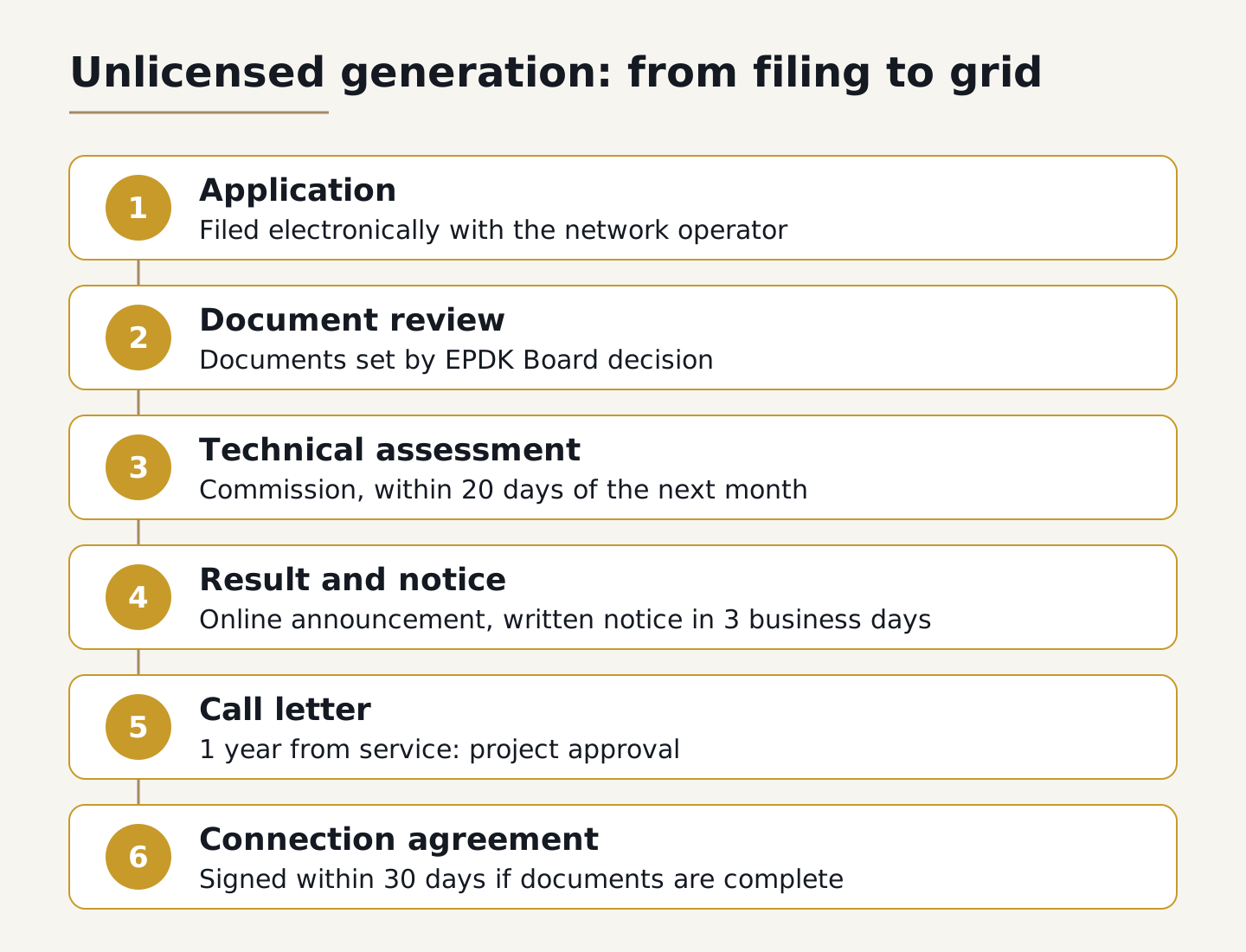
The application is submitted electronically to the relevant network operator, together with the information and documents specified by decision of the EPDK Board. Apart from obligations arising under other legislation, the network operator may not reject an application because a document that is not on that list is missing. Documents received electronically are not returned.
- Identify the facility type: self-consumption, tied to contracted capacity or a general renewable plant?
- Prepare the subscription and contracted capacity details of the consumption facility and its consumption data for the last year.
- Check the document list set by Board decision on the websites of EPDK and the distribution company.
- File the application electronically with the network operator, and do not file duplicate applications for the same site in the same name.
- Monitor the website where document review and technical assessment results are announced.
- If the result is positive, request the call letter in time and start the project approval process.
Can the installed capacity be changed during the application?
The applicant may request a change of installed capacity in writing within the month in which the application was filed. In that case the date of the change request counts as the application date, and the documents required for the new capacity are added to the file. Changes requested after that month are governed by different rules.
If the applicant asks in writing for data needed for the application that by its nature can be obtained from the network operator, the operator must provide it in writing within three business days. The 2026 amendment also bars the same person from filing a second application for the same site before the first one is decided; if the earlier application is withdrawn, the new one is not treated as a duplicate.
Who assesses the application?
Applications are examined on documents and technical merits by a commission set up within the network operator. At distribution companies, the commission consists of one representative each from TEİAŞ (Turkish Electricity Transmission Corporation), TEDAŞ (Turkish Electricity Distribution Corporation) and the network operator concerned; it decides by majority vote and is chaired by the TEİAŞ representative.
The power to receive, assess and conclude applications belongs to the network operator. For this reason, in the case law of the Council of State (Danıştay), applying directly to EPDK for an application to be accepted has not been seen as a route that produces a result.
How does the technical assessment work and how long does it take?
Applications found to be complete are technically assessed within twenty days of the month following the month in which the document review took place. Applications for which TEİAŞ reports that the fault current limit or the transformer capacity at the substation is exceeded are rejected without a technical assessment. Applications are grouped by transformer substation and examined on the basis of the connection point.
Priority ranking for solar and wind applications
Where capacity at the same connection point is insufficient, the Regulation's priority criteria are applied to wind and solar applications in the following order. If more than one application meets all the criteria, the application date determines the ranking.
- the generation facility is at the same metering point as the consumption facility it will be linked to;
- the applicant's consumption over the last year (or the consumption used for the priority assessment) is higher;
- the contracted capacity in the connection agreement is higher;
- the applicant has no earlier application that received a positive connection opinion.
Assessment results are published on the network operator's website within the business day following the assessment date. The applicant is notified in writing within three business days, and a rejection notice must set out the reasons for the rejection and the technical assessment.
Which deadlines run after the call letter?
A person served with the call letter for the grid connection agreement is given one year from the date of service. Within that year, the generation facility project and, if there is one, the connection line project must be approved by the Ministry or an institution the Ministry has authorised.
If the project approval and, for hydro plants, the water use rights agreement are submitted in time and in full, the network operator must sign the grid connection agreement within thirty days. If the documents cannot be submitted within the one-year period, the right to sign the grid connection agreement is lost.
Share transfers and surplus electricity
For wind and solar plants that fall under the Law's general one-megawatt limit, shares may not be transferred from the application date until provisional acceptance of all the facilities, except in cases exempted by the EPDK Board. If shares are transferred, the call letter for the grid connection agreement is cancelled.
Electricity generated beyond the facility's needs and fed into the grid is handled through the incumbent supply company under YEKDEM (Renewable Energy Support Mechanism). Transactions relating to sales and netting can be challenged with the incumbent supply company or the aggregator within three business days of notification.
What can you do if the application is rejected?
First, establish whether the rejection is based on missing documents, grid capacity or the priority ranking. Under the Regulation, the reasons must appear in the written notice, and the right course of action depends on them.
In administrative proceedings, the time limit for filing an action is sixty days from written notification, unless a specific law sets a different period (İYUK m. 7, İdari Yargılama Usulü Kanunu, the Administrative Procedure Law). Whether the distribution company's decision counts as an administrative act, and which court has jurisdiction, must however be assessed for the specific act. That is why it is important to keep a record of the date on which the rejection notice was served.
For rejections based on insufficient capacity, the capacity to be announced for the same transformer substation in the coming months and the option of a different connection point can be considered. For rejections based on missing documents, check whether the document really appears on the list set by Board decision; an application cannot be rejected over a document that is not on that list.
Common mistakes
- Misidentifying the facility type and filing under a provision that does not fit the project.
- Leasing land without checking that the generation and consumption facilities are in the same distribution region.
- Not following the result announcements and missing the period for requesting the call letter.
- Failing to complete project approval within one year and losing the right to a connection agreement.
- Transferring company shares before provisional acceptance and triggering cancellation of the call letter.
- Not recording the date the rejection was served and leaving the time limit for legal action uncertain.
For foreign companies and investors involved in such a project: under Article 32(2) of the Trade Registry Regulation (Ticaret Sicili Yönetmeliği), documents issued abroad under foreign law must be certified by a Turkish consulate or under the Hague Apostille Convention and filed with the trade registry together with a notarised Turkish translation. According to the HCCH status table, the Convention has been in force for the United Kingdom since 24 January 1965, for the United States since 15 October 1981 and for Türkiye since 29 September 1985. In the UK, the FCDO Legalisation Office issues apostilles, and documents such as powers of attorney must first be certified by a UK notary or solicitor; in the US, state-issued documents are apostilled by the authorities of the issuing state and federal documents by the Department of State's Office of Authentications. Confirm the exact document list with the trade registry directorate and the network operator before filing.
With the right facility type and timely steps, unlicensed electricity generation is a predictable process; however, the Regulation was amended again in 2025 and 2026, so every application calls for a check of the current text. For a legal roadmap before your project, review our scope of services in energy law; you can browse our other articles on the Our Work page and send us your questions via the Contact page.