A solar power plant in Turkey moves forward on three legal tracks at once: whether the site can lawfully be owned or used for the project, whether the plant has a right to connect to the grid, and whether it holds permission to generate. If any one of these is missing, even a project that is technically ready can stall at the licensing or acceptance stage.
This article walks through the legal stages a solar power plant passes from site selection to operation, under the Electricity Market Law No. 6446 (Elektrik Piyasası Kanunu), the Electricity Market Licensing Regulation (Elektrik Piyasası Lisans Yönetmeliği) and the Soil Conservation and Land Use Law No. 5403 (Toprak Koruma ve Arazi Kullanımı Kanunu). For the details of small-scale generation, see our article on unlicensed electricity generation; for the documents needed for a pre-licence application, see our guide to the EPDK generation licence.
Should a solar power plant be licensed or unlicensed?
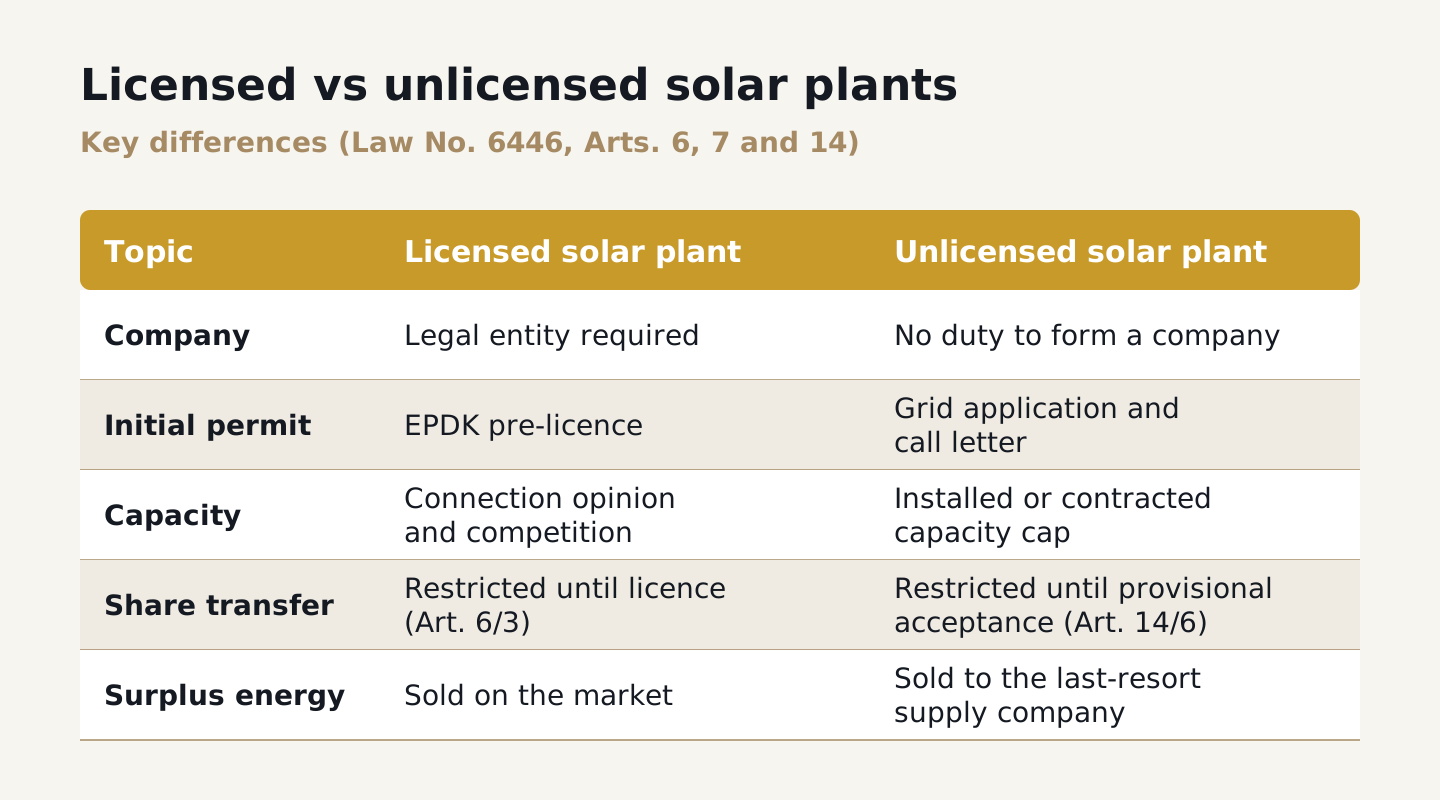
Whether a solar power plant runs on a licence or without one depends mainly on its installed capacity and on where the electricity will be consumed. Under Law No. 6446, Art. 5/2-a, legal entities that will carry out market activities must obtain a licence before they start, unless a statutory exception applies. Article 14 of the same Law, by contrast, exempts certain generation facilities from both the licence requirement and the duty to set up a company.
The statute sets the unlicensed threshold at renewable facilities with an installed capacity of up to one megawatt (Art. 14/1-b). The President may raise this ceiling up to five times, on a source-by-source basis (Art. 14/2). Facilities built for self-consumption are regulated separately and are capped at the contracted capacity in the grid connection agreement (Art. 14/1-g). Confirm the ceiling and implementing rules in force on your application date with EPDK (Energy Market Regulatory Authority) and the relevant distribution company.
What legal checks should be done when choosing a site?
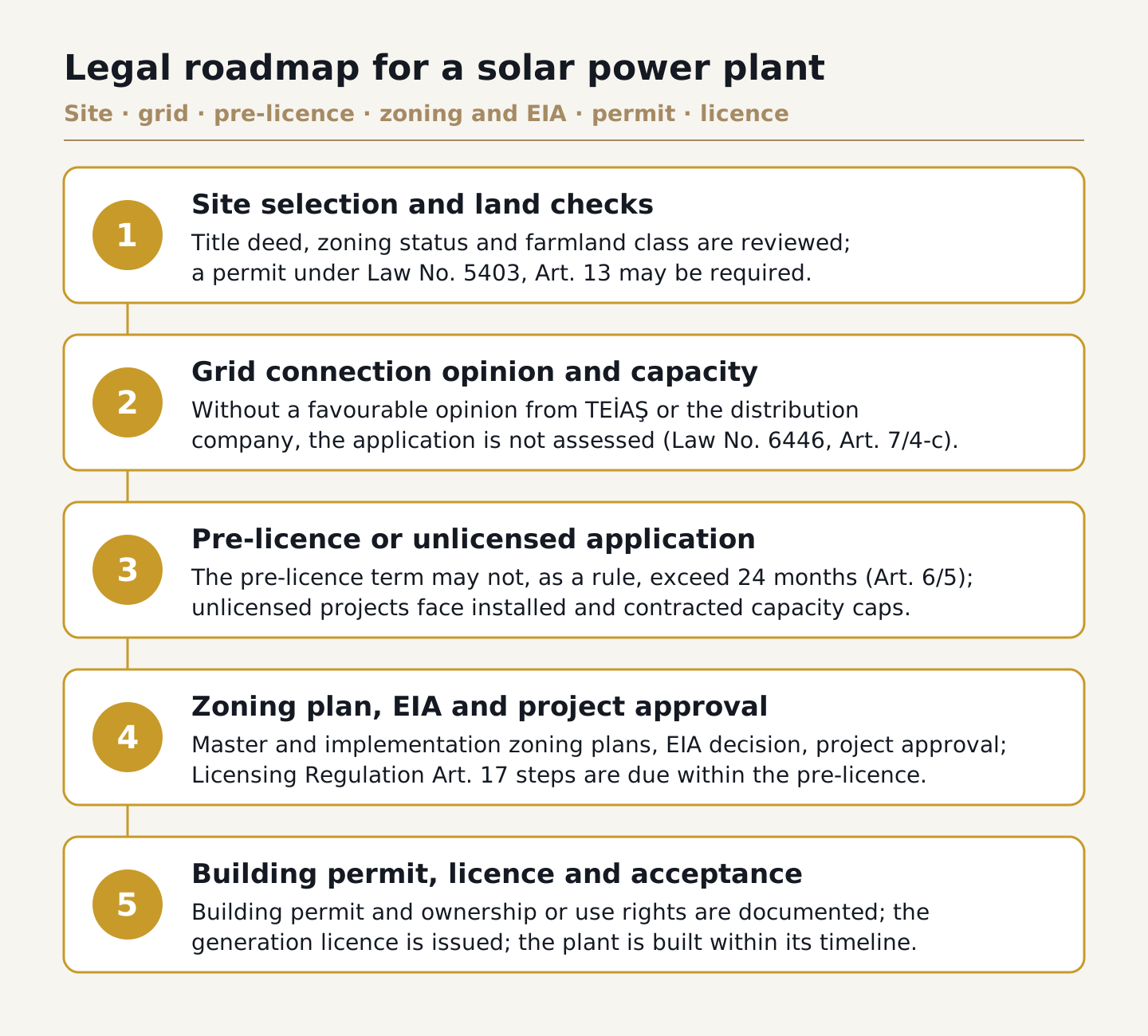
The first step is to review the property's ownership, its zoning status and its farmland classification together. Annotations on the land register, mortgages and co-ownership arrangements can make it harder to secure a right of use later. If the land is leased, the lease term should match the licence and operating periods, and the contract should be drafted so that it can serve as evidence of the right of use.
- Land register entry, annotations and encumbrances (mortgage, attachment, easements)
- Zoning status and existing planning decisions
- Farmland class and the soil conservation board procedure
- Special status such as forest, pasture, protected area or coastline
- Route of the connection line, if it requires expropriation or an easement
- Term and transferability of the lease or right of superficies
Can a solar power plant be built on agricultural land?
Building a solar power plant on farmland depends on the land class: some classes require a permit, and others are closed to non-agricultural use as a rule. Under Law No. 5403, Art. 13, absolute agricultural land, special-crop land, planted agricultural land and irrigated agricultural land may not be used for purposes other than farming. The Ministry may still grant a permit for the listed exceptions, but only if no alternative site exists and the board considers the use appropriate.
Farmland outside these four classes may be allocated to non-agricultural use by the governorship (provincial governor's office), provided the soil conservation project is followed. Objections to the governorship's decision are decided by the Ministry, and that decision can be challenged before the administrative courts. The Council of State has upheld a ruling that annulled the refusal of a solar permit for land that a site inspection and a court-appointed technical report showed to be marginal.
Is expropriation possible if the site or connection route cannot be secured?
For licensed projects, requests to expropriate or otherwise obtain land needed by a pre-licence or licence holder are handled by EPDK. Under Law No. 6446, Art. 19/1-a, the authority runs these requests under the Expropriation Law No. 2942 (Kamulaştırma Kanunu), and if it approves them, a Board decision is taken that also stands in for a public interest decision. Article 46 of the Licensing Regulation adds that applications may also be made for easements, use permits, leases and changes to the designated use of pasture land.
The costs of these procedures, compensation arising from the project and related expenses are borne by the pre-licence or licence holder (Art. 19/1-c). Easement, lease and use permit contracts over Treasury land remain valid only for the term of the pre-licence or licence. Expropriation costs and timelines therefore belong in the budget and the project schedule from the start.
What should a land lease or right of superficies agreement cover?
When the investor does not own the site, the right of use usually comes from a lease or a right of superficies (üst hakkı: the right to own a structure on someone else's land). The term should at least cover the licence and operating periods. Lenders typically want the right of use annotated on the land register and the agreement to be usable as collateral. The contract should also state clearly who removes the panels and restores the land when it ends.
Why is the grid connection opinion so decisive?
The grid connection opinion decides whether a solar power plant can feed electricity into the network, and so whether the project can actually be built. Under Law No. 6446, Art. 7/4-c, wind and solar pre-licence applications are assessed only if TEİAŞ (Turkish Electricity Transmission Corporation) or the relevant distribution company has issued a favourable connection opinion. Where several applications compete for the same connection point or region, TEİAŞ allocates the capacity through a competition (Art. 7/4-ç).
Unlicensed projects likewise start with a connection application to the distribution company; if it is approved, a call letter for the grid connection agreement is issued. A negative connection opinion or a rejected application is an administrative act, so it can be objected to and taken to court within the time limits. At this stage, it helps to request the reasons for refusal in writing and to keep a record of the published transformer capacity data.
Why are share transfers restricted in unlicensed projects?
The Law limits share transfers in unlicensed wind and solar projects to stop connection rights from being traded. Under Law No. 6446, Art. 14/6, no share transfer may take place from the application date until provisional acceptance of all facilities, apart from the exceptions in the regulation; otherwise the call letter for the grid connection agreement is cancelled. Any change in the ownership structure before provisional acceptance should therefore be reviewed legally first.
What must be completed during the pre-licence term?
A pre-licence (önlisans) is a time-limited right that gives the sponsor of a licensed solar power plant the chance to obtain its permits and secure ownership or use of the site. Under Law No. 6446, Art. 6/5, the pre-licence term may not exceed twenty-four months, save for force majeure; the Board may extend it by up to half, depending on the energy source and installed capacity. A legal entity that does not complete its obligations within the term is not granted a licence (Art. 6/2).
Article 17 of the Licensing Regulation lists what must be done within the pre-licence term. For solar projects, the main items are:
- Securing ownership or a right of use over the site
- Finalising the master and implementation zoning plans
- Obtaining approval of the preliminary or final project design
- Applying to TEİAŞ or the distribution company for a connection agreement
- Obtaining the decision required under the EIA Regulation
- Submitting a building permit or an equivalent document
- Signing the TEİAŞ contribution share agreement for solar plants, where required
The Regulation also requires the holder to apply to the competent authority for the decision required under the EIA Regulation (ÇED Yönetmeliği) within ninety days of being notified of the pre-licence decision (Art. 17/2-a). During the pre-licence period, a change in the shareholding structure or a share transfer before the licence is issued, outside the exceptions in the regulation, leads to cancellation of the pre-licence (Law No. 6446, Art. 6/3).
Does every solar project need an EIA?
Not every solar power plant goes through the same environmental impact assessment (ÇED) procedure. Depending on the project type and site area, it may fall under Annex 1 of the EIA Regulation (full EIA report), Annex 2 (screening based on a project description file) or outside the Regulation altogether. Thresholds and decision types change with amendments, so check the text in force on your application date with the Ministry of Environment, Urbanisation and Climate Change. EIA decisions can also be challenged before the administrative courts, and third parties do bring such actions.
What should you watch for at the licence stage and beyond?
Once the pre-licence obligations are met, the generation licence is issued and the plant must be built within the construction period set in the licence. Under Law No. 6446, Art. 5/7, a bank-issued security (teminat mektubu) of up to ten per cent of the investment amount is taken for this purpose. If the plant is not built on time, other than for force majeure or justified reasons not attributable to the licence holder, the licence is revoked and the security is forfeited.
Licences are granted for a maximum of forty-nine years, and generation licences for a minimum of ten (Art. 5/2-c). Capacity increases and repowering are allowed if the project stays within the licensed site and obtains a favourable connection opinion for the amendment (Art. 7/7). For contracts to sell the electricity you generate, our article on the PPA (power purchase agreement) may help.
Sponsors based in the United States or the United Kingdom should plan for their corporate paperwork as well, because documents issued abroad, such as certificates of incorporation, board resolutions and powers of attorney, generally need to be authenticated before Turkish authorities accept them. Türkiye, the United States and the United Kingdom are all parties to the Hague Apostille Convention (Lahey Apostil Sözleşmesi), so an apostille takes the place of consular legalisation. In the UK, apostilles come from the Foreign, Commonwealth and Development Office's Legalisation Office, which also issues e-Apostilles; in the US, state-level documents, including notarised ones, are apostilled by the state's competent authority, usually the Secretary of State, while federal documents go to the State Department's Office of Authentications. A certified Turkish translation may also be requested, so confirm the format with the receiving authority before sending anything.
Stage | Legal basis | Key point |
|---|---|---|
Pre-licence term | Law No. 6446, Art. 6/5 | 24 months as a rule; the Board may extend it by up to half |
EIA application | Licensing Regulation, Art. 17/2-a | Within 90 days of notification of the pre-licence |
Licence term | Law No. 6446, Art. 5/2-c | Maximum 49 years; minimum 10 years for generation |
Construction security | Law No. 6446, Art. 5/7 | Up to 10% of the investment amount |
Common legal mistakes in solar power plant projects
Many problems in practice arise because technical and commercial decisions are taken before the legal review is finished. The following mistakes are among the most common causes of delay or lost rights:
- Agreeing a land lease shorter than the licence and operating periods
- Checking the farmland class only after the site has been chosen
- Committing to equipment and construction contracts before the connection opinion
- Transferring shares before provisional acceptance or before the licence
- Losing track of the pre-licence term and the ninety-day EIA filing deadline
- Missing the deadlines for objections and lawsuits against refusals
The legal process for a solar power plant requires land, grid, permit and contract steps to be managed as one connected chain. A delay or gap in any of them can have serious consequences, such as cancellation of the pre-licence or forfeiture of the security. This article is for general information and does not replace legal advice; for time limits on administrative fines, see our article on challenging an EPDK administrative fine. You can review the scope of our services on the Energy Law page or reach us through the Contact page.