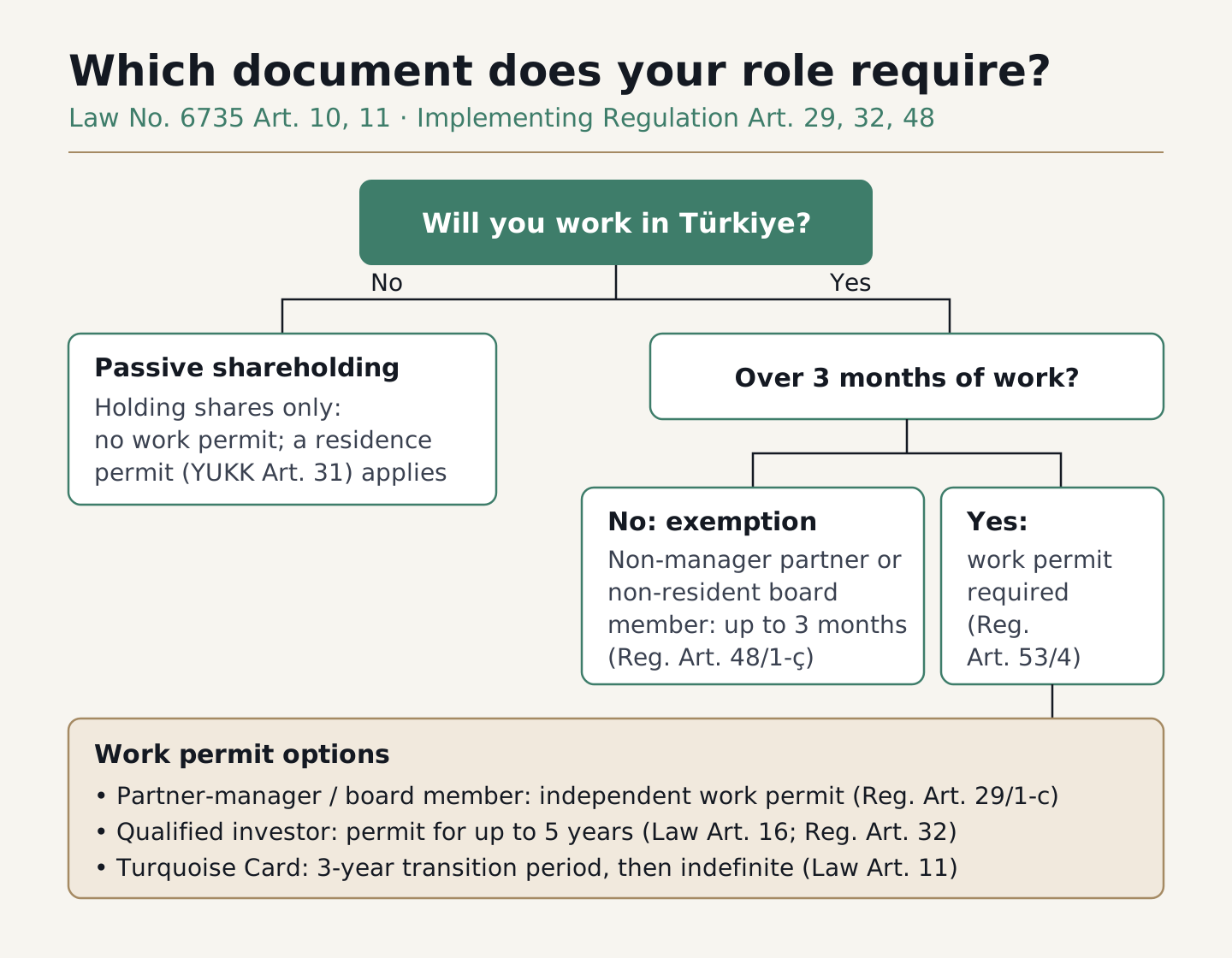
Whether a foreign investor needs a work permit in Turkey depends on the role they hold in the company and on whether they will actually work in the country. A partner who acts as manager of a limited company, or a partner who sits on the board of directors of a joint-stock company, must obtain a work permit before working in Turkey; partners without a management role and board members who do not reside in Turkey can work for up to three months under a work permit exemption.
The foreign investor work permit question is also closely tied to residence: a valid work permit stands in for a residence permit, while a residence permit granted for investment does not let you work. In this article we explain the exemptions, the permit types and the residence link under the International Labour Force Law No. 6735 (6735 sayılı Uluslararası İşgücü Kanunu) and its Implementing Regulation (Uluslararası İşgücü Kanunu Uygulama Yönetmeliği; "the Regulation").
Does a foreign investor need a work permit in Turkey?
Investing does not in itself create a right to work; every foreigner who will actually work in Turkey needs a work permit unless a specific exemption applies. Article 10/5 of Law No. 6735 expressly provides that a partner who is the manager of a limited company, a partner who is a board member of a joint-stock company, and a general partner who manages a partnership limited by shares may work by obtaining a work permit.
Article 3/g of the Foreign Direct Investment Law No. 4875 (4875 sayılı Doğrudan Yabancı Yatırımlar Kanunu) likewise states that foreign staff employed in companies, branches and entities set up under that Law receive their work permits from the Ministry of Labour and Social Security (Çalışma ve Sosyal Güvenlik Bakanlığı). The table below shows which document typically comes into play for each role an investor may hold.
Role in the company | Document required | Legal basis |
|---|---|---|
Partner who is the manager of a limited company | Independent work permit | Law No. 6735 Art. 10/5; Reg. Art. 29/1-c |
Partner who is a board member of a joint-stock company | Independent work permit | Law No. 6735 Art. 10/5; Reg. Art. 29/1-c |
Partner without a management role (if working in Turkey) | Work permit exemption of up to three months | Reg. Art. 48/1-ç |
Board member of a joint-stock company not resident in Turkey | Work permit exemption of up to three months | Reg. Art. 48/1-ç |
Non-partner foreigner with top-level authority to represent and bind the company | Work permit exemption of up to three months | Reg. Art. 48/1-ç |
Foreigner who only invests and does not work in Turkey | No work permit; a short-term residence permit instead | YUKK Art. 31/1-j |
What is a work permit exemption and which exemptions can investors use?
A work permit exemption is an official document issued by the Ministry that, while it is valid, lets a foreigner work and reside in Turkey without a work permit (Regulation Art. 4/1-ç). The exemption does not arise automatically: under Regulation Art. 49/1, even foreigners who fall within an exemption category may work only after they have obtained the exemption document.
For investors, the most relevant exemptions are listed in Regulation Art. 48/1:
- Board members of joint-stock companies who do not reside in Turkey, partners of other companies who have no management role, and non-partner foreigners with top-level authority to represent and bind the company: up to three months (Art. 48/1-ç)
- Foreigners coming to install, maintain or repair imported machinery and equipment, or to train staff in its use: up to three months in total (Art. 48/1-b)
- Foreigners providing cross-border services: up to three months (Art. 48/1-c)
- Foreigners reported by the relevant public bodies as able to make a significant contribution to Turkey in economic, socio-cultural or technological fields or in education: up to three years (Art. 48/1-h)
What time limits and repeat restrictions apply to an exemption?
The exemption is issued for the period the foreigner requests, without exceeding the ceiling set in Art. 48; it must end sixty days before the passport expires, and no extension can be applied for (Regulation Art. 51).
During its validity, the exemption document allows multiple entries into and exits from Turkey (Art. 53/2).
Under Regulation Art. 53/1, a new application for the same exemption cannot be filed until six months have passed for the exemptions in sub-paragraphs (b) and (c), and twelve months for the others. If the work covered by the exemption is going to run beyond the permitted period, a work permit must be obtained from the Ministry (Art. 53/4).
For that reason, when planning a foreign investor work permit for someone who will take on an ongoing management role, an exemption should be treated only as a short-term solution.
Which work permit does a partner-manager obtain?
Among the foreign investor work permit options, the one used most often is the independent work permit. A foreigner who is a partner in the company and also its manager or a member of its board of directors can be granted an independent work permit (Regulation Art. 29/1-c and ç).
An independent work permit is issued for a fixed term, without being bound by the one-, two- and three-year periods set out in Art. 10 of the Law (Law No. 6735, Art. 10/8).
When the application is assessed, the authorities consider the foreigner's level of education and professional experience, the effect of the investment on the national economy and on employment, and the foreigner's share in the company's capital (Law Art. 10/7; Regulation Art. 29/5).
Regulation Art. 22 also lists criteria such as the company's paid-in capital, gross sales, exports and the proportion of Turkish nationals in its total workforce.
What capital and employment criteria does the Ministry apply?
According to the work permit evaluation criteria published on the Ministry of Labour and Social Security website (as of November 2026), for a foreign partner in a business that keeps balance-sheet accounts, both the paid-in capital of the business and the foreigner's own capital contribution must be at least TRY 500,000, and the foreigner's shareholding must be at least 20 per cent. These thresholds have applied since 1 January 2025.
The same criteria require the business to employ at least five Turkish citizens. The first work permit is therefore issued with an annotation (a condition noted on the permit), and from the seventh month of the permit onwards the employment of five Turkish citizens is checked for every month. These capital, shareholding and employment criteria do not apply to foreign partners whose capital contribution is USD 100,000 or more.
The criteria are administrative rules and can change, so please confirm the current text with the Ministry before you apply.
For the details of setting up a company, see our articles on forming a limited company with a foreign partner and setting up a joint-stock company with foreign capital; for the practical steps of the application, see our guide on how to apply for a work permit in Turkey.
If you are investing from the United States or the United Kingdom, keep in mind that Türkiye, the US and the UK are all parties to the Hague Apostille Convention, so public documents issued in those countries, such as a certificate for a foreign corporate shareholder or a notarised power of attorney, can be used in Türkiye with an apostille instead of consular legalisation. In the UK, apostilles are issued by the Legalisation Office of the Foreign, Commonwealth and Development Office, and private papers such as powers of attorney or passport copies must first be certified by a UK notary or solicitor. In the US, documents from federal agencies are apostilled by the State Department's Office of Authentications, while state-issued and notarised documents go to the competent state authority, usually the Secretary of State. Before filing, ask which documents must also be submitted with a Turkish translation.
What advantages do qualified investor status and the Turquoise Card offer?
In some cases a foreign investor work permit can be issued on more favourable terms. Foreigners recognised as qualified investors may benefit from exceptions to the rules on permit periods and assessment under Art. 16/1-b of Law No. 6735, and their work permit may be issued for up to five years (Regulation Art. 32/6).
Under Regulation Art. 32/2, qualified investor status requires that at least three of the following conditions are met, or that the investor undertakes to meet them within two years at the latest:
- Investment capital above the amount set in the Regulation (TRY 1 million in the text)
- Annual exports reaching the amount set in the Regulation (TRY 1.5 million in the text)
- Direct and permanent employment of at least ten Turkish citizens
- Investment in a strategic sector or in a priority development region
- Establishment of an R&D or design centre within the investment
Under Regulation Art. 32/5, these Turkish lira amounts are increased at the start of each calendar year by the revaluation rate announced under the Tax Procedure Law (Vergi Usul Kanunu); please confirm the current 2026 figures with the Ministry. Where an investment has several partners, the capital, export and employment criteria are calculated according to the applicant's own shareholding (Art. 32/3).
The Turquoise Card (Turkuaz Kart) is granted to foreigners found eligible on criteria such as the impact of their investment on the economy and on employment. The first three years are a transition period; if the card is not cancelled during that time, the transition annotation is removed on application and an indefinite Turquoise Card is issued (Law No. 6735, Art. 11/1-2).
The cardholder enjoys the rights granted by an indefinite work permit, and the cardholder's spouse and dependent children receive a document that replaces the residence permit (Art. 11/3-4).
How are work permits and residence permits connected?
A valid work permit or work permit exemption serves as a residence permit for as long as it remains valid (Law on Foreigners and International Protection No. 6458 (6458 sayılı Yabancılar ve Uluslararası Koruma Kanunu, YUKK) Art. 27/1; Regulation Art. 57/1). The reverse is not true: holding a residence permit on any ground does not give a foreigner the right to work.
YUKK Art. 31/1-j provides for a short-term residence permit for foreigners who do not work in Turkey but will invest within the scope and amount set by the President, and for their family members; this permit can be granted for up to five years at a time (Art. 31/5). The words "who do not work in Turkey" in this provision show that taking an active role in the company while holding investor residence requires a separate work permit.
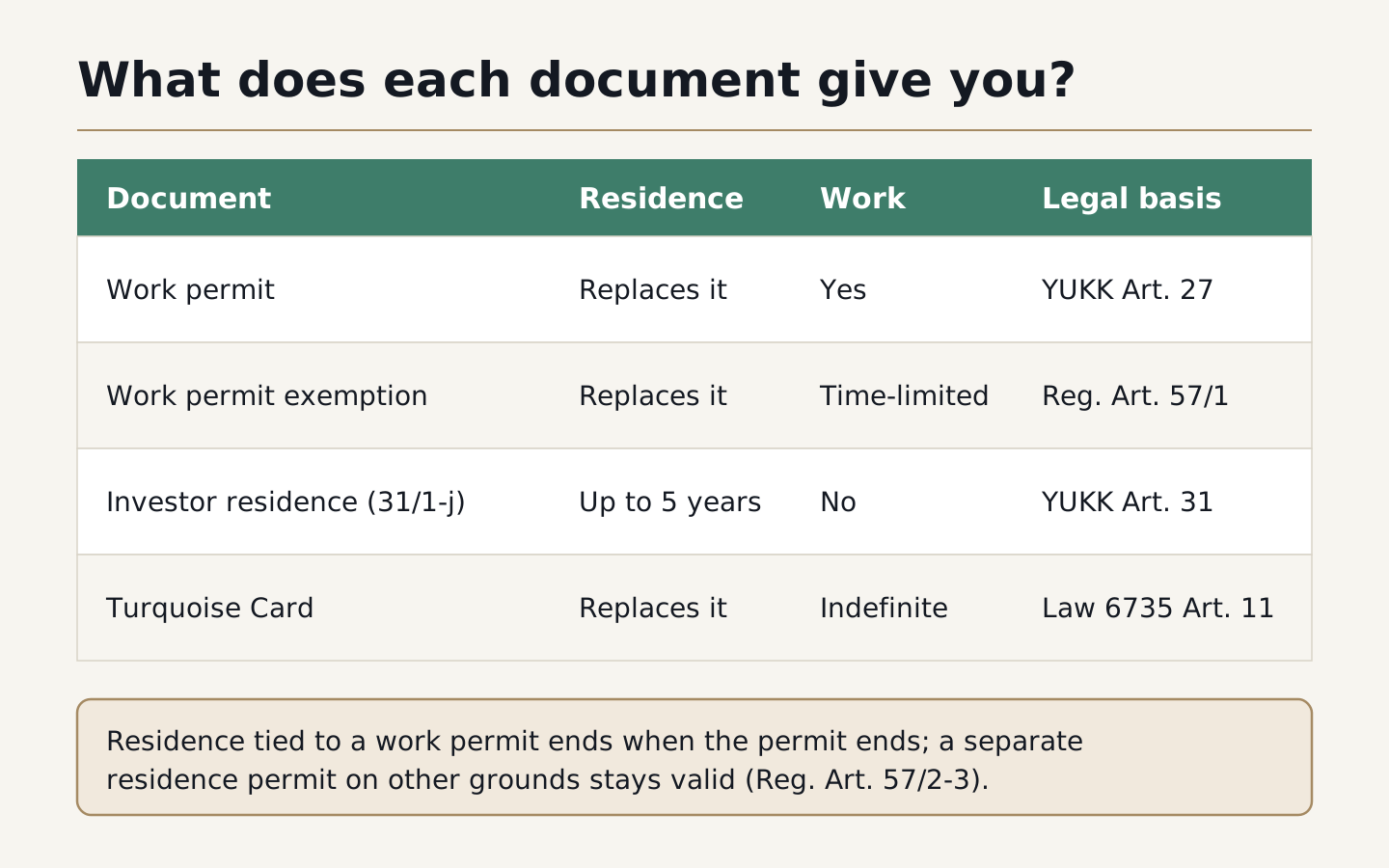
If a work permit or exemption becomes invalid for any reason, the right of residence that depends on it also ends (Regulation Art. 57/2). However, if the foreigner holds a valid residence permit based on a separate ground, independent of the work permit, that permit remains in force (Art. 57/3); this is why some investors prefer to plan their residence and work rights through separate documents.
What happens if you work without a permit?
Under Art. 23/5 of Law No. 6735, an administrative fine is imposed separately on a foreigner who works without a work permit and on the employer who employs them; the fine is doubled if the violation is repeated (Art. 23/6). Because these amounts are updated every year by the revaluation rate, please confirm the current figure with the relevant authority.
Under Art. 23/8 of the Law, foreigners found to be working without a work permit are reported to the Ministry of Interior (İçişleri Bakanlığı) for removal. For the remedies available against removal decisions, see our article on challenging a deportation order in Turkey.
What can you do if your work permit is refused?
A decision of the Ministry refusing a work permit or exemption application can be challenged by filing an objection with the Ministry through the online system within thirty days of notification; if the objection is rejected, you may bring the matter before the administrative courts (Regulation Art. 66). The grounds on which an exemption application will be refused are listed in Regulation Art. 52.
The Council of State (Danıştay, Turkey's highest administrative court) has upheld administrative court judgments annulling refusals that were based on the company's insufficient contribution to the economy and to employment, issued under the repealed Law No. 4817 on Work Permits for Foreigners (4817 sayılı Yabancıların Çalışma İzinleri Hakkında Kanun). Although these rulings rest on the earlier legislation, they are a useful guide because they show that the grounds for refusal are reviewed against the facts of each file.
Step by step: choosing the right document as an investor
- Clarify your role in the company: shareholder, manager, board member or authorised representative.
- Work out how long you will actually work in Turkey; work lasting more than three months requires a work permit.
- If you are a partner-manager, compare your capital contribution and the company's number of Turkish employees with the Ministry's criteria.
- Assess whether you meet the conditions for qualified investor status or the Turquoise Card.
- If you will not work, look into the short-term residence permit for investment or for setting up a business.
- If your application is refused, do not miss the thirty-day objection period, and answer the stated grounds with documents.
A foreign investor work permit plan is more coherent when it is considered together with company formation, residence and, later on, a possible application for Turkish citizenship by investment. This article is for general information only and does not replace legal advice. To learn more about our work for foreign investors, review the scope of our services or visit our Contact page.