A foreign-owned joint-stock company (anonim şirket, A.Ş.) is set up under the same rules as one founded by Turkish citizens, and the foreign shareholder needs no separate incorporation permit. Art. 3(a) of Foreign Direct Investment Law No. 4875 (4875 sayılı Doğrudan Yabancı Yatırımlar Kanunu) provides that, unless international agreements or special laws say otherwise, foreign investors are free to invest in Türkiye and are treated equally with domestic investors.
This article covers what the articles of association must contain, the minimum capital and payment rules, how the board of directors is formed, the registration process and the document preparation that is specific to foreign shareholders. Investors weighing up a limited company may also want to compare it with our article on setting up a limited company with foreign shareholders.
Can a foreign investor set up a joint-stock company in Turkey?
Yes. Foreign individuals and legal entities can set up a joint-stock company in Türkiye on their own or together with Turkish partners. Art. 2(a) of Law No. 4875 defines a foreign investor as a natural person holding foreign citizenship, a Turkish citizen resident abroad or a legal entity incorporated under foreign law. Sub-paragraph (b) of the same article lists establishing a new company among the forms of foreign direct investment.
For a foreign-owned joint-stock company, the equal treatment principle means that the incorporation requirements are the same as for a domestic company. In some sectors, however (for example banking, energy or media), licences and permits required by special laws must also be obtained; these flow from the business activity, not from incorporation itself.
What is the minimum share capital for a joint-stock company?
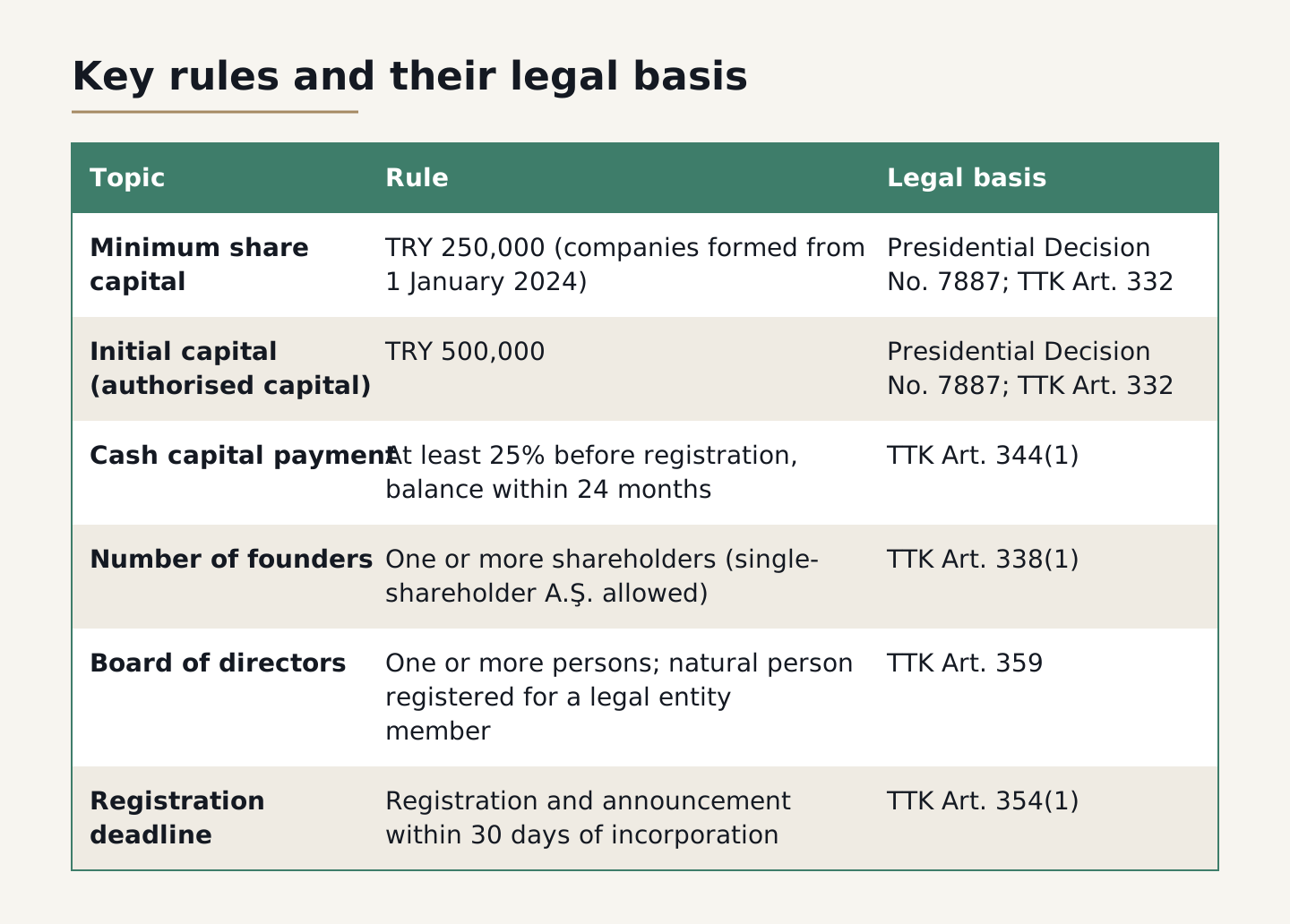
For joint-stock companies incorporated from 1 January 2024, the minimum share capital is TRY 250,000. The TRY 50,000 figure in Art. 332(1) of the Turkish Commercial Code No. 6102 (6102 sayılı Türk Ticaret Kanunu, “TTK”) was raised to TRY 250,000 by Presidential Decision No. 7887 (Official Gazette of 25 November 2023, issue 32380). The same Decision raised the minimum initial capital for non-public companies that adopt the authorised capital system to TRY 500,000.
Because these amounts can be raised again by Presidential decision, please confirm the figure in force on the incorporation date with the Ministry of Trade (Ticaret Bakanlığı) or the relevant trade registry directorate.
What is the authorised capital system for?
The authorised capital system (kayıtlı sermaye sistemi) lets the board of directors increase capital up to a set ceiling, so the general assembly does not have to meet to amend the articles every time. Under Art. 332(2) TTK, the initial capital is the capital that must exist at incorporation and when the company first adopts the system, while the issued capital is the total nominal value of the shares issued.
The system gives flexibility to foreign investors who plan to invest in stages, but non-public companies need a higher initial capital to use it. The right model depends on the investment timetable and the shareholding structure, which should be looked at together.
When and how is the capital paid?
At least 25% of the nominal value of shares subscribed in cash must be paid before registration, and the balance within 24 months after registration (Art. 344(1) TTK).
Any share issue premium must be paid in full before registration. Cash capital that a foreign shareholder brings in from abroad qualifies as foreign direct investment under Art. 2(b) of Law No. 4875.
Assets other than cash can also be contributed. Under Art. 342(1) TTK, assets that are free of limited rights in rem, attachments and injunctions, can be valued in money and are transferable may be contributed as capital in kind. Services, personal labour, commercial reputation and receivables that are not yet due cannot be contributed as capital.
Under Art. 3(f) of Law No. 4875, the value of a foreign investor's non-cash capital is determined in line with the TTK. Where shares or other securities of foreign companies are contributed, valuations by the competent authorities of the country of origin or by international valuation bodies are taken as the basis.
What happens if the capital is not paid?
A shareholder who fails to pay its capital contribution on time owes default interest without any need for a formal notice, and the board of directors may strip it of its shares (Art. 482 TTK). Unless the articles say otherwise, the board calls for share payments by public announcement, stating the amount, the payment date and the place of payment (Art. 481(1) TTK).
The decision concerns a limited company, but because the joint-stock company rules on paying in capital also apply to limited companies, it shows equally for joint-stock companies why the payment schedule should be written clearly into the articles of association.
How are the articles of association prepared?
The articles of association must be in writing, with the signatures of all founders certified by a notary, or signed in the presence of the trade registry director or a deputy (Art. 339(1) TTK). The company is formed when the founders declare their intention to establish a joint-stock company in articles in which they undertake to pay the full capital unconditionally (Art. 335(1) TTK).
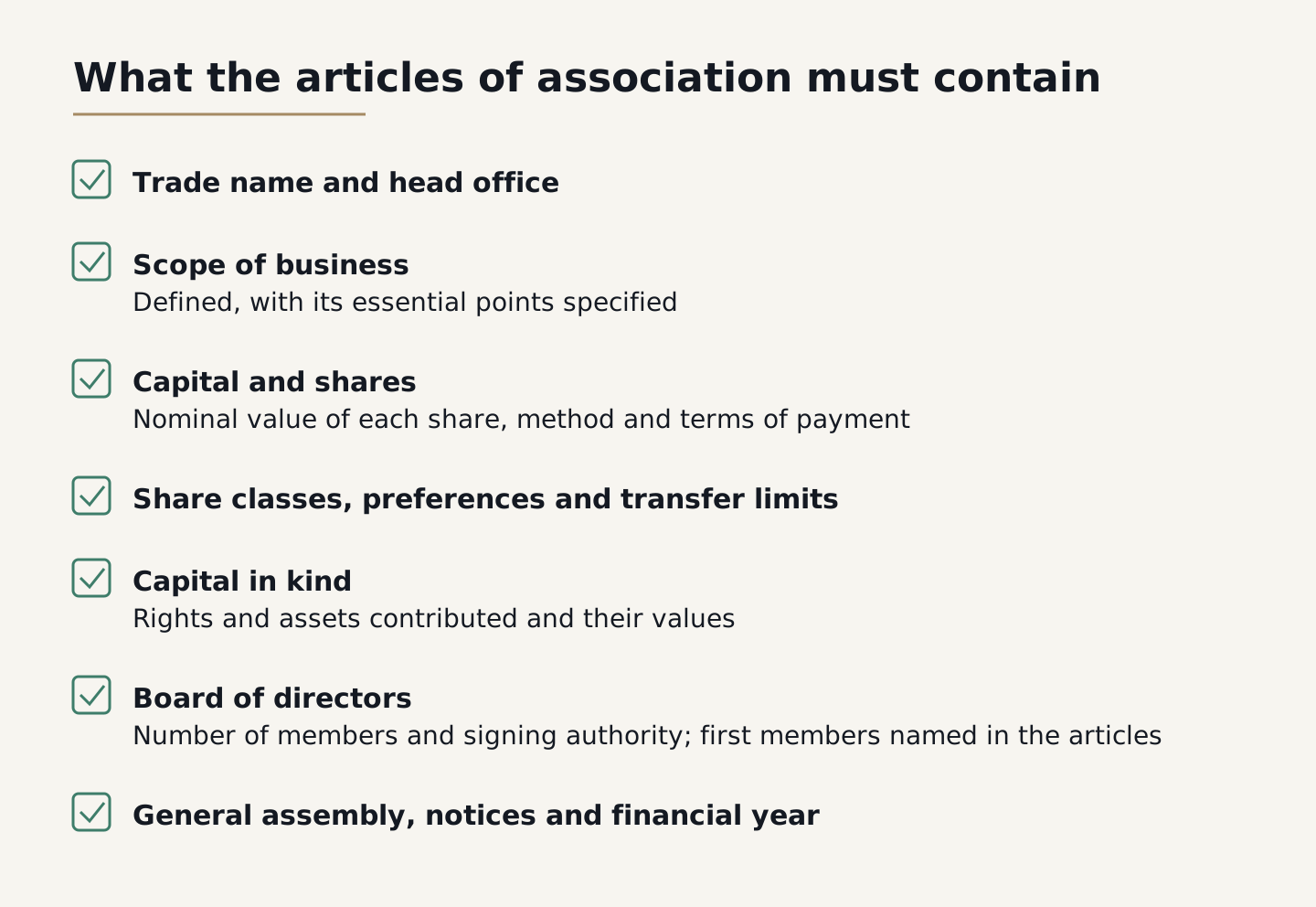
Art. 339(2) TTK lists what the articles must contain. If any of these items is missing or vague, the registration application may come back with a request for correction, and the shareholders may later disagree over how the articles should be read.
In companies with foreign shareholders, share transfer restrictions, preferred shares and board representation deserve particular attention if later shareholder disputes are to be avoided. These matters can be written into the articles of association or dealt with in a separate shareholders' agreement.
Can foreign nationals sit on the board of directors?
Yes. The TTK does not require board members to be Turkish citizens or to live in Türkiye.
Under Art. 359(1) TTK, a joint-stock company has a board of directors made up of one or more persons, appointed in the articles of association or elected by the general assembly. The first board members are appointed in the articles (Art. 339(3) TTK).
If a legal entity is elected to the board, one natural person designated to act on its behalf is registered and announced together with it (Art. 359(2) TTK). Board members, and the natural person registered for a legal entity member, must have full legal capacity (Art. 359(3) TTK).
Single-shareholder joint-stock company
A joint-stock company can also be formed by a single founder (Art. 338(1) TTK). Where the company has only one shareholder, that shareholder's name, place of residence and citizenship are also registered and announced (Art. 338(2) TTK).
This model is often used when a foreign parent company sets up a foreign-owned joint-stock company in Türkiye as a wholly owned subsidiary.
Which documents should a foreign shareholder prepare?
For foreign shareholders, the most time-consuming stage is making documents issued abroad usable in Türkiye. In practice, foreign individual shareholders are asked for a Turkish tax identification number and a translated copy of their passport, while foreign corporate shareholders are asked for a certificate of good standing, a registry extract and a resolution of the competent corporate body.
When setting up a foreign-owned joint-stock company, documents executed abroad must, depending on the issuing country, carry an apostille or Turkish consular legalisation and be submitted with a Turkish translation. As the list of required documents may vary from one directorate to another, confirm it with the relevant trade registry directorate before applying.
For US and UK shareholders, the apostille route applies: Türkiye, the United States and the United Kingdom are all parties to the Hague Apostille Convention of 5 October 1961, so consular legalisation is not needed. UK documents, including Companies House certificates and powers of attorney or resolutions certified by a UK notary or solicitor, are apostilled by the Legalisation Office, which also offers an electronic e-Apostille for PDFs signed electronically by a UK notary or solicitor. In the US, corporate records and notarised documents issued under state authority are apostilled by the competent authority of the issuing state, while documents signed by federal officials are handled by the US Department of State's Office of Authentications. Whether a particular trade registry directorate will accept an e-Apostille, and in what form it wants the Turkish translation, should be checked with that office in advance.
What happens at registration and after incorporation?
The full articles of association must be registered with the trade registry where the company's head office is located and announced in the Turkish Trade Registry Gazette (Türkiye Ticaret Sicili Gazetesi) within thirty days of incorporation (Art. 354(1) TTK). On registration, the company acquires legal personality and is ready to operate.
After registration come steps such as tax registration, opening a bank account and following the payment schedule for the rest of the capital. Foreign investors may freely transfer abroad, through banks, the net profit, dividends and liquidation proceeds arising from their activities in Türkiye (Art. 3(c) of Law No. 4875).
Under Art. 3(g) of Law No. 4875, work permits for foreign staff employed by the company are issued by the Ministry of Labour and Social Security; for details, see our article on how to apply for a work permit. Investors planning incorporation alongside Turkish citizenship should also look separately at the requirements for Turkish citizenship by investment.
Joint-stock companies whose share capital exceeds the threshold set by law must retain a contracted attorney under Art. 35(3) of Attorneyship Law No. 1136 (1136 sayılı Avukatlık Kanunu). Failure to comply is punishable by an administrative fine, so check separately, based on your capital, whether the threshold applies to your company.
How are shareholder relationships protected in a foreign-owned joint-stock company?
The balance between shareholders is protected through share transfer restrictions, preferential rights and the board structure set out in the articles. Art. 339(2)(d) TTK requires preferential rights attached to particular shares, and any transfer restrictions, to appear in the articles of association. Where foreign and Turkish shareholders sit side by side, the number of board seats each side will hold should therefore be settled at the incorporation stage.
Shareholders of a foreign-owned joint-stock company can deal with matters outside the articles (for example pre-emption rights, tag-along rights or exit mechanisms in a deadlock) in a separate shareholders' agreement. That agreement binds only its parties and does not directly bind the company's organs, so its key provisions should be drafted consistently with the articles.
Art. 3(e) of Law No. 4875 provides that, for disputes arising from investment contracts governed by private law, the parties may agree to national or international arbitration as well as the competent courts, provided the conditions in the relevant legislation are met. If arbitration is chosen, the seat, the language and the rules should be stated expressly.
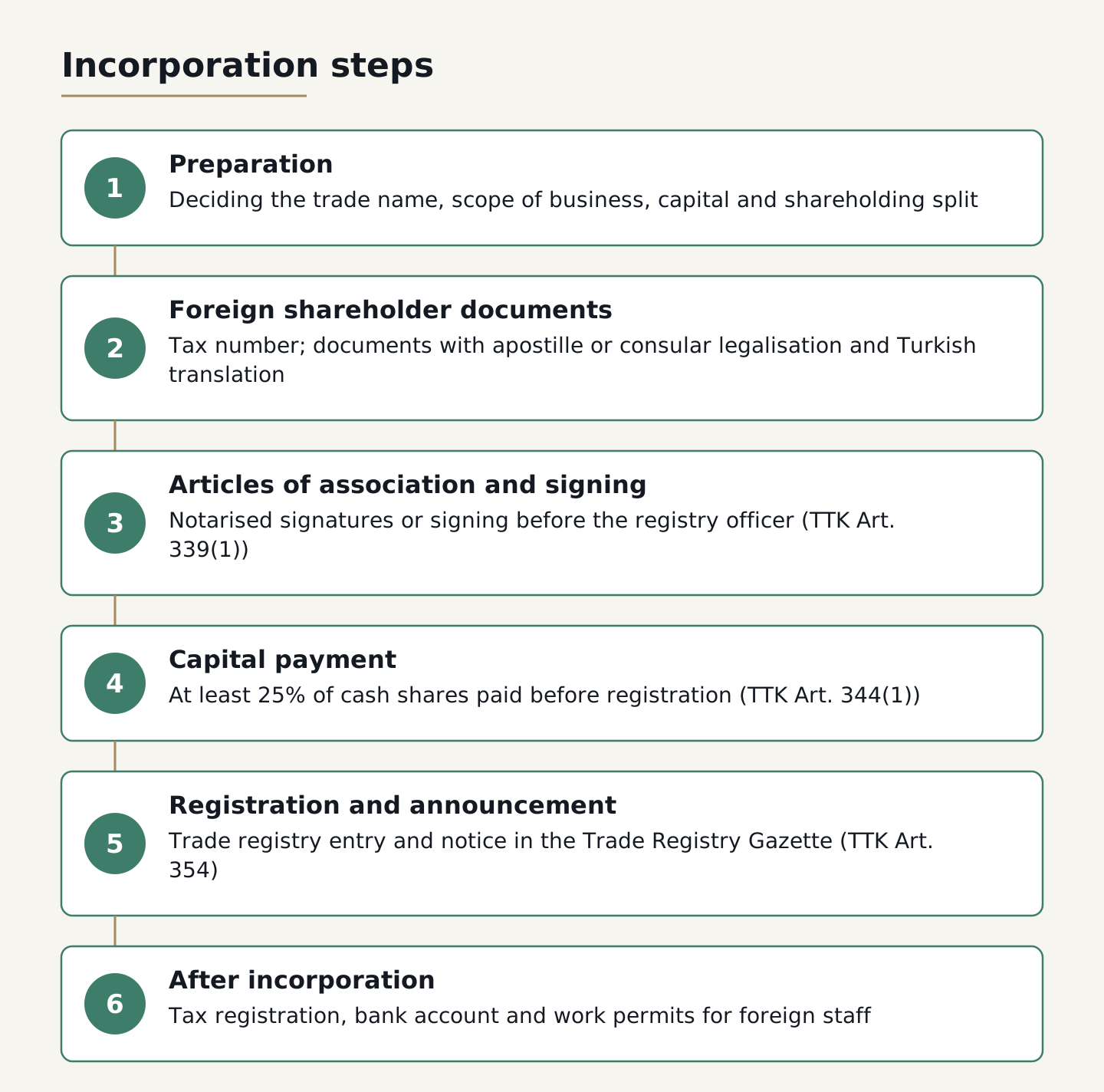
Step-by-step incorporation plan
- Define the scope of business and, where needed, any sector-specific licence requirements.
- Settle the trade name, registered office address, capital amount and shareholding split.
- Prepare the foreign shareholders' tax numbers, identity and registry documents with apostilles or legalisation and translations.
- Draft the articles of association so that they cover every item listed in Art. 339(2) TTK.
- Pay in at least 25% of the cash capital before registration and set out the schedule for the balance in the articles.
- Complete registration and announcement within 30 days of incorporation.
- After registration, start the tax, banking and foreign staff work permit procedures.
Common mistakes
- Planning around outdated minimum capital figures.
- Leaving the capital payment schedule vague in the articles of association.
- Underestimating how long apostilles and translations of foreign documents take.
- Not designating the natural person to be registered for a legal entity board member.
- Trying to add share transfer restrictions and preferential rights only after incorporation.
- Not checking at the outset which sector licences the business activity requires.
A foreign-owned joint-stock company follows the same rules as a domestic one, yet foreign documents, capital transfers and the balance between shareholders call for careful preparation. Getting the articles of association, the capital schedule and the management structure right from the start heads off a large share of potential disputes. You can review our scope of services for foreign investors or reach us through our Contact page.