A work permit application in Türkiye goes directly to the Ministry of Labour and Social Security if the foreign national is lawfully in the country, and to the Turkish embassy or consulate in their country of residence if they are abroad (International Labour Force Law No. 6735 – 6735 sayılı Uluslararası İşgücü Kanunu, Art. 7). For employed work, the employer is the party that completes and approves the application; for self-employment, the foreign national applies personally.
This guide explains how to apply from inside Türkiye and from abroad, which steps fall to the employer and which to the employee, the review and appeal deadlines, the types of permit and the most common mistakes, in light of current legislation and Council of State (Danıştay) case law.
Who makes the work permit application, and where?
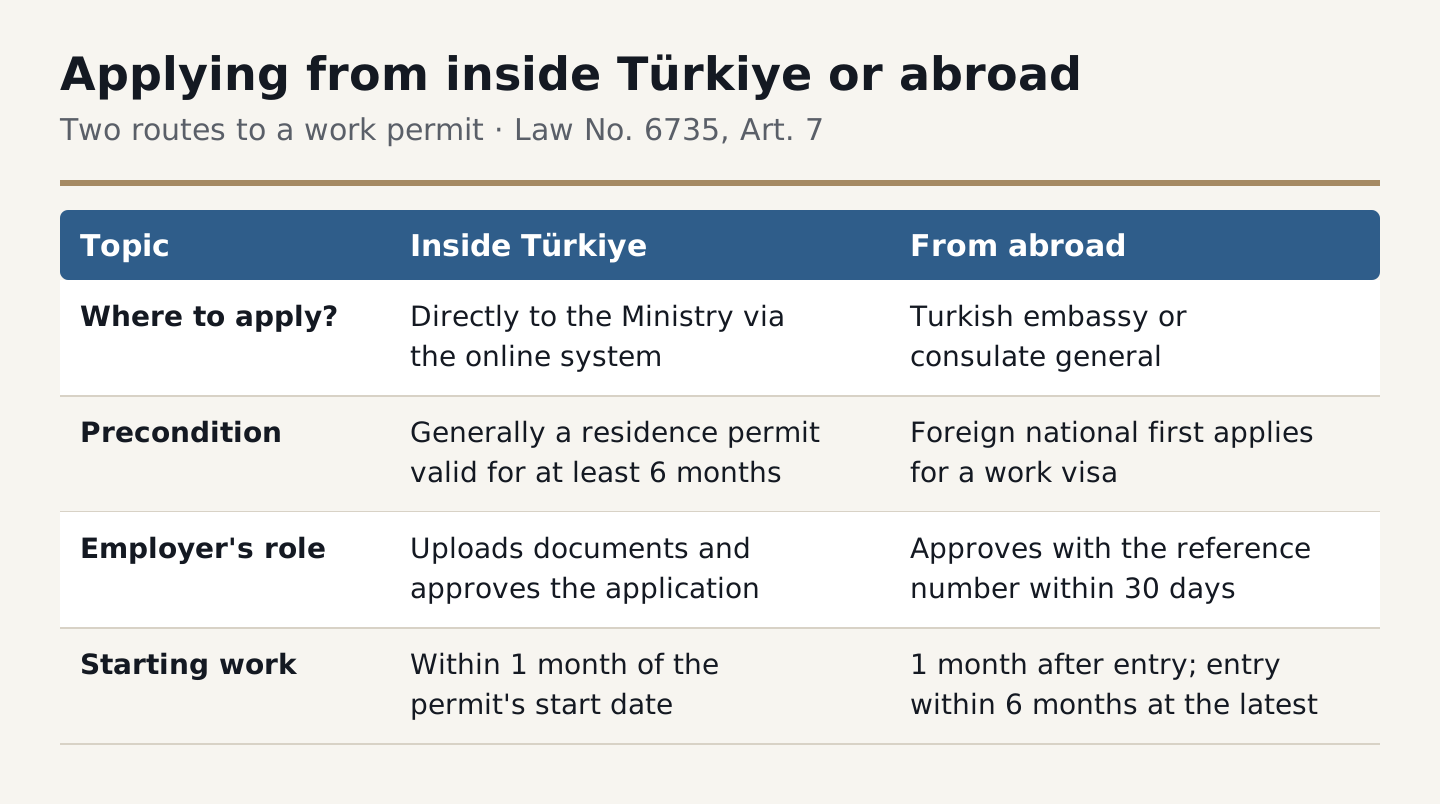
Where you apply depends on where the foreign national is when the application is made. Applications from inside Türkiye go straight to the Ministry through its electronic system; applications from abroad are lodged with a Turkish mission and forwarded by it to the Ministry. The law also allows an authorised intermediary to file the application (Law No. 6735, Art. 7/2).
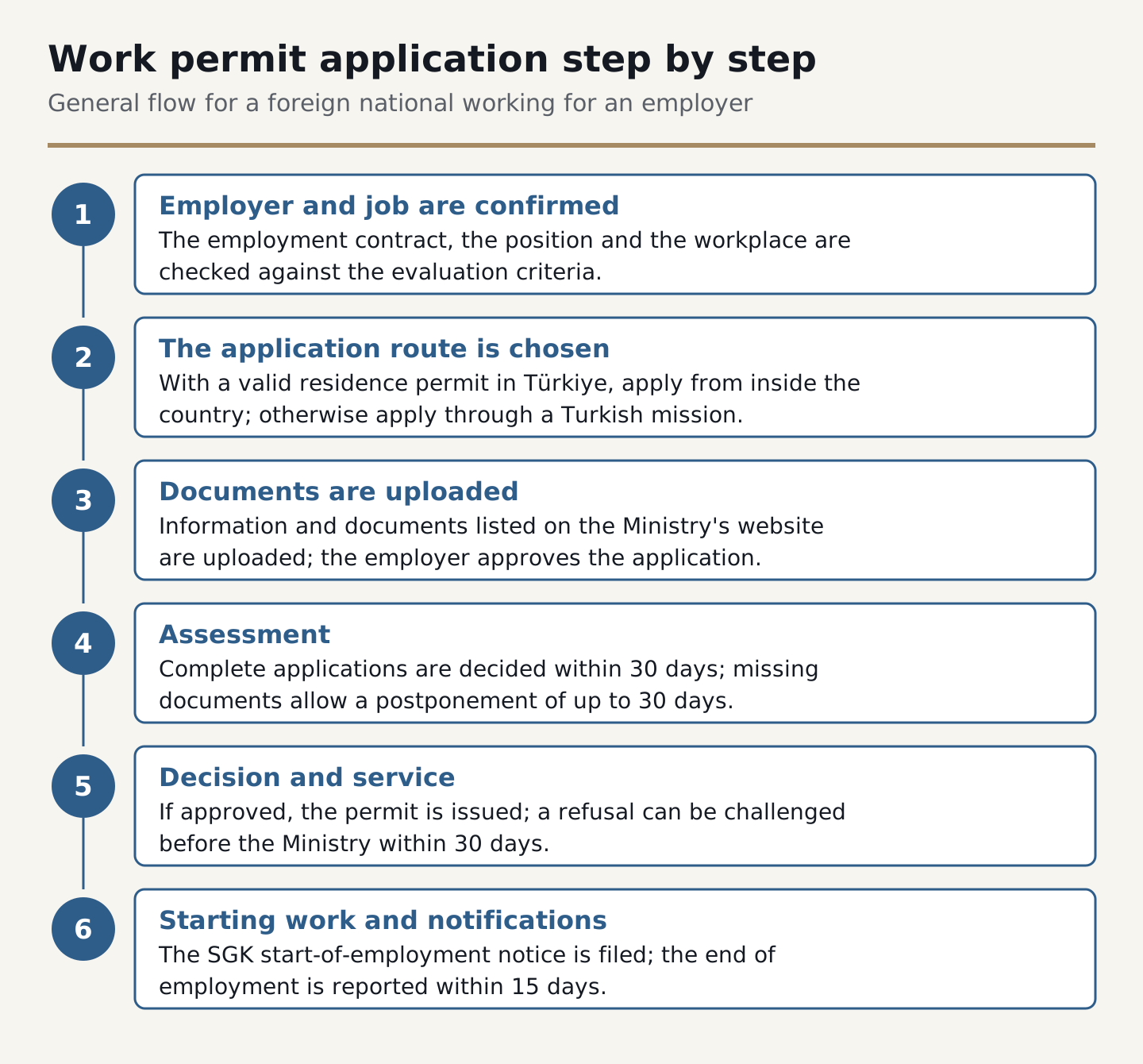
For employed work, the application is complete once the employer uploads the required information and documents and approves it. Where there is no employer, in other words for an independent work permit, the foreign national uploads the documents and approves the application (Implementing Regulation of the International Labour Force Law – Uluslararası İşgücü Kanunu Uygulama Yönetmeliği, Art. 17).
What does a work permit application from inside Türkiye require?
To apply from inside Türkiye, the foreign national generally needs a valid residence permit with at least six months remaining (Regulation Art. 15/4). The Ministry may allow certain groups to apply through the system without a residence permit, and it updates the list of these groups on its official website in six-month cycles.
Someone in Türkiye on a tourist visa or a visa exemption cannot apply from inside the country unless they fall within one of these exceptions. Check the type and remaining validity of the current residence permit before choosing the route; our guide to residence permits for foreigners explains the permit types.
How is an application from abroad completed?
From abroad, the foreign national first applies for a work visa at a Turkish mission. The employer then uploads the required documents using the reference number issued by the mission and approves the application. This approval must be given within thirty days of the work visa application (Regulation Art. 17/2).
A foreign national granted a permit on an application from abroad must enter Türkiye within six months of the permit's start date, or the permit is cancelled (Law No. 6735, Art. 12/2). They must also start work within one month of entering the country (Regulation Art. 25/2).
For applicants from the United States or the United Kingdom, document preparation deserves early attention. The Ministry's document list asks for a copy of the diploma with a Turkish translation certified by a sworn translator or an official authority, and engineers and architects who studied abroad also need a diploma equivalence certificate. Türkiye, the US and the UK are all parties to the 1961 Hague Apostille Convention, so a public document apostilled at home does not need consular legalisation; confirm with the mission or the Ministry which of your documents must carry an apostille.
What are the employer's and the employee's steps?
In a work permit application the division of labour is clear: the employer acts as the owner of the application, while the foreign national supplies identity and qualification documents. The information to be entered and the documents to be uploaded are set by the Ministry and published on its official website (Regulation Art. 15/8). Because the list is updated from time to time, check it again on the day you apply.
- Employer: obtains an electronic notification address, prepares the employment contract, uploads workplace documents and approves the application
- Foreign national: provides the passport, residence permit (for applications from inside Türkiye), diploma and, where needed, professional qualification documents
- Foreign national applying from abroad: applies for a work visa at the Turkish mission and passes the reference number to the employer
- Employer: files the start-of-employment notification with the Social Security Institution (SGK) on time once the permit is issued
- Employer: notifies the Ministry within fifteen days if the employment ends or a ground for cancellation arises (Regulation Art. 61)
Why is an electronic notification address mandatory?
For applications on behalf of a foreign employee, the employer must have an electronic notification address; for independent or indefinite work permit applications, the requirement applies to the foreign national (Regulation Art. 16). Refusals, missing-document notices and cancellations are served to this address, so it must be checked regularly to avoid missing the appeal deadline.
Partners who will act as managers of a company with foreign shareholders must also obtain a work permit (Law No. 6735, Art. 10/5). To plan company formation and work permit steps together, see our article on setting up a limited company with foreign partners.
How is a work permit application assessed, and how long does it take?
A work permit application with complete information and documents is decided within thirty days (Law No. 6735, Art. 7/8). If documents are missing, the assessment is postponed; except for officially documented force majeure, the postponement cannot exceed thirty days, and an application still incomplete at the end of that period is refused (Art. 7/7).
The Ministry assesses the application against international labour force policy and its own evaluation criteria. These cover matters such as the number of Turkish citizens employed at the workplace, the employer's financial strength and the salary to be paid to the foreign national, and they are published on the Ministry's website. The numerical thresholds change from time to time, so confirm the current values with the Ministry.
Where it considers it necessary, the Ministry also takes into account the opinions of relevant public bodies and professional organisations (Law No. 6735, Art. 7/5). For jobs requiring a professional qualification, for example, the prior approval or opinion of the competent body can decide the outcome. Check before applying whether your profession needs a specific licence or diploma equivalence.
On what grounds can a work permit be refused?
The refusal grounds are set out in the law, and the most common are failing the evaluation criteria and an insufficient justification for employing a foreign national (Law No. 6735, Art. 9). The main grounds are:
- Inconsistency with international labour force policy
- Use of false or misleading information or documents
- Insufficient justification for employing a foreign national
- Applying for jobs and professions reserved for Turkish citizens
- Failure to meet the Ministry's evaluation criteria
- Concerns relating to public order, public security or public health
- Failure to apply within the statutory period or to complete missing documents
Where a refusal or cancellation is based on public order, the authority must produce concrete and serious information rather than an abstract assessment. The Council of State stressed this principle in a decision under the repealed Law No. 4817; the same principle offers guidance for the similar refusal and cancellation grounds in Law No. 6735.
How do you appeal a work permit refusal?
A refusal or cancellation by the Ministry can be challenged before the Ministry within thirty days of service (Law No. 6735, Art. 21/2). Decisions are served under the Notification Law (Tebligat Kanunu) on the employer, or on the foreign national who holds an independent or indefinite work permit or a Turquoise Card.
If the objection is rejected, the administrative courts are open. Because the special law sets no separate period, the deadline for an action before the administrative court is sixty days from the day after written notification (Law on Administrative Procedure – İYUK Art. 7). Answering every element of the refusal reasons with documents in the objection also lays the groundwork for any later court case.
How long is a work permit granted for?
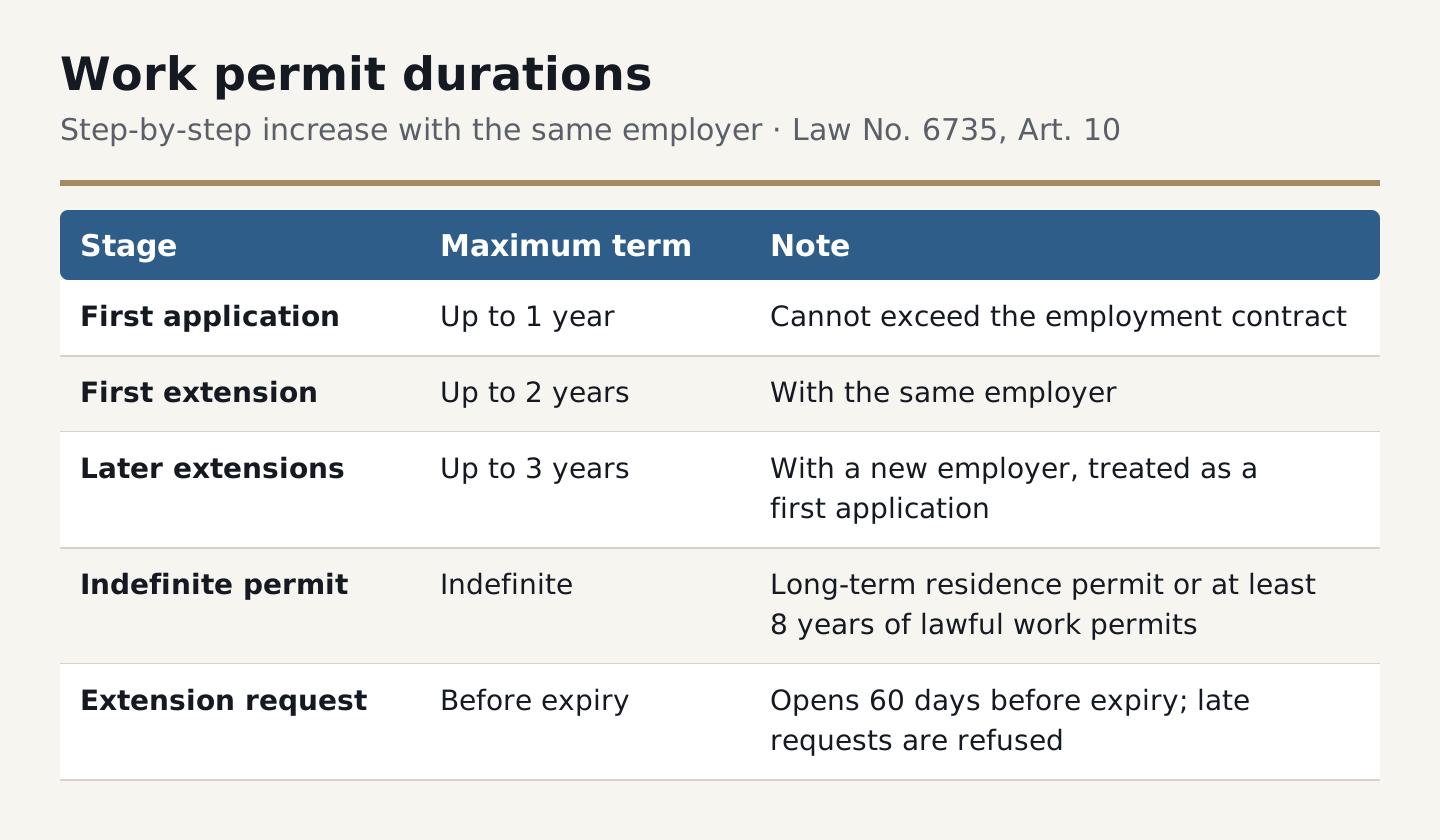
On a first application, a work permit is granted for up to one year, and never longer than the employment contract. With the same employer, the first extension can be for up to two years and later extensions for up to three years; an application to work for a different employer is treated as a first application (Law No. 6735, Art. 10).
Foreign nationals with a long-term residence permit, or with at least eight years of lawful work permits, can apply for an indefinite work permit; meeting the conditions does not, however, create an absolute right (Art. 10/3). For the conditions of long-term residence, see our guide to the long-term residence permit.
When should an extension be requested?
An extension can be requested from sixty days before the permit expires and must in any event be filed before expiry (Law No. 6735, Art. 7/3). Extension requests made after expiry are refused by law; a new first application is then needed.
Does a work permit replace a residence permit?
Yes. A valid work permit or work permit exemption counts as a residence permit (Law No. 6735, Art. 12/1; Law on Foreigners and International Protection – YUKK Art. 27). The reverse is not true: apart from refugee and subsidiary protection status, no residence permit gives a foreign national the right to work.
Working without a permit leads to an administrative fine for both the foreign national and the employer, doubled on repetition (Law No. 6735, Art. 23). The statutory amounts are revalued every year, so confirm the figure for 2026 with the Ministry. Foreign nationals found working without a permit are also reported to the Ministry of Interior for removal; for your rights in that process, see our article on appealing a deportation order.
Which foreign nationals can benefit from exceptions?
The law allows exceptions to the rules on applications, assessment and permit duration for certain foreign nationals (Law No. 6735, Art. 16). These exceptions are applied in line with the Ministry's international labour force policy and do not create an automatic right. The main groups are:
- Foreign nationals assessed as qualified workers or qualified investors
- Those married to a Turkish citizen and living with their spouse in Türkiye
- Citizens of European Union member states and of the Turkish Republic of Northern Cyprus
- Foreign nationals of Turkish descent as notified by the relevant ministry
- Those employed on a fixed-term project and cross-border service providers
What is the Turquoise Card?
The Turquoise Card is a work permit granted to qualified foreign nationals whose application is approved because of their education, professional experience, contribution to science and technology, or the economic impact of their investment (Law No. 6735, Art. 11). The first three years are a transition period; at the end, on application, this restriction is lifted and the card becomes indefinite.
The application to lift the transition period must be made from one hundred and eighty days before it ends and, in any case, before it expires. The holder's spouse and dependent children receive a document that counts as a residence permit, and the holder enjoys the rights attached to an indefinite work permit.
Common mistakes
- Applying from inside Türkiye without a residence permit, or with one valid for less than six months
- The employer failing to approve within thirty days when applying from abroad
- Requesting an extension after the permit has expired
- Not responding to a missing-document notice within thirty days
- Putting the foreign national to work before the permit is issued
- Not notifying the Ministry within fifteen days when the employment ends
- Missing the thirty-day deadline to challenge a refusal
A work permit application in Türkiye is an administrative process with strict deadlines, where success depends on choosing the right route, the employer's approval and completing documents on time. You can review our scope of services in foreigners law or reach us via the Contact page. This article is for general information only and is not a substitute for legal advice.