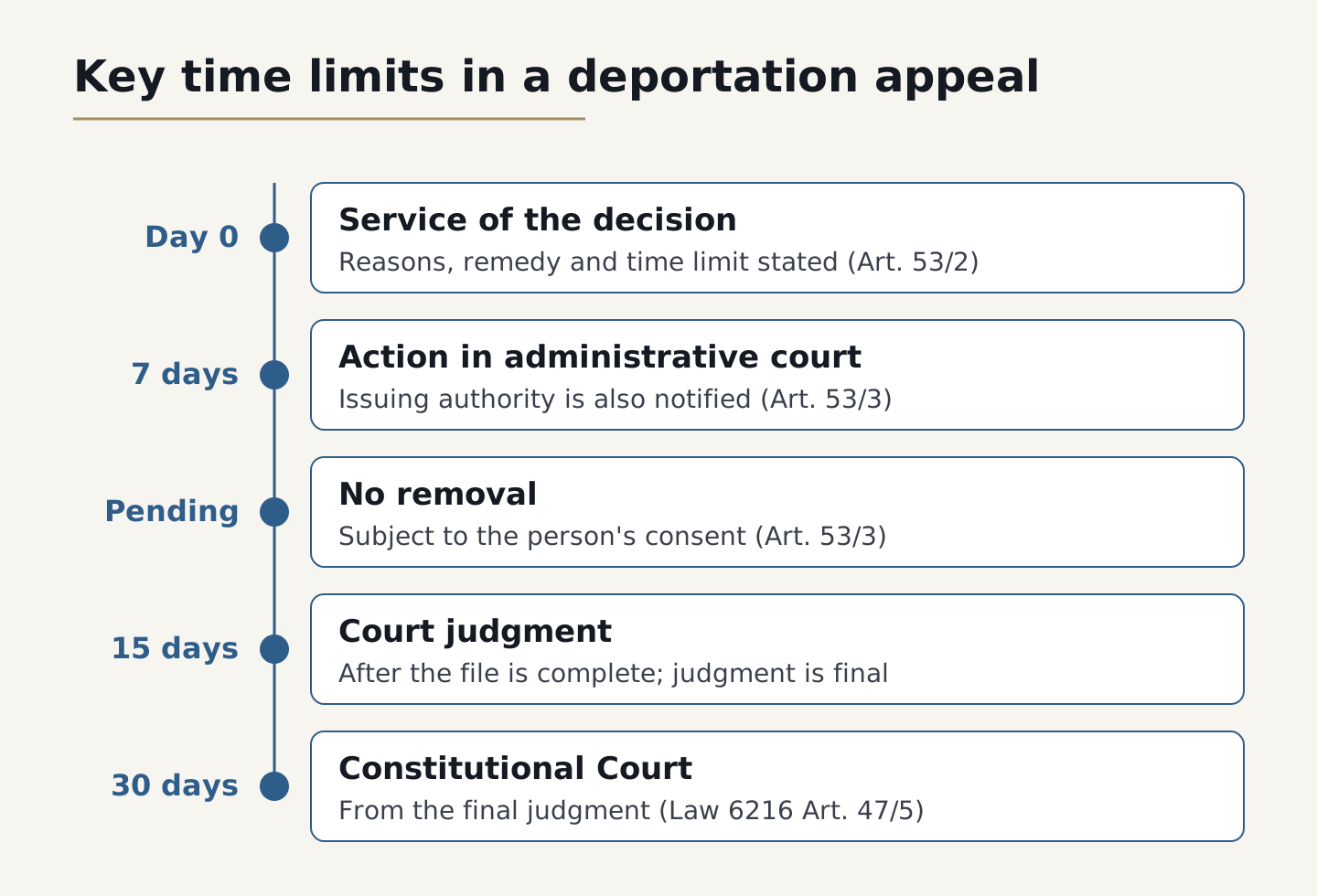
To appeal a deportation order in Türkiye, you must file an action before the administrative court within seven days of being served with the removal decision. During that seven-day period, and for as long as the case is pending, the foreign national cannot be removed unless they consent, and the court's judgment is final.
Because the time limit to appeal a deportation order is so short, you need to act from the moment of service. This guide explains when a removal decision (deportation order) may be issued, how the deadline is counted, the separate route against administrative detention, who is protected from removal and how an individual application to the Constitutional Court works.
What is a removal decision and who issues it?
A removal decision is an administrative decision ordering that a foreign national be sent to their country of origin, a transit country or a third country (Law No. 6458 on Foreigners and International Protection, Yabancılar ve Uluslararası Koruma Kanunu – YUKK, Art. 52). It is issued by the valilik (provincial governorship), either on the instruction of the Presidency of Migration Management or on its own initiative (YUKK Art. 53/1).
The decision, together with its reasons, must be served on the foreign national, their legal representative or their lawyer. A person who has no lawyer, or their legal representative, must also be told about the outcome of the decision, how to challenge it and the applicable time limits (YUKK Art. 53/2). As explained below, this information is critical for deciding when the deadline actually starts.
When can a deportation order be issued?
YUKK Art. 54/1 lists the categories of foreign nationals who may be removed; in practice, the most common grounds are overstaying a visa or residence permit, working without a permit and public order concerns. Knowing which sub-paragraph your decision relies on tells you exactly what your statement of claim has to rebut.
- Overstaying a visa or visa exemption by more than ten days, or having a visa cancelled (Art. 54/1-e).
- Having a residence permit cancelled, or overstaying an expired permit by more than ten days without an acceptable reason (Art. 54/1-f, g).
- Being found working without a work permit (Art. 54/1-ğ).
- Using false information or forged documents in entry, visa or residence procedures (Art. 54/1-c).
- Being assessed as a threat to public order, public security or public health (Art. 54/1-d).
- Failing to leave within ten days after a residence permit renewal is refused (Art. 54/1-j).
People whose international protection application is rejected or whose status ends also fall under Art. 54/1-i if they have no other right to stay in Türkiye. Under sub-paragraphs (b), (d) and (k), which concern links to terrorist organisations or threats to public order, a removal decision may be taken at any stage of international protection proceedings (Art. 54/2).
A refused residence permit application or renewal is often the first step towards removal. For the options at that stage, see our article on challenging a residence permit refusal.
What is the deadline to appeal a deportation order?
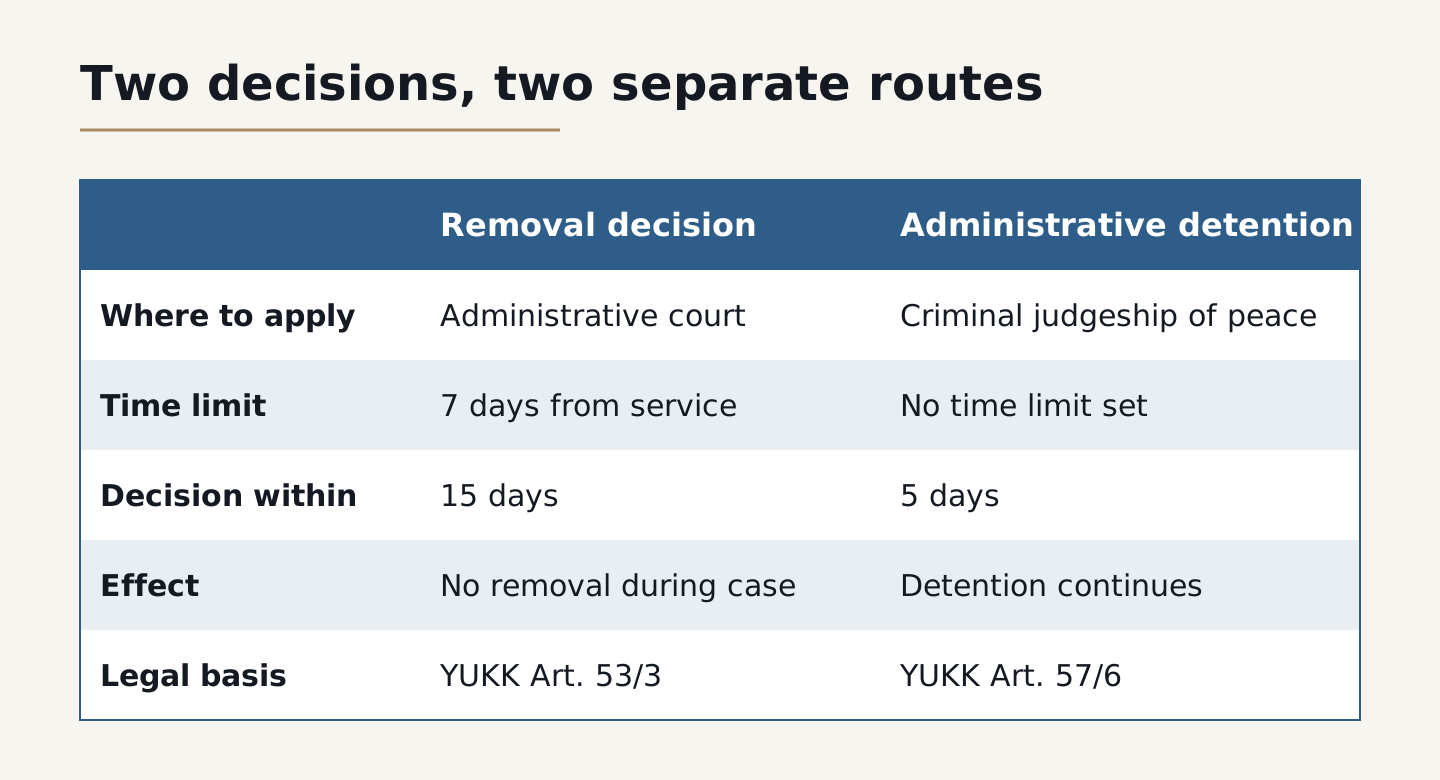
The time limit for filing an action is seven days from service of the decision. YUKK Art. 53/3 reads: "The foreigner, or their legal representative or lawyer, may appeal against the removal decision to the administrative court within seven days from the notification of the decision."
This is a preclusive (forfeiture) period: an action filed late is dismissed without any review of the merits. The person who files must also notify the authority that issued the decision, namely the relevant governorship. If that notice is not given, the authorities may learn of the case late, which can create real risks in practice.
The paragraph was last amended by Art. 36 of Law No. 7533 of 21 November 2024. Under the amendment, the case file is deemed complete once the defence is submitted or the time for it expires, holding a hearing is at the court's discretion, and if notification cannot be served at the address given by the claimant, the period in Art. 26/3 of Law No. 2577 on Administrative Procedure (İdari Yargılama Usulü Kanunu – İYUK) applies as two months.
What should the statement of claim include?
When you appeal a deportation order, the core of the statement of claim should be that the YUKK Art. 54 ground relied on did not occur in your case, or that the decision is disproportionate. For example, where removal is based on a visa overstay, you can contest how the overstay was calculated, or rely on an acceptable excuse or a pending residence permit application, supported by documents.
Where the decision rests on public order or public security, ask the court to order the administration to produce the specific information and documents on which that assessment was based. If the court decides without examining them, this may also matter at the later individual application stage.
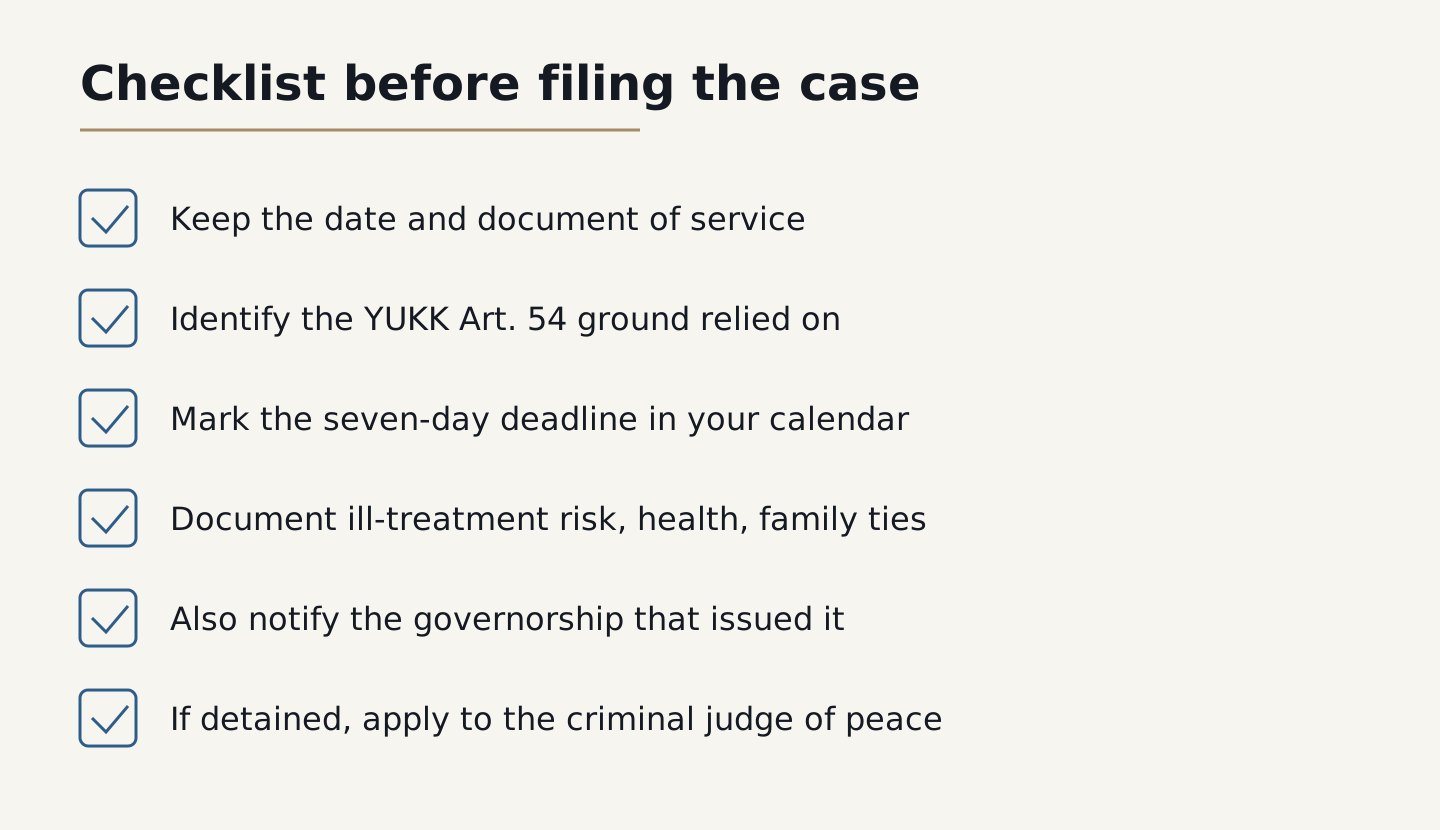
- The date of service and a copy of the service document.
- Objections to the legal provision and the facts relied on.
- Risks covered by YUKK Art. 55: country-of-origin reports and medical records.
- Family ties in Türkiye, the situation of a spouse and children, education and employment.
- Documents on any pending residence permit, work permit or international protection application.
Does filing a lawsuit stop the deportation?
Yes. Subject to the foreign national's own consent, they cannot be removed during the time limit for filing an action or, once a case is filed, until it is decided (YUKK Art. 53/3, last sentence). This protection applies automatically when the case is filed; there is no need to wait for a stay of execution order.
The court rules within fifteen days of the file being complete or, where an interim decision or hearing is needed, of those steps being completed. The administrative court's judgment on this point is final: there is no appeal to a regional court or the Council of State. That is why the statement of claim and all evidence should be submitted in full at the outset.
How do you challenge administrative detention?
Administrative detention (being held in a removal centre) is a decision separate from the removal decision, and it is challenged before the criminal judgeship of peace (YUKK Art. 57/6). The judge concludes the review within five days and the decision is final; however, a new application may be made if circumstances are said to have changed.
Applying to the judge does not, by itself, suspend detention.
Administrative detention in a removal centre may not exceed six months; where, for example, the foreign national does not cooperate, it may be extended by up to six more months (Art. 57/3). The governorship must review every month whether continued detention is necessary (Art. 57/4).
Instead of detention, the authorities may impose alternatives to administrative detention such as registering an address, reporting duties, a security deposit or electronic monitoring (YUKK Art. 57/A). These obligations may not last longer than twenty-four months in total, and electronic monitoring can also be challenged before the criminal judgeship of peace.
Who cannot be deported from Türkiye?
YUKK Art. 55 provides that certain people may not be made subject to a removal decision even if they fall under Art. 54. Each case is assessed individually, and these people may be required to live at a specified address or to report to the authorities.
- People for whom there are serious indications that they would face the death penalty, torture or inhuman or degrading treatment in the receiving country.
- People for whom travel is considered risky because of serious health problems, age or pregnancy.
- People receiving treatment for a life-threatening illness that is unavailable in the receiving country.
- Victims of human trafficking who are benefiting from the victim support process.
- Victims of psychological, physical or sexual violence, until their treatment is completed.
So the statement of claim should address not only the facts behind the decision but also any risks covered by Art. 55, and these must be documented. Medical reports, up-to-date reports on the country of origin and evidence of family ties become important at this stage.
Does the deadline run if service was defective?
If the notification did not genuinely inform the foreign national, holding the time limit against them becomes open to challenge. The Constitutional Court has found a violation of the right to an effective remedy where the case of an applicant who could not read or write, and for whom no interpreter's assistance was recorded, was dismissed as out of time.
By contrast, the outcome differs where the information was given properly. In a case where the decision was served in a language the foreign national understood, the remedy and time limit were clearly stated and the person signed the document, the Constitutional Court did not regard the dismissal of a late action as a violation.
What if the administrative court rejects the case?
Because the administrative court's judgment is final, there is no ordinary appeal; the next step is an individual application to the Constitutional Court. It must be lodged within thirty days of exhausting legal remedies (Law No. 6216, Art. 47/5).
The Constitutional Court may, of its own motion or on request, order the interim measures it considers necessary to protect the applicant's fundamental rights (Law No. 6216, Art. 49/5). If removal would expose the applicant to a serious and irreparable risk, a reasoned and documented request for an interim measure should be submitted together with the application.
Is there an entry ban after deportation?
As a rule, yes: foreign nationals removed from Türkiye are banned from re-entering by the Presidency of Migration Management or the governorships (YUKK Art. 9/2). An entry ban lasts up to five years; where there is a serious threat to public order or public security, it may be extended by up to ten more years (Art. 9/3).
No entry ban need be imposed on people who are invited to leave Türkiye and do so within the period given to them (Art. 9/5). That period is between fifteen and thirty days, but it is not granted where there is a risk of absconding, use of forged documents or a public order concern (Art. 56/1).
An entry ban is not necessarily permanent or unchangeable. Under YUKK Art. 9/6, the Presidency of Migration Management may lift an entry ban or, while keeping it, allow the person to enter Türkiye for a set period; this possibility deserves separate attention for foreign nationals with a spouse or children in Türkiye.
For readers from the United States or the United Kingdom: Türkiye, the US and the UK are all parties to the 1961 Hague Apostille Convention, so evidence issued in either country – such as a marriage or birth certificate proving family ties in Türkiye – is generally accepted with an apostille instead of consular legalisation. In the US, state-issued records are apostilled by that state's Secretary of State and federal documents by the US Department of State; in the UK, apostilles are issued by the FCDO Legalisation Office. Because the deadline is only seven days, start gathering these documents and their sworn Turkish translations immediately.
What are the most common mistakes?
When people appeal a deportation order, most mistakes come from missing the deadline or confusing the two separate decisions. The following errors cause the most lost rights in practice:
- Counting the seven days from when you learned of the decision instead of from the date of service.
- Challenging only administrative detention and not suing against the removal decision itself.
- Not notifying the governorship that issued the decision that a case has been filed.
- Leaving out evidence of risks in the receiving country, health problems or family ties.
- Not keeping a copy of the service document or not having the presence of an interpreter recorded.
- Missing the thirty-day deadline for an individual application after the court's judgment.
If you appeal a deportation order, it is also worth reviewing your residence status; for possible options, see our guide to residence permit types in Türkiye. For the general framework of immigration law, review our immigration law practice area; for specific questions, reach us via the Contact page. This article is for general information only and is not a substitute for legal advice.