
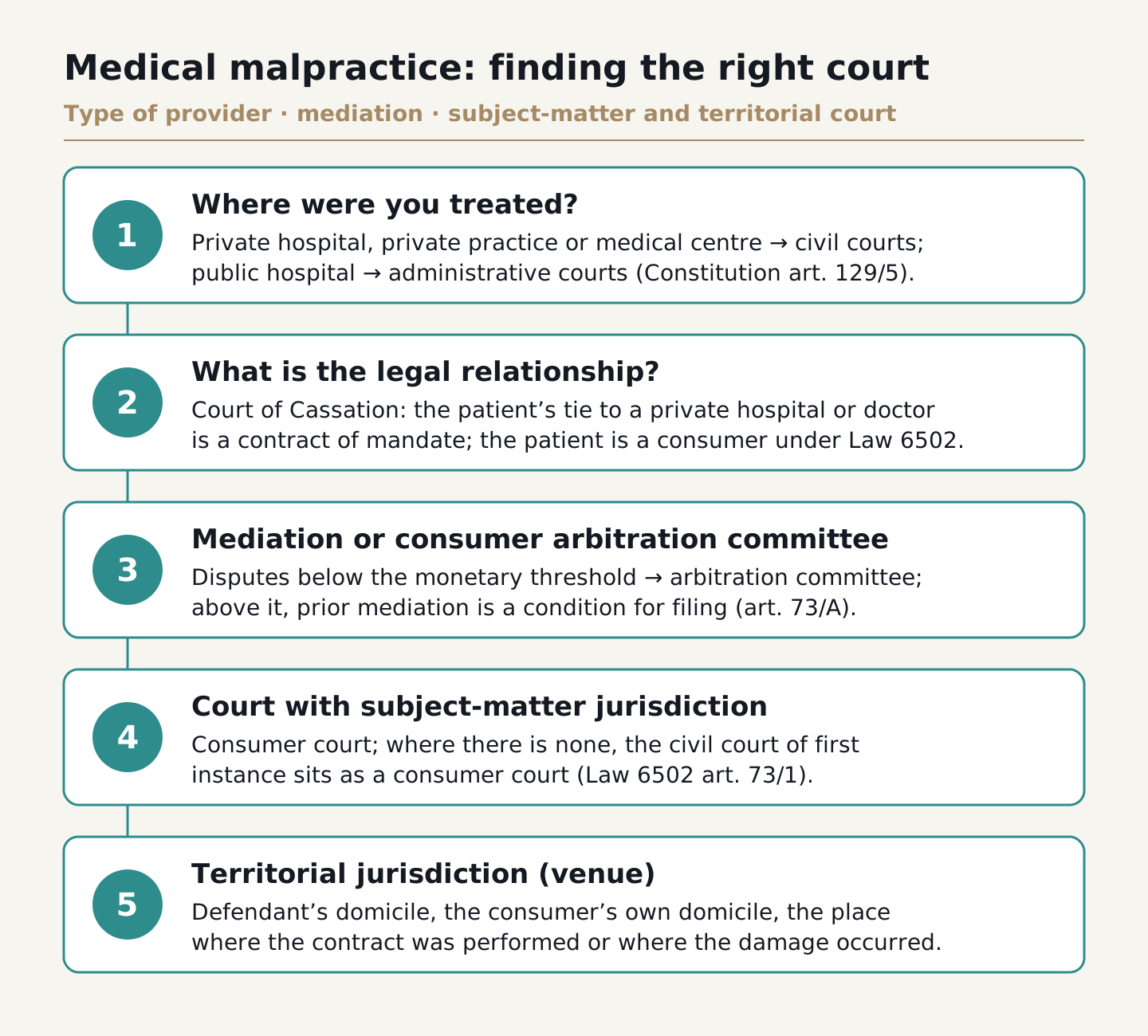
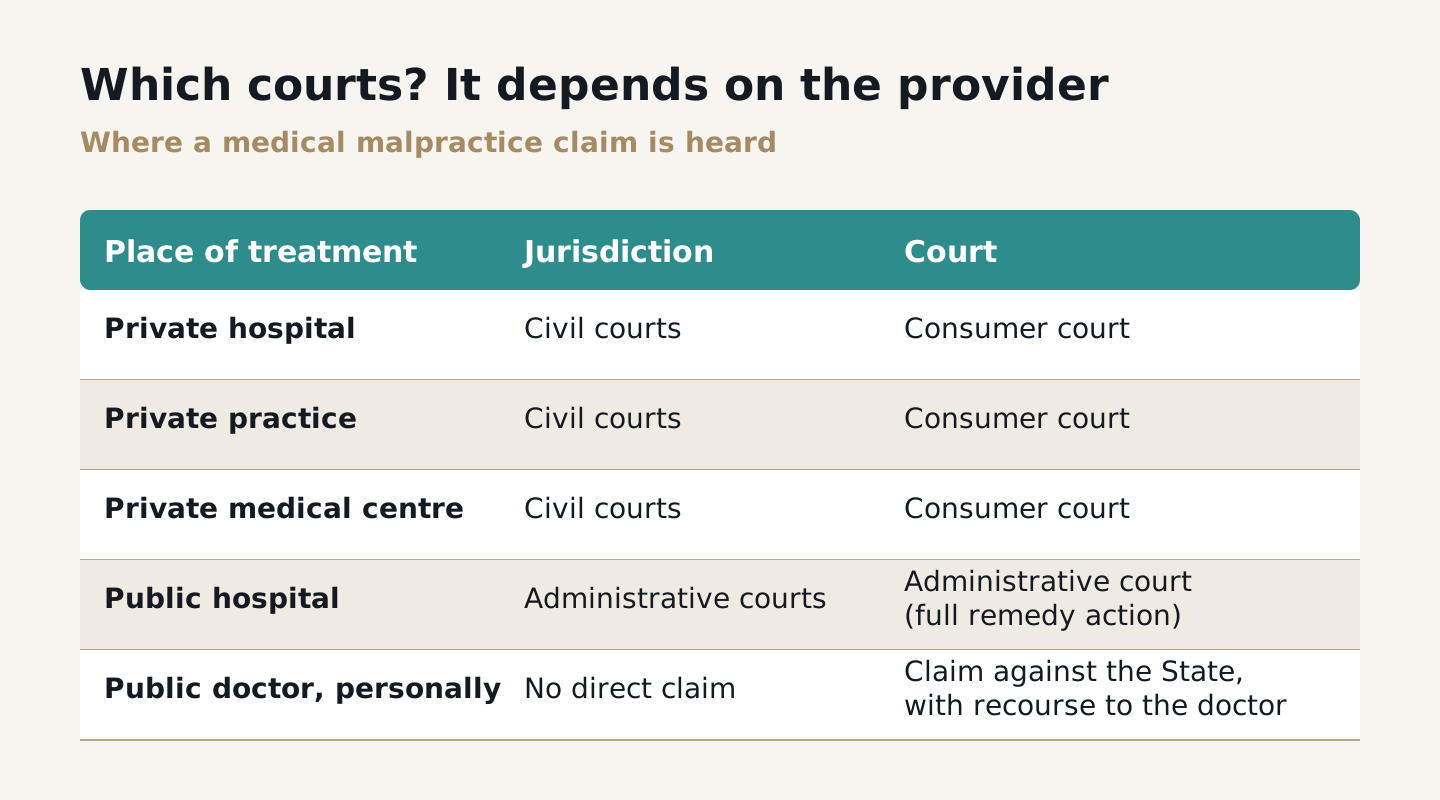
A medical malpractice lawsuit against a private hospital in Turkey must, as a rule, be filed with the consumer court (tüketici mahkemesi). The Court of Cassation (Yargıtay) classifies the relationship between a patient and a private hospital or doctor as a contract of mandate (vekâlet sözleşmesi), and it holds that such claims, when filed after the Consumer Protection Law No. 6502 (6502 sayılı Tüketicinin Korunması Hakkında Kanun) took effect, belong before the consumer courts.
Picking the wrong court can end in a dismissal for lack of jurisdiction before the merits are even looked at, and months can be lost. Below we explain how private hospitals, private practices and public hospitals are treated differently, why mediation is required before filing, and how to choose the venue. For the overall course of a case, including evidence and expert reports, see our guide on how to bring a medical malpractice lawsuit.
Which court hears a medical malpractice lawsuit against a private hospital?
The consumer court has subject-matter jurisdiction over a medical malpractice lawsuit against a private hospital or a doctor in private practice. Under Law No. 6502, art. 73/1, consumer courts hear disputes arising from consumer transactions and from practices aimed at consumers. Article 3 of the same Law expressly brings contracts of mandate within the definition of a consumer transaction.
The 3rd Civil Chamber of the Court of Cassation repeatedly states that the patient’s relationship with a private hospital and doctor is a contract of mandate, and that consumer courts have jurisdiction over cases filed after 28 May 2014. The patient acts for non-commercial, non-professional purposes and is therefore a consumer, while the hospital and the doctor offer a professional service and qualify as providers.
What if there is no consumer court in the area?
Where no separate consumer court exists, the case is filed with the civil court of first instance (asliye hukuk mahkemesi), which then hears it sitting as a consumer court. According to the Court of Cassation, the court must record this capacity in an interim decision; handling the file as an ordinary civil court is a ground for reversal. The point may look like a formality, yet it affects both the procedure and the routes of appeal.
Does the same rule apply to private practices and medical centres?
Yes. The consumer court’s jurisdiction rests on the health service being provided for commercial or professional purposes, not on the size of the facility. A self-employed doctor in a private medical practice (muayenehane), a private medical centre, an outpatient clinic or a dental clinic is equally a provider within the meaning of Law No. 6502. A medical malpractice lawsuit against them therefore also goes, as a rule, to the consumer court.
The Court of Cassation also accepts that a consumer transaction is not limited to the medical intervention itself. In one case, patients were hurt when the lift fell inside a medical centre they had visited for treatment; the Court found that their relationship with the centre was a consumer transaction and that the consumer court should hear the claim. Harm suffered while using the services of a healthcare facility can thus be treated, quite broadly, as a consumer dispute.
Where is the case filed if there are several defendants?
Some defendants may fall under the consumer court and others under the general civil court, for instance where a hospital, a doctor and a maintenance company are all held liable. Under the settled view cited by the Court of Cassation, a claim belonging to a specialised court cannot be joined to another claim before a general court. The reverse is possible: a claim within the specialised court’s remit and one within the civil court of first instance can be brought together before the specialised court.
Why does the jurisdiction rule matter so much?
Rules on subject-matter jurisdiction are a matter of public order, so the court must check them of its own motion at every stage. Under art. 1 of the Code of Civil Procedure (Hukuk Muhakemeleri Kanunu, HMK), the jurisdiction of courts can be set only by statute and the related rules are of public order. The Court of Cassation also holds that no vested right can arise on this issue, meaning that a judgment given by the wrong court may be reversed for that reason alone.
If the court declines jurisdiction, one of the parties must, under HMK art. 20, apply to that court within two weeks after the decision becomes final and ask for the file to be sent to the competent court. Miss this deadline and the case is deemed never to have been filed. Together with limitation periods, this can lead to losses that are hard to undo; for the time limits, read our article on malpractice compensation and limitation periods.
Is mediation mandatory before you file?
Yes. For a medical malpractice lawsuit that belongs before the consumer court, applying to a mediator first is a procedural precondition for filing. Law No. 6502, art. 73/A makes mediation mandatory for disputes heard by consumer courts, although disputes within the remit of consumer arbitration committees (tüketici hakem heyeti) are excluded. If no settlement is reached, the claim may then be brought in court.
For disputes worth less than the monetary threshold set by the Law, an application to the consumer arbitration committee is mandatory instead (Law No. 6502, art. 68/1). Because the threshold is revalued every year, confirm the figure in force on your application date from the announcements of the Ministry of Trade. Claims for pecuniary and non-pecuniary damages after a medical error usually exceed it, so in practice mediation is the route that most often applies.
- The mediation application is made to the mediation office where the defendant hospital and doctor are located or where the competent court sits
- State the subject and the amount of the claim clearly in the application
- Attach the original or a certified copy of the final mediation report recording that no agreement was reached to the statement of claim
- Having the medical records to hand during mediation makes the negotiations easier
Which court hears claims over errors at a public hospital?
For medical errors at a public hospital, the claim is brought against the administration, not the doctor, and before the administrative courts. Under art. 129/5 of the Constitution (Anayasa), damages claims arising from faults that civil servants and other public officials commit while exercising their powers may be brought only against the administration, which may then seek recourse from the official. Treatment at a state hospital or a public university hospital therefore leads to a full remedy action (tam yargı davası, a claim asking the administration to compensate the loss) before the administrative court.
This private/public divide changes the time limits, the application procedure and who the defendant is. For the public hospital route, see our article on service fault claims against public hospitals.
Can the doctor working at a private hospital be sued as well?
A patient treated at a private hospital can, as a rule, name both the hospital and the treating doctor as defendants. In many of the files reviewed by the Court of Cassation, the hospital and the doctor were sued together and the relationship was treated as mandate in respect of both. Their respective shares of liability are then set on the basis of the expert reports obtained during the proceedings.
How should you prepare before filing?
Even a case filed in the right court can be weakened if evidence is not gathered in time. The assessment of jurisdiction and venue should therefore go hand in hand with collecting evidence. Before filing, patients or their relatives should try to obtain the following:
- Discharge summary (epikriz), surgical notes and nursing observation records
- Laboratory, imaging and pathology results
- Signed informed consent forms and patient information documents
- Invoices, payment receipts and the cost of any later treatment
- Reports from doctors who treated you afterwards and certificates of incapacity for work
If evidence may be lost or become much harder to present, a preliminary preservation of evidence (delil tespiti) can be requested even before the case is filed. Under HMK art. 400, a party may ask for an on-site inspection, an expert examination or the hearing of witnesses to record a fact it will rely on in a future case, provided it has a legal interest in doing so. This step is worth considering where there are concerns that medical records might be altered or handed over incomplete.
If you live in the United States or the United Kingdom and are weighing a claim over treatment at a private hospital in Turkey, papers produced at home, such as a power of attorney signed before a local notary or reports from doctors who saw you later, need to be authenticated for use in Turkey. Turkey, the UK and the US are all parties to the 1961 Hague Apostille Convention, so an apostille takes the place of consular legalisation. In the UK, apostilles are issued by the Legalisation Office of the Foreign, Commonwealth & Development Office. In the US, documents issued in a state, including notarised papers, are apostilled by that state’s competent authority (usually the Secretary of State), while federal documents go to the Department of State’s Office of Authentications.
Which court has territorial jurisdiction?
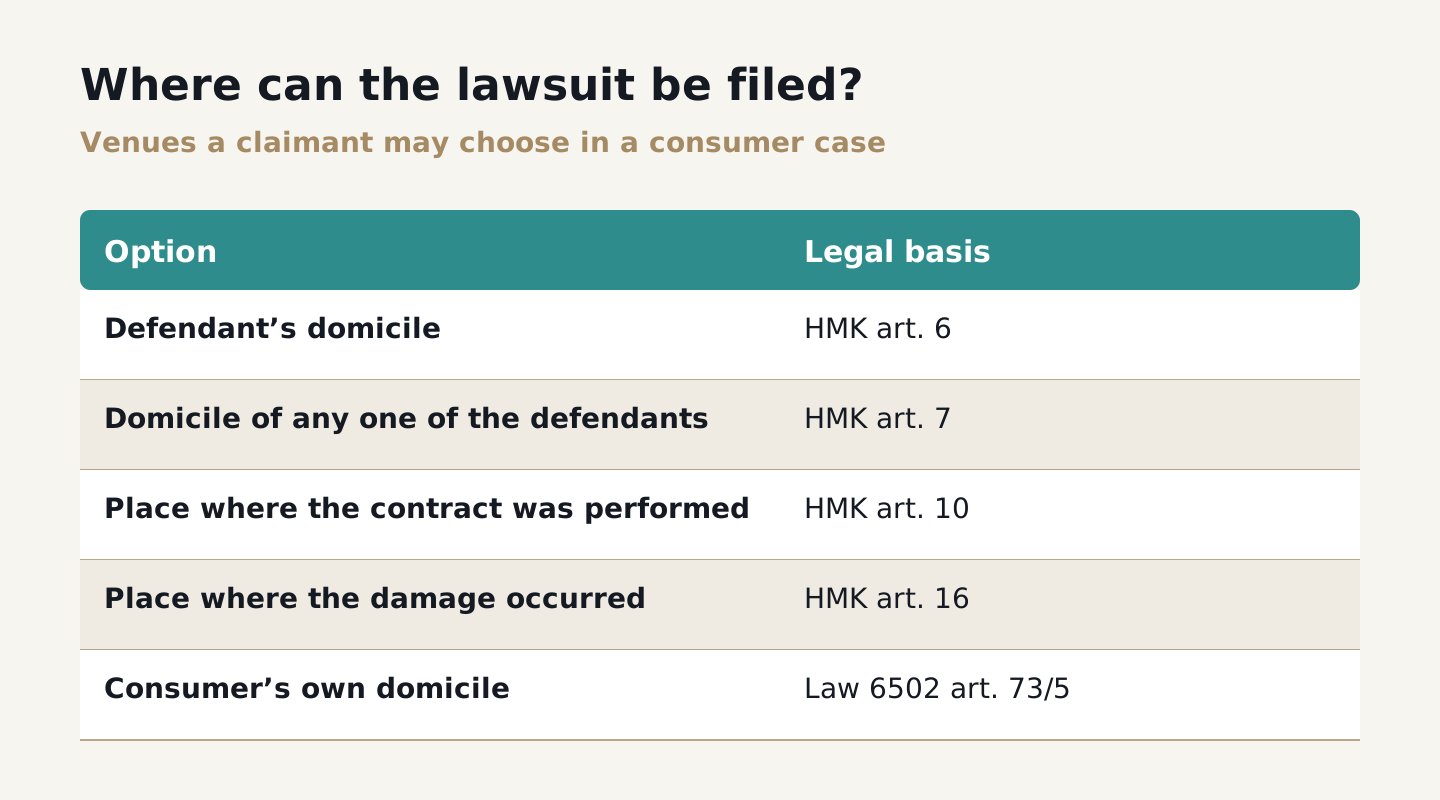
Territorial jurisdiction decides the city in which the case is heard, and in a medical malpractice lawsuit the claimant has several options. Under HMK art. 6, the general venue is the court of the defendant’s domicile; with several defendants, the case may be filed at the domicile of any one of them (HMK art. 7). The place where the contract is to be performed (HMK art. 10) and, for torts, the place where the damage occurred (HMK art. 16) are also competent.
Law No. 6502, art. 73/5 additionally lets the consumer sue before the consumer court of their own domicile. This option is especially useful for patients who travelled to another city for treatment. Where territorial jurisdiction is not exclusive, the defendant must raise any objection in the statement of defence; otherwise the court in which the case was filed becomes competent (HMK art. 19).
How does a medical malpractice lawsuit proceed in the consumer court?
Once filed, a medical malpractice lawsuit in the consumer court moves through preliminary examination, the gathering of evidence, expert examination and judgment. Under Law No. 6502, art. 73/4, consumer court cases follow Part Six of the HMK, that is, the simplified trial procedure. Under HMK art. 317, the defendant has two weeks from service of the statement of claim to file a statement of defence, and no reply or rejoinder is allowed. Every allegation and item of evidence should therefore be set out fully and carefully in the statement of claim, to avoid gaps that are hard to fill later.
The outcome of a malpractice case often turns on the expert report. The court asks medical experts whether the doctor and the hospital met the standard of care required by medical science and whether there is a causal link between the intervention and the harm. The parties may file reasoned objections to the report and request a supplementary report or one from a new panel.
The first-instance judgment can be challenged by an appeal on facts and law (istinaf) before the regional court of appeal and, where the conditions are met, by an appeal on points of law (temyiz) before the Court of Cassation. Because a jurisdiction error is examined of the courts’ own motion at these stages too, filing in the correct court from the outset keeps years of proceedings from being wasted. For more on the expert process and heads of damages, see our related articles.
Common procedural mistakes in malpractice cases
Procedural slips can get even a well-founded claim dismissed without any look at the merits. The most common mistakes in practice are:
- Suing a private hospital before the civil court of first instance without the court acting as a consumer court
- Suing a public hospital doctor personally in the ordinary courts
- Filing without first going through mandatory mediation
- Missing the two-week deadline to ask for the file to be transferred after a decision of lack of jurisdiction
- Not obtaining the medical records and discharge summary before filing
- Losing sight of limitation periods while procedural issues are being argued
Our article on patient rights and informed consent can help you prepare, including access to medical records and patient complaint routes. This article is for general information only and does not replace legal advice. You can review our scope of services on the Health Law page or reach us via the Contact page.