
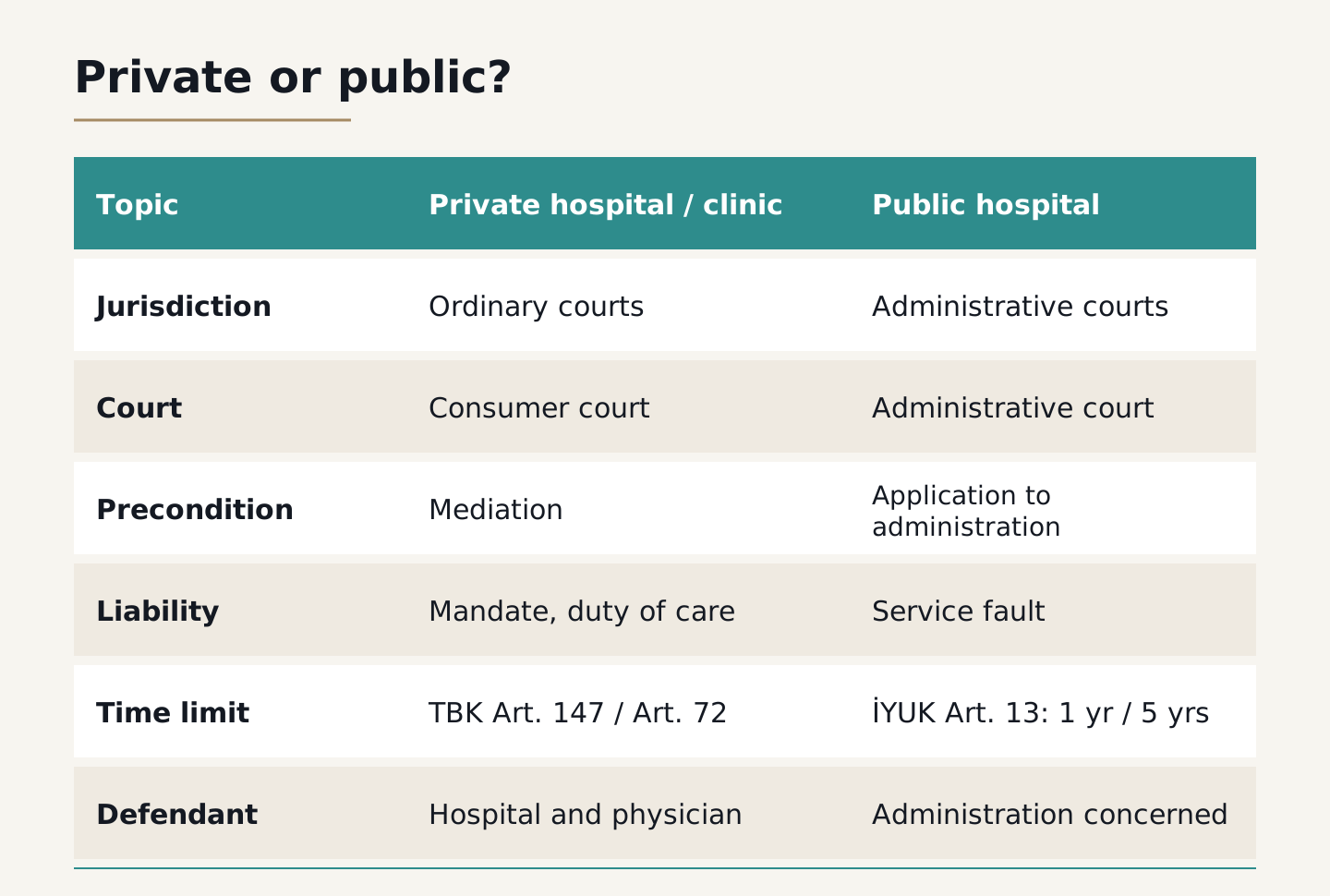
A medical malpractice lawsuit in Türkiye is filed in the consumer court if the treatment took place at a private hospital or clinic, and in the administrative court if it took place at a public hospital. Before suing a private provider you must go to mediation, and before suing a public hospital you must first apply to the administration concerned; in most cases the outcome turns on the medical records and the court-appointed expert's report.
Medical malpractice (tıbbi hata) means harm suffered by a patient because a physician or healthcare provider did not exercise the care and diligence required by medical science. Not every poor outcome is an error, so the central question in any case is whether the treatment met medical standards. This article provides general information and is not a substitute for legal advice on a specific situation.
Is every complication a medical error?
No. A complication is a known risk of a medical procedure that can occur even when everything is done with due care, and it is not an error in itself. An error is a failure to exercise the care required by medical science at some stage of diagnosis, treatment, monitoring or informing the patient. The line between the two directly shapes the outcome of the case.
The situations most often disputed in practice are delayed or wrong diagnosis, unnecessary surgery or surgery using the wrong method, inadequate post-operative monitoring, failure to take infection precautions, and failure to inform the patient properly. The question is always the same: what would a careful physician have done in the same circumstances?
Which court hears a medical malpractice lawsuit?
The competent court depends on who provided the healthcare. Under Court of Cassation (Yargıtay) case law, the relationship between a patient and a private provider, such as a private hospital, private clinic or private medical practice (muayenehane), is a consumer transaction, so the case is heard by the consumer court (tüketici mahkemesi). For public healthcare providers such as state hospitals, the harm is assessed as a service fault of the administration, and a full remedy action (tam yargı davası) is brought in the administrative court (idare mahkemesi).
Consumer cases may also be filed at the consumer court where the consumer is domiciled (Consumer Protection Law No. 6502 (Tüketicinin Korunması Hakkında Kanun), Art. 73/5). This rule matters for patients who were treated in another city. Because rules on subject-matter and territorial jurisdiction may be matters of public order, filing in the wrong court costs valuable time.
Which applications are mandatory before filing?
For claims against private providers, applying to a mediator is a mandatory precondition for disputes heard by the consumer court (Law No. 6502, Art. 73/A). If no settlement is reached, the case is filed together with the final mediation report. A case filed without first going to mediation may be dismissed for failure to meet a procedural precondition.
For public hospitals, you must first apply to the administration concerned and ask it to compensate the harm before filing an administrative case. This application must be made within one year of learning of the act and, in any event, within five years of the act itself (Administrative Procedure Law No. 2577 (İdari Yargılama Usulü Kanunu, İYUK), Art. 13). If the request is rejected or left unanswered for thirty days, the case is brought in the administrative court within the time limit for filing an action.
Unless a specific law sets a different period, the time limit for filing in the administrative courts is sixty days, running from the day after written notification in administrative disputes (İYUK Art. 7). For this reason, record the date on which the rejection was served, or the date on which the thirty-day response period expired. Setting out the events, each item of loss and the amount claimed clearly in the application to the administration also frames the later lawsuit.
What evidence matters in a medical malpractice lawsuit?
The most important evidence is the complete set of medical records showing the course of treatment. Patients may inspect the file and records on their health, directly or through a representative or legal guardian, and obtain a copy (Patient Rights Regulation (Hasta Hakları Yönetmeliği), Art. 16). Requesting the full records is therefore the first step in preparing a medical malpractice lawsuit.
- Patient file, outpatient and ward records, and nursing observation charts.
- Operation notes, anaesthesia record and discharge summary (epikriz).
- Informed consent forms.
- Laboratory results, radiology images and reports.
- Invoices, prescriptions and payment records; reports from later treatment.
- Any correspondence, messages, appointment records and witness details.
Obtain copies as early as possible, in case the originals are altered or lost. Keeping a record of every application with its date and reference number helps both with calculating time limits and with proving your case.
Why does informed consent matter?
Courts separately examine whether the patient was told about the risks, alternatives and possible complications before the procedure. In cases reviewed by the Court of Cassation, a document showing that the patient had been informed in detail about a complication before surgery was taken into account when assessing fault. The content of the consent form and the date it was signed therefore deserve close attention.
Also note when and by which department the records were handed over. You can reapply for missing documents, and once the case is filed you can ask the court to order the provider to produce them.
What fault are the physician and hospital liable for?
In a private law relationship, the relationship between physician and patient is classified as a contract of mandate (vekâlet sözleşmesi). The agent must carry out the work faithfully and with care, measured against how a prudent agent providing similar services would act (Turkish Code of Obligations No. 6098 (Türk Borçlar Kanunu, TBK), Art. 506). A physician does not promise a successful outcome, but is liable for any lack of care in the effort made to achieve it.
According to the Court of Cassation, a physician must identify the patient's condition in time, take all necessary precautions and apply the appropriate treatment without delay. The same principles apply to the healthcare facility that employs the physician. In public hospitals, the administration is liable under the service fault principle for harm caused by the service not being run as it should.
Who bears the burden of proof?
In contract-based claims, where an obligation has not been performed at all or not performed properly, the obligor must compensate the loss unless it proves that it bears no fault whatsoever (TBK Art. 112). The patient shows that the treatment was not carried out properly and proves the harm. The physician and the hospital may then have to prove that they were not at fault.
How does the expert examination work?
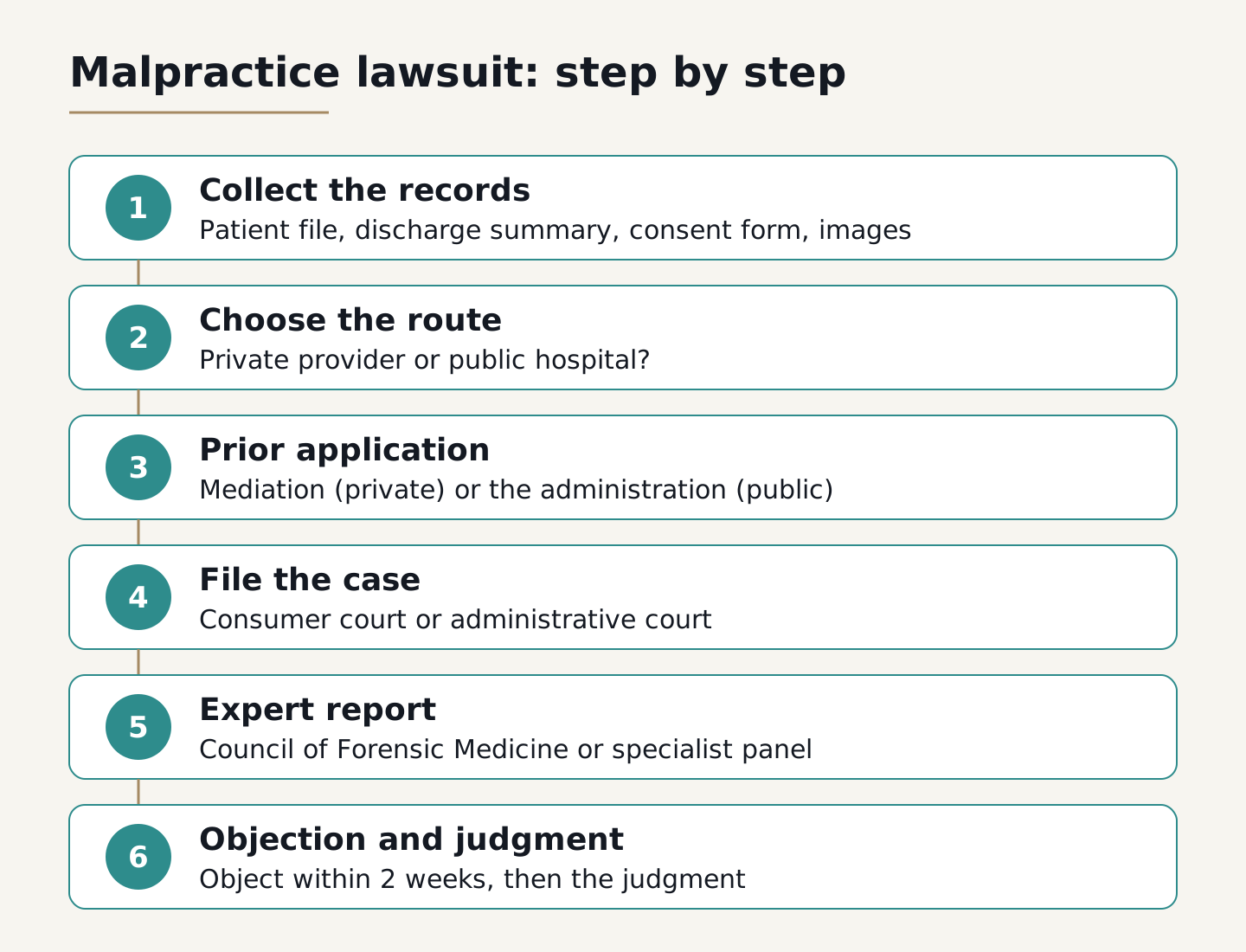
Because a claim of medical error requires specialist technical knowledge, the court obtains an expert opinion at the request of a party or on its own motion (Code of Civil Procedure No. 6100 (Hukuk Muhakemeleri Kanunu, HMK), Art. 266). In practice, the file is usually sent to the Council of Forensic Medicine (Adli Tıp Kurumu); in some cases a report is also obtained from a panel of physicians specialising in the relevant field. The report explains whether the treatment complied with accepted medical rules and, if there was fault, to whom it is attributable.
Objecting to the expert report
Within two weeks of being served with the report, the parties may ask the court to complete missing points, clarify ambiguities or appoint a new expert (HMK Art. 281/1). If preparing the request within this period is very difficult, an additional period of up to two weeks may be granted once, provided the request is made within the same period.
If it considers it necessary, the court may obtain a supplementary report, hear the expert at a hearing or have a new expert examine the case. Where reports contradict one another, resolving the conflict is decisive for the basis of the judgment. That is why an objection should refer specifically to medical literature and to the documents in the file.
What is the time limit for a medical malpractice lawsuit?
For contract-based claims against private providers, receivables arising from a contract of mandate are subject to a five-year limitation period (TBK Art. 147/5). For tort-based claims, the period is two years from the date the claimant learned of the harm and of the person liable, and in any event ten years from the act (TBK Art. 72).
If the act also constitutes a crime for which criminal law sets a longer limitation period, that longer period applies. When these periods start to run may also be disputed, depending on when the harm emerged and when the liable party became known.
For public hospitals, the one-year and five-year periods for applying to the administration described above apply. Since the applicable period depends on the nature of the case, the safe approach is to track deadlines on the basis of the shortest possible period.
Situation | Time limit | Legal basis |
|---|---|---|
Claim based on contract of mandate | 5 years | TBK m. 147/5 |
Claim based on tort | 2 years from knowledge, 10 years at most | TBK m. 72 |
Public hospital: application to the administration | 1 year from knowledge, 5 years at most | İYUK m. 13 |
Objection to the expert report | 2 weeks from service | HMK m. 281/1 |
What compensation can be claimed?
In a medical malpractice lawsuit, you can claim pecuniary and non-pecuniary damages. Pecuniary damages may cover treatment costs, loss of working capacity and loss of earnings, and in the event of death, loss of support for dependants. Non-pecuniary damages are an amount set at the judge's discretion for the pain and suffering endured.
Rights of relatives in the event of death
If the patient dies, relatives may claim funeral costs, treatment costs and loss of working capacity if death did not occur immediately, and the losses of those deprived of the deceased's support (TBK Art. 53). In cases of serious bodily harm or death, the court may also award non-pecuniary damages to the relatives of the injured or deceased person (TBK Art. 56).
The calculation is based on the degree of fault and the disability rating set out in the expert report. Because the amounts depend on concrete factors such as age, income and whether the harm is permanent, no precise figure can be given in advance.
Step by step: preparing a medical malpractice lawsuit
- Establish whether the facility that treated you is private or public.
- Request copies of the patient file and all medical records in writing.
- Record the date of the incident, the date you learned of the harm and every application date.
- Apply to a mediator for private providers, or to the administration concerned for public hospitals.
- Keep reports and receipts for all subsequent treatment.
- Track the date the expert report is served so you do not miss the two-week objection period.
Common mistakes
- Following the public hospital rules for a private hospital, or the other way round, and filing in the wrong branch of the judiciary.
- Going straight to the consumer court without first applying to a mediator.
- Suing a public hospital without applying to the administration, or after missing the one-year application period.
- Requesting only part of the medical records and leaving out the operation notes, anaesthesia record and images.
- Objecting to the expert report in general terms, without concrete medical reasons and supporting documents.
- Failing to document later treatment costs and the period of incapacity for work.
New treatment, follow-up examinations and reports may arise while the case is ongoing. Filing these documents regularly helps the expert assess the extent and permanence of the harm accurately. Since the disability rating can often be determined only after treatment ends, keep dated records of your recovery.
If you travelled from the US or the UK for treatment, some evidence, such as reports from doctors who treated you back home, will be issued abroad; under the Regulation on International Health Tourism and Tourist Health (Uluslararası Sağlık Turizmi ve Turistin Sağlığı Hakkında Yönetmelik, Art. 12) you can ask the Turkish facility for your laboratory results and radiology images before leaving. Türkiye, the UK and the US are all parties to the Hague Apostille Convention, so public documents are authenticated with an apostille rather than consular legalisation: in the UK by the FCDO Legalisation Office, and in the US by the Secretary of State of the issuing state or, for federal documents, by the Department of State's Office of Authentications. English documents are generally filed with a Turkish translation by a sworn translator (yeminli tercüman); confirm the court's requirements in advance. If you will not be in Türkiye during the proceedings, a power of attorney for a lawyer can be signed at a Turkish consulate, which handles notarial matters abroad (Notary Law No. 1512 (Noterlik Kanunu), Art. 191), or before a local notary and then apostilled.
A medical malpractice lawsuit takes time and requires medical and legal assessment side by side. For information on health law matters, review our scope of services in health law; you can find our other articles on the our articles page, and for questions, visit our Contact page.