
Medical malpractice compensation in Türkiye means claiming pecuniary losses, such as treatment costs, lost earnings and loss of working capacity, together with non-pecuniary damages from the doctor, hospital or public administration that provided negligent care. The amount is calculated under Articles 53–56 of the Turkish Code of Obligations (Türk Borçlar Kanunu, TBK), and in most cases on the basis of a report by an actuarial expert (a specialist in insurance mathematics).
There is no single answer on time limits. The Court of Cassation (Yargıtay) treats the relationship between a patient and a private hospital or doctor as a contract of mandate (a service contract) and applies a five-year limitation period. For public hospitals, the patient must first apply to the administration and observe the deadlines in the Law on Administrative Procedure (İdari Yargılama Usulü Kanunu, İYUK).
Which damages can be claimed after medical malpractice?
Compensation falls into two main groups: pecuniary and non-pecuniary damages. Pecuniary damages cover concrete, measurable losses, while non-pecuniary damages are a sum set at the judge's discretion for pain, suffering and the decline in quality of life.
Pecuniary damages for bodily injury
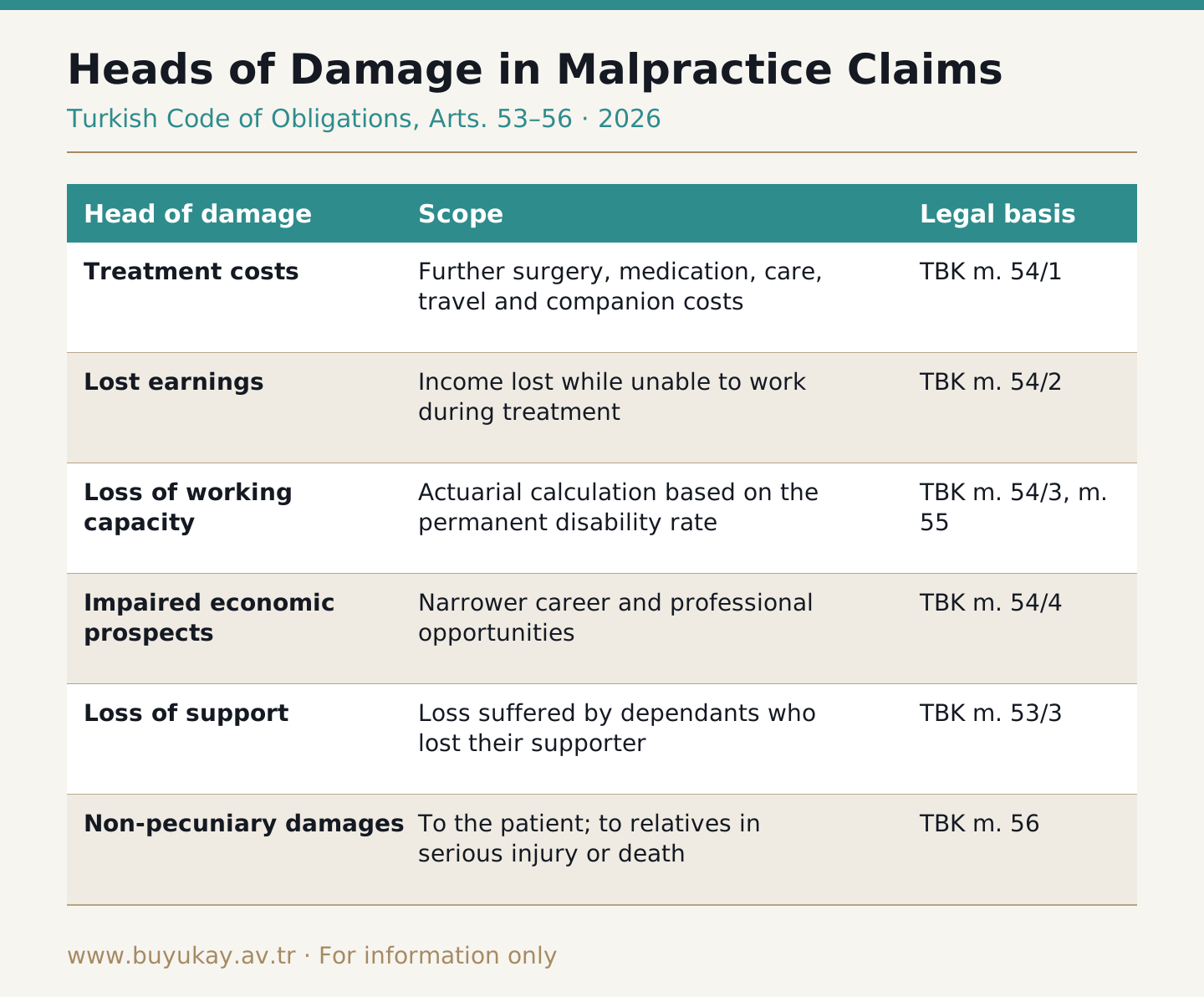
TBK m. 54 lists four categories of loss for bodily injury: treatment costs, lost earnings, losses arising from reduced or lost working capacity, and losses from the impairment of economic prospects. The list is not exhaustive; the word “in particular” shows that other losses of a similar nature can also be claimed.
- Corrective surgery, physiotherapy, medication and medical supplies
- Carer or companion costs and travel to and from hospital
- Wages or business income lost during treatment
- Future income lost because of permanent disability
- Damage to economic prospects, such as a forced career change or a setback in one's profession
What can be claimed if the patient dies?
If the patient dies as a result of malpractice, funeral costs, treatment costs and loss of working capacity (where death did not occur immediately) and the losses of those deprived of the deceased's support can be claimed (TBK m. 53). Compensation for loss of support is paid to the spouse, the children or other persons whom the deceased actually supported.
How are pecuniary damages calculated?
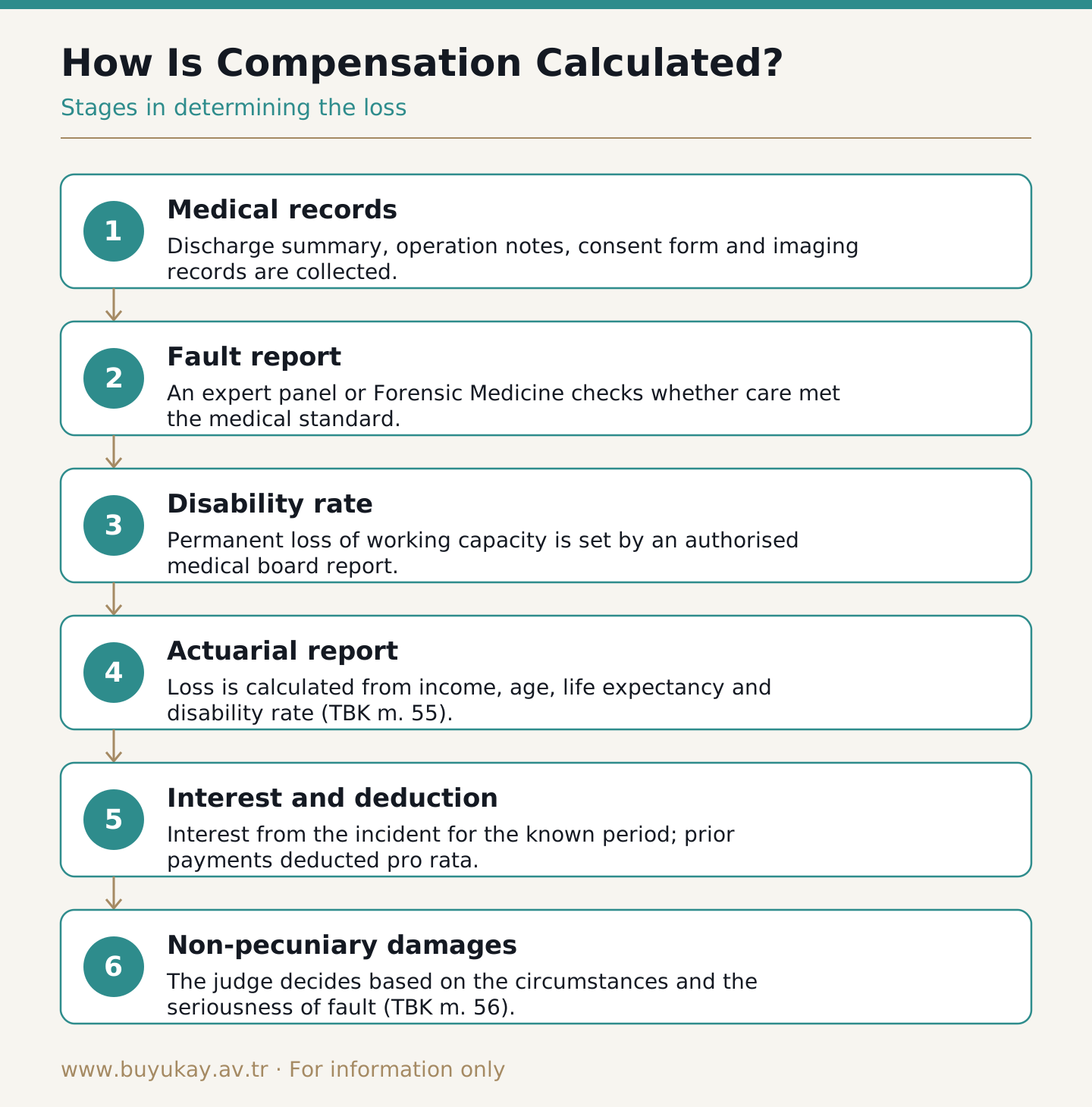
Pecuniary damages are calculated according to the TBK and the principles of liability law (TBK m. 55/1). The court first establishes whether there was fault in the medical intervention through a specialist expert panel or a report from the Council of Forensic Medicine (Adli Tıp Kurumu). It then has the permanent disability rate determined and refers the file to an actuarial expert.
The actuarial calculation takes into account the injured person's age, income, remaining life expectancy, working life and disability rate. Which life table and discount method should be used has been shaped by Court of Cassation case law, so it is worth checking separately whether the assumptions in the report follow current precedent.
Are social security payments deducted from compensation?
Social security payments that cannot be recovered, in whole or in part, and payments not made in performance of the debt cannot be deducted from the loss (TBK m. 55/1). The calculated compensation also cannot be increased or reduced on equitable grounds simply because of its amount.
Under a new paragraph added to TBK m. 55 by Law No. 7589 (Official Gazette, 31 July 2026), sums paid in performance of the debt before the evidentiary stage begins are deducted proportionally from the loss of working capacity and loss of support compensation, as calculated at the payment date. A partial payment made by an insurer before the lawsuit, for example, is taken into account in this way.
From when does interest run?
The same amendment provides that, for loss of working capacity and loss of support, statutory interest runs from the date of the harmful event on the amount relating to the period for which earnings are known, and from the judgment date on the amount relating to the period for which earnings are not known (TBK m. 55/3). Because the start date of interest significantly affects the total, it should be requested expressly in the statement of claim.
How is the amount of non-pecuniary damages determined?
A patient whose physical integrity has been harmed may claim an appropriate amount of non-pecuniary damages, set by the judge in light of the circumstances (TBK m. 56/1). In cases of serious bodily injury or death, the patient's or the deceased's relatives may also claim non-pecuniary damages (TBK m. 56/2).
Turkish law contains no fixed scale for non-pecuniary damages. The judge weighs the seriousness of the fault, the permanence of the harm, the parties' financial situation and the purchasing power of money together (TBK m. 51). As a result, awards can differ even in cases that look similar, and an exact figure cannot be predicted.
Concrete evidence of how the harm affects daily life carries weight in a non-pecuniary claim. Supporting consequences such as being unable to return to work, changed family roles, lengthy treatment or permanent scarring with witness statements and medical records helps the judge exercise that discretion on a sound basis.
What is the limitation period for medical malpractice claims?
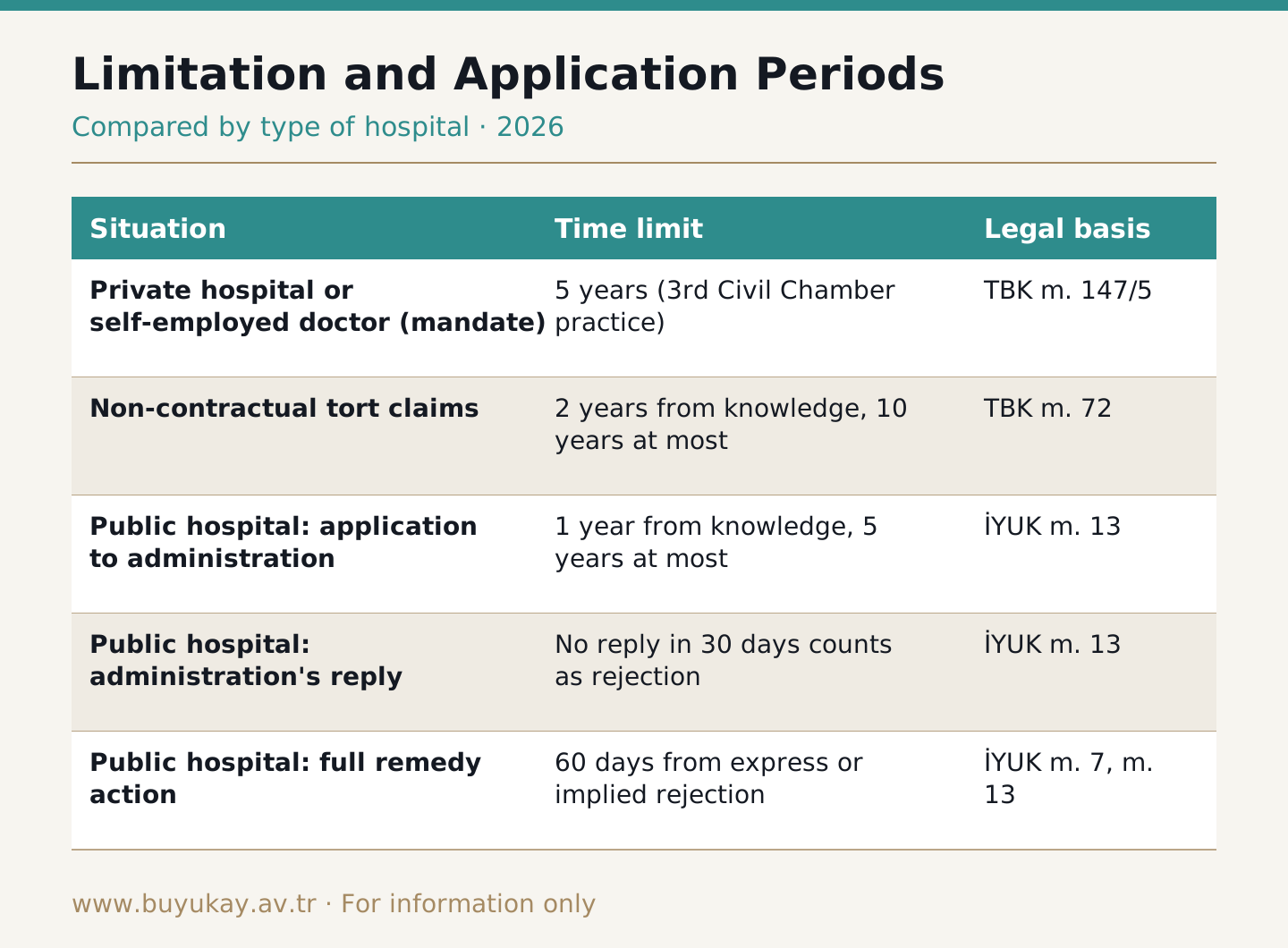
For claims against a private hospital or a self-employed doctor, the 3rd Civil Chamber of the Court of Cassation holds that the relationship with the patient is a contract of mandate and that the five-year limitation period in TBK m. 147/5 applies. This is shorter than the general ten-year period, and the defendant must raise it as a defence (def'i).
When do tort rules apply?
Where there is no contract or the claim is based on tort, TBK m. 72 applies: two years from the date the injured party learned of the damage and of the person liable, and in any event ten years from the act. If the claim arises from a criminal offence for which criminal law provides a longer limitation period, that longer period applies.
Are the time limits different for public hospitals?
Yes. Malpractice in a public hospital is treated as a service fault (hizmet kusuru) of the administration, and compensation is sought through a full remedy action (tam yargı davası) before the administrative court. Before suing, the patient must apply to the relevant administration within one year of learning of the act and in any event within five years of the act (İYUK m. 13/1).
If the administration rejects the application or does not respond within thirty days, the sixty-day period for filing suit starts from notification of the rejection or from the end of the thirty-day period (İYUK m. 7, m. 13). This thirty-day response period was reduced from sixty days by Law No. 7331 in 2021.
The calculation rules in TBK m. 55 also apply to bodily injury and death claims for which the administration is liable (TBK m. 55/2). The actuarial calculation in a full remedy action against a public hospital therefore follows the same principles.
Who is liable to pay compensation?
When malpractice occurs at a private healthcare facility, the patient can claim against both the doctor and the company operating the hospital. The hospital is liable as an employer for damage its staff cause in the course of their work and is released only if it proves it took the necessary care (TBK m. 66).
Where several persons are liable for the same harm, the rules on joint and several liability apply, and the patient may claim the full amount from any one of them (TBK m. 61). A hospital that pays can seek recourse from the doctor only to the extent the doctor is personally liable (TBK m. 66/4).
The role of compulsory professional liability insurance
Additional Article 12 of Law No. 1219 requires doctors working in the public and private sectors to be insured against damages and recourse claims arising from medical malpractice. For doctors employed by private facilities, the employing facility takes out this insurance.
Insurance cover can make it easier to collect compensation, but the sum insured and the period covered by the policy are limited. Whether the doctor and the hospital should be joined to the lawsuit alongside the insurer should therefore be decided after reviewing the policy terms.
Does the patient's own fault reduce compensation?
Yes, it can. If the patient contributed to the harm or made it worse, for example by not following the doctor's treatment instructions or by withholding important health information, the judge may reduce the compensation or deny it entirely (TBK m. 52/1).
This reduction applies only where the expert report clearly assesses how the patient's conduct contributed to the harm. Records showing that follow-up appointments were attended and prescriptions were followed are important against a possible allegation of contributory negligence (müterafik kusur).
When does the limitation period start, and how is it interrupted?
For contractual claims, the limitation period generally starts when the claim becomes due (TBK m. 149). In malpractice cases, the harm does not always appear on the date of the intervention, so the starting point needs to be determined carefully on the facts of each case.
The limitation period is interrupted, for example, when the debtor acknowledges the debt or makes a partial payment, or when a lawsuit or enforcement proceedings are started (TBK m. 154). If the deadline is approaching, taking one of these steps in time prevents the loss of the right.
Which documents strengthen the compensation claim?
The calculation in a malpractice case depends largely on documents. Having the following in the file makes it easier for the expert to assess the actual loss:
- The complete hospital file: discharge summary (epikriz), operation notes and nursing observation forms
- The informed consent form and information documents given to the patient
- Invoices and receipts for treatment, medication, care and travel
- Pre-incident income records: payslips, tax returns, Social Security Institution (SGK) service records
- A report from an authorised medical board on permanent disability
- Records of any payments made by the insurer or the hospital
For access to the patient file and the consent process, see our article on informed consent and patient rights; for filing the lawsuit and the expert stage, see our guide on how to bring a medical malpractice claim.
Türkiye, the United States and the United Kingdom are all parties to the Hague Apostille Convention. A power of attorney signed in the US or the UK for proceedings in Türkiye, or medical records issued by a home-country provider, can be apostilled in the issuing country and then translated by a sworn translator and notarised in Türkiye, with no further consular legalisation. A power of attorney can also be executed at a Turkish consulate. Patients who return home after treatment in Türkiye should also keep invoices and records for any follow-up care received abroad, because treatment costs are claimed on the basis of documents.
Step-by-step compensation claim
- Request a complete copy of the patient file from the hospital or healthcare facility.
- Note the date of the incident, the date you learned of the harm and the type of hospital to identify the applicable time limit.
- File documents on treatment costs and loss of income in chronological order.
- If a public hospital is involved, apply in writing to the relevant administration within the time limit.
- Keep a record of correspondence and payments with the insurer or the hospital.
- Track the deadlines for objecting to expert reports and requesting supplementary reports.
These steps reduce the risk of missing the limitation period and help the expert see the full extent of the actual loss. Gathering documents before filing suit also reduces the need to request extra time during the proceedings.
Common mistakes
- Relying on the general ten-year period in private hospital cases and missing the five-year limit
- Suing a public hospital directly without first applying to the administration
- Claiming lost earnings without submitting income records
- Fixing pecuniary and non-pecuniary claims before the disability rate is determined
- Failing to mention insurer or hospital payments in the statement of claim
- Not requesting the start date of interest separately
Medical malpractice compensation is a technical process in which fault, causation (illiyet bağı), disability and actuarial reports are assessed together, and the outcome differs in every case. This article is for general information only and is not a substitute for legal advice. You can review our work in this field on the Health Law page and use the Contact page for your questions.