
Informed consent is the patient's free decision to accept a medical intervention after being told, in terms they can understand, about their condition, the risks and complications of the procedure and the available alternatives. In Türkiye, the Patient Rights Regulation (Hasta Hakları Yönetmeliği) sets out what the patient must be told, who must tell them and which procedures require a written consent form.
This guide explains the rules on informed consent in Türkiye, the exceptions where consent is not required and the routes available when patient rights are breached. The patient rights unit and the Patient Rights Board are administrative complaint channels, while a claim for compensation has to be brought before the courts. Knowing this difference helps you choose the right route from the start.
What is informed consent and what is its legal basis?
Informed consent has two elements: information and consent. Article 4 of the Regulation defines information as the health professional who will perform the intervention giving the person the necessary details, and consent as the person accepting the intervention freely and with full knowledge.
Article 5(d) of the Regulation lays down the principle that, apart from medical necessity and cases provided by law, no one's bodily integrity may be interfered with without consent. Under Article 22, no one may undergo a medical procedure without their consent or in a way that goes beyond the consent given. Article 31(1) adds that, when consent is obtained, the patient must in principle be informed about the subject and consequences of the intervention.
The Turkish Court of Cassation (Yargıtay) also treats the duty to inform as part of the physician's duty of care: the patient must be told about the purpose, nature and consequences of the intervention and its complication risks. An intervention carried out without this information may be unlawful even if it was performed in line with medical standards.
What information must the patient be given?
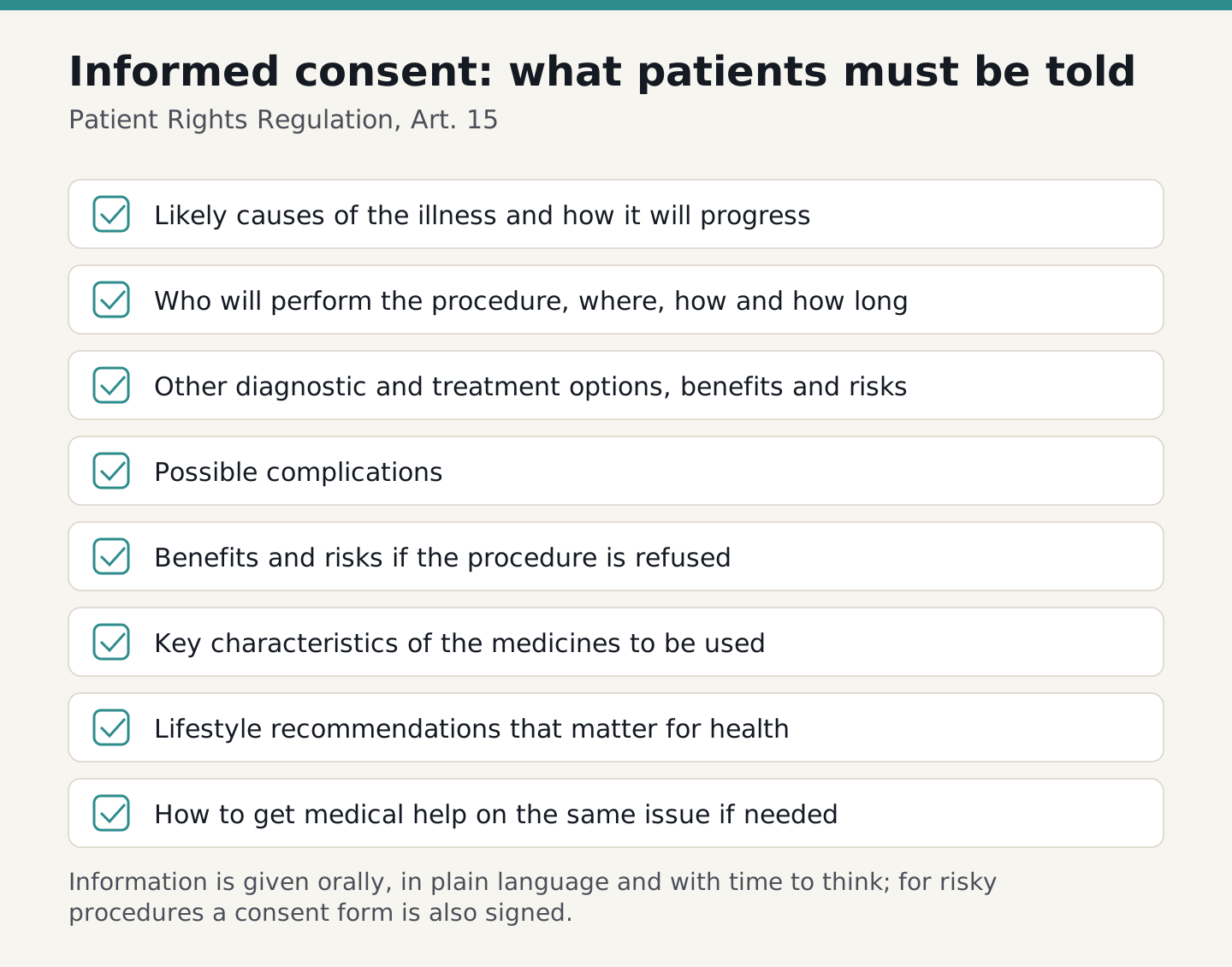
Article 15 of the Patient Rights Regulation lists eight minimum points of information. Together they form the core benchmark for whether informed consent was valid, and a gap in any of them can make informed consent incomplete:
- The likely causes of the illness and how it is expected to progress.
- Who will carry out the intervention, where and how, and roughly how long it will take.
- Other diagnostic and treatment options, with their benefits and risks.
- Possible complications.
- The benefits and risks that may follow if the intervention is refused.
- The key characteristics of any medicines to be used.
- Lifestyle recommendations that matter for the patient's health.
- How to obtain medical help on the same issue if needed.
How and by whom should the patient be informed?
For informed consent to be valid, the health professional who will perform the intervention informs the patient orally and in plain language the patient can follow (Art. 18 of the Regulation). Where necessary, another qualified health professional may take on this task, provided this is explained to the patient.
Under Article 18, except in emergencies, the patient should be given a reasonable time to think, and the conversation should take place in a suitable setting that respects privacy. The patient may ask another physician for a second opinion on the same complaint and, on request, the relevant hospital departments must also explain the cost of the procedure.
The person to be informed is primarily the patient. If the patient wants someone else to receive the information, that request is recorded in writing and signed. Article 20 also gives the patient the right to ask that neither they nor their relatives be told about their health condition, except where the law requires otherwise.
There is a narrow exception to the right to information that underpins informed consent. Under Article 19, if the illness looks serious and the news could harm the patient's morale and worsen the condition, the diagnosis may be withheld. An incurable diagnosis may be disclosed only by a physician and with great caution; unless the patient objects, the family is told.
When is a consent form required and what must it contain?
A written consent form is mandatory where the legislation requires it and for interventions that are medically likely to lead to a dispute (Art. 26 of the Regulation). As written evidence of informed consent, the form must cover the information listed in Article 15, which must first be explained orally before the patient or their legal representative signs.
The form is drawn up in two copies: one goes into the patient file and the other is handed to the patient or their representative. The health professional who gives the information and performs the intervention also signs the form and is responsible for the accuracy of what it says. Under Article 28, consent is generally not subject to any particular form, but consent obtained in breach of the law or public morals is void.
The most common problem in practice is the pre-printed form (matbu form) that every patient receives and that says nothing about the risks of the specific procedure. The Court of Cassation holds that the physician and the healthcare provider bear the burden of proving that informed consent was obtained, and a signed form relating to a different procedure is not treated as sufficient.
How is consent obtained in teaching hospitals and medical research?
Informed consent has specific rules in teaching hospitals: if people not directly involved in the treatment need to be present during the intervention, the patient's separate consent is required (Art. 21 of the Regulation). The rule is stricter for medical research: no one may be subjected to a research intervention without both the permission of the Ministry of Health and their own consent (Art. 32).
Consent to research must be given in writing, and the volunteer is told in advance that consent can be withdrawn at any stage of the study (Arts. 33 and 34). A volunteer's consent does not relieve the research staff of their own liability.
When is consent not required?
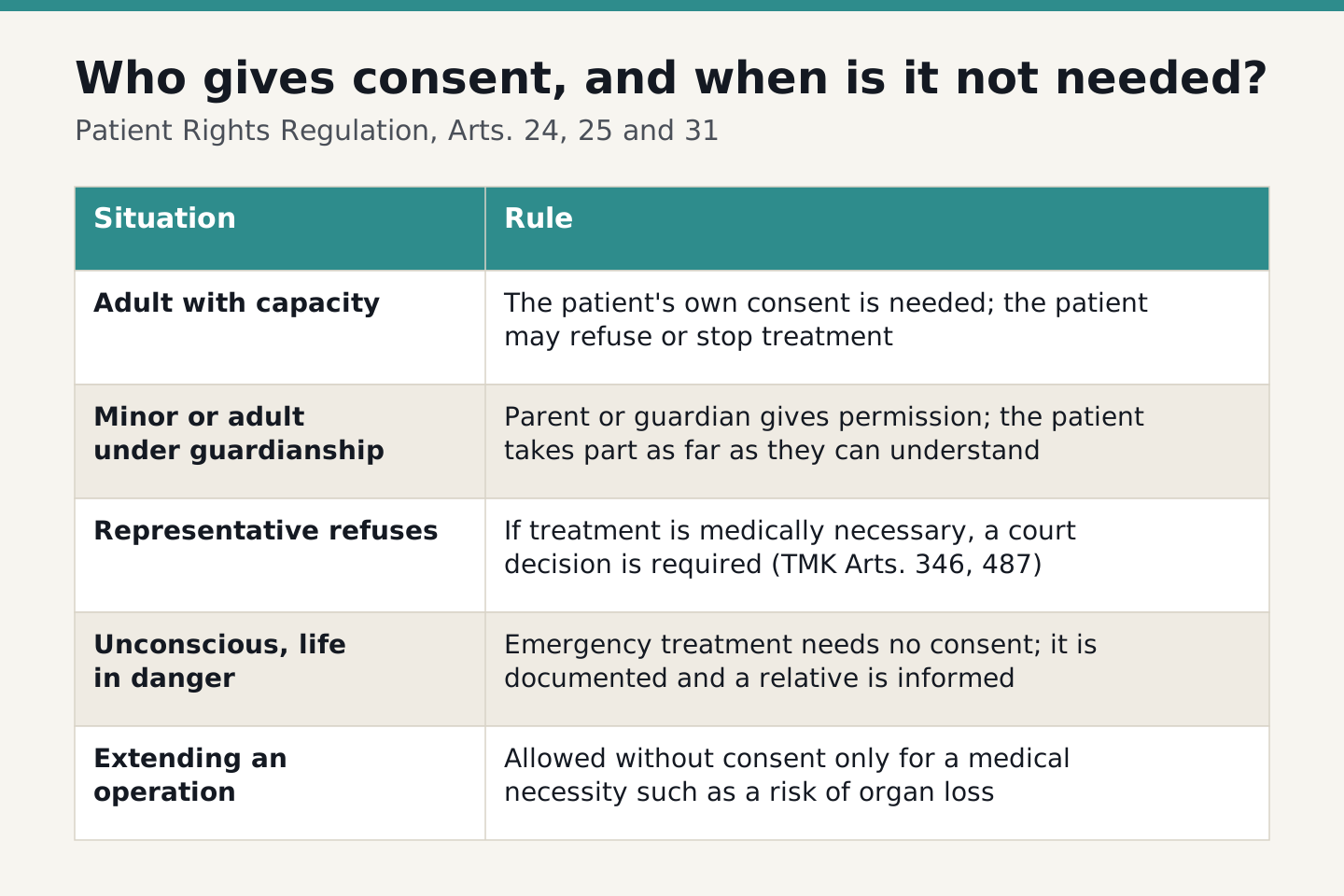
The main exception to informed consent is emergency treatment of a patient whose life is in danger and who is unconscious (Art. 24 of the Regulation). Consent is also not required where the patient faces the loss of an organ or of an organ's function. In these cases the intervention is documented and, where possible, a relative or legal representative is informed.
For minors and adults under guardianship (kısıtlı), permission is obtained from the parent (veli) or guardian (vasi), and the patient takes part in the process as far as they are able to understand. If the representative refuses but the intervention is medically necessary, Article 24 requires a court decision under Articles 346 and 487 of the Turkish Civil Code (Türk Medeni Kanunu, TMK). A surgeon may extend an operation without fresh consent only where there is a medical necessity such as a risk of organ loss (Art. 31).
Except where treatment is compulsory by law, the patient also has the right to refuse or stop treatment (Art. 25 of the Regulation). The possible consequences must then be explained to the patient and a written document confirming this must be obtained. Using this right cannot later be held against the patient when they seek care again.
What other core rights do patients have besides informed consent?
Beyond informed consent, the Patient Rights Regulation provides a broad set of rights, from access to care to privacy. The rights that most often lead to complaints in practice are:
- Fair and equitable access to healthcare and the right to choose and change one's healthcare provider (Arts. 6 and 8).
- The right to know the identity of the physician and staff providing treatment, to change physician in line with the rules and to request a consultation (Art. 9).
- The right to privacy, including examination and treatment in reasonably private conditions (Art. 21).
- Confidentiality of information obtained during care, except where the law permits disclosure (Art. 23).
- The right to ask for a companion to stay with the patient, subject to the physician's approval (Art. 40).
The Regulation also places certain responsibilities on patients. A patient should give health information, including past illnesses and current medication, as fully as possible, keep to appointment and follow-up dates and refrain from verbal or physical aggression towards staff (Art. 42/A). If a patient gives incomplete information, this may later be taken into account when liability is assessed.
Where can you complain if your patient rights are breached?
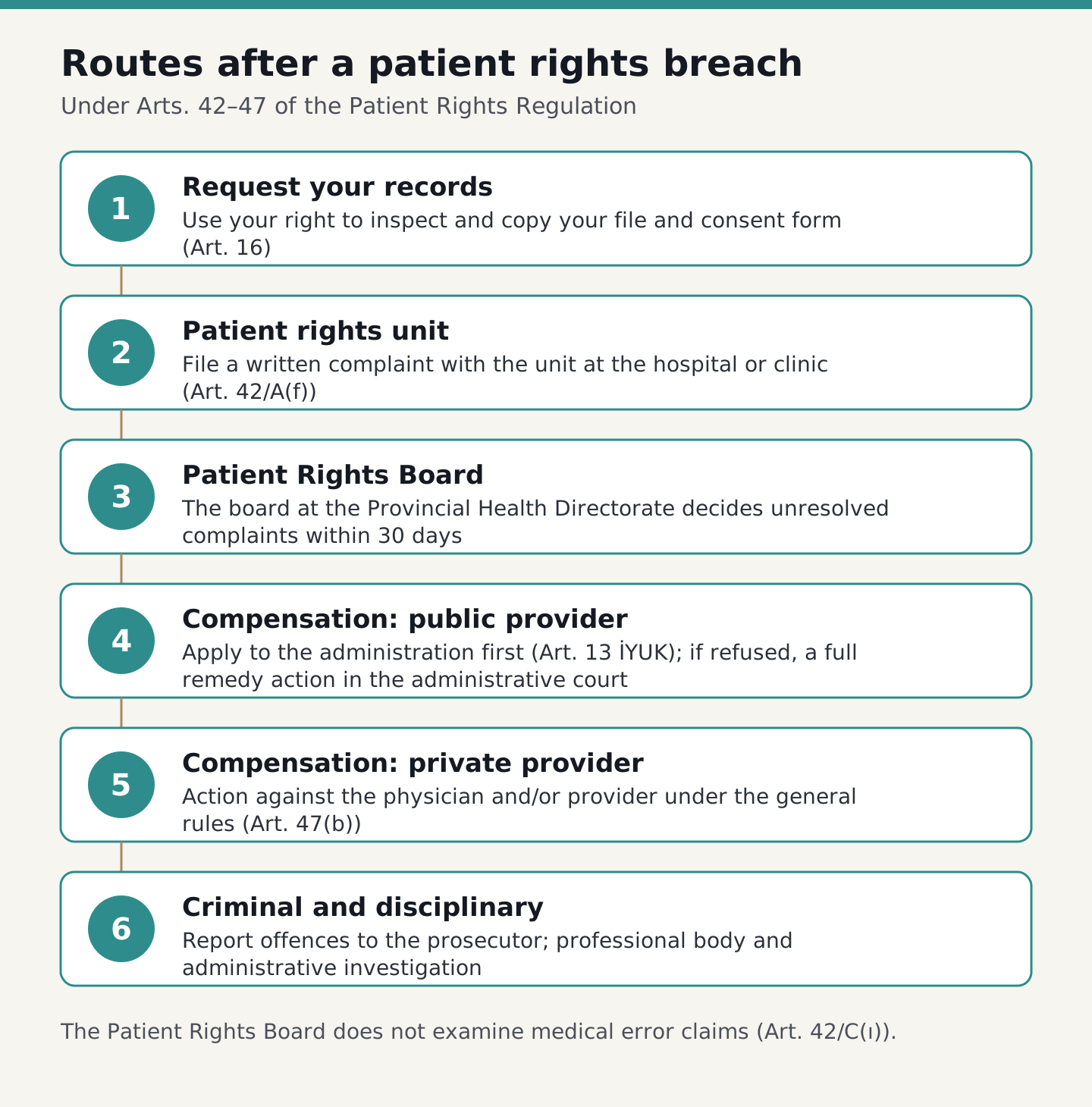
The first port of call is the hasta hakları birimi (patient rights unit) at the hospital or clinic (Arts. 42/A(f) and 42/B of the Regulation). Written or electronic complaints that cannot be resolved there are reviewed by the Hasta Hakları Kurulu (Patient Rights Board) set up within the İl Sağlık Müdürlüğü (Provincial Health Directorate). The Board decides within thirty days of receiving the complaint (Art. 42/C(d)).
The Board's findings of a breach are notified in writing to the provider and the staff member concerned. Where more than two breach findings have been made against a health professional in the last six months, the file is sent to the Sağlık Meslekleri Kurulu (Health Professions Board) (Art. 42/C(b)). One key limit applies: the Board does not examine allegations of medical error (Art. 42/C(ı)), so a court route must be planned separately for such claims.
Before filing a complaint about informed consent or another right, it is worth obtaining copies of your medical records and the consent form: Article 16 gives patients the right to inspect their records and take copies, and Article 17 lets them ask for incorrect entries to be corrected. The Ministry of Health's SABİM hotline (184) is also used for information and complaints; please confirm the current complaint channels with the Ministry.
For readers from the United States and the United Kingdom: Türkiye, the US and the UK are all parties to the 1961 Hague Apostille Convention, so public documents can move between them with an apostille instead of consular legalisation. In Türkiye, apostilles are issued by governorships (valilik) and district governorships (kaymakamlık), which is relevant if you need notarised copies of Turkish medical records for an insurer or proceedings back home. A power of attorney signed in the US or UK for a case in Türkiye is usually notarised there, apostilled by the competent local authority and then translated into Turkish by a sworn translator. Confirm the current requirements with the issuing authority before you start.
How do you bring a claim for compensation?
Where a lack of informed consent or another breach has caused harm, the route depends on whether the care was provided by a public or a private institution. Article 43 of the Regulation states that, where patient rights are breached, an action for pecuniary and non-pecuniary damages may be brought against the institution employing the staff member. If a public institution is involved, you must first apply to the administration under Article 13 of the Law on Administrative Procedure (İdari Yargılama Usulü Kanunu, İYUK).
Under Art. 13 İYUK, this application must be made within one year of learning of the harmful act and, in any case, within five years of the act itself. If the request is rejected or left unanswered for thirty days, a full remedy action (tam yargı davası) can be filed with the administrative court within the time limit. Under Article 46(c) of the Regulation, no direct action may be brought against a physician who is a public official; the claim is directed at the administration.
For private hospitals and private practices, Article 47(b) of the Regulation allows an action under the general rules against the physician, the institution or both. For evidence and court-appointed expert reports in such proceedings, see our guide to filing a medical malpractice lawsuit.
How do disciplinary and criminal routes work?
Alongside compensation, disciplinary and criminal routes may be pursued against staff who breach patient rights, including the rules on informed consent. For staff working in a public institution, the governorship, the Ministry or the relevant body appoints an inspector or investigator, either on complaint or of its own motion (Art. 45 of the Regulation). Staff who are not public officials may be sanctioned by the disciplinary bodies of their professional organisation, and acts that amount to an offence can be reported directly to the public prosecutor's office (Arts. 47(a) and 47(c)).
Common mistakes
The following mistakes can directly affect the outcome of informed consent and patient rights complaints:
- Taking a medical error claim only to the Patient Rights Board and missing the court deadlines.
- Suing a public hospital without first applying to the administration under Art. 13 İYUK.
- Not requesting copies of the patient file and consent form early on.
- Treating a signed pre-printed form as conclusive proof that the patient was properly informed.
- Refusing treatment without keeping a record of whether its consequences were explained in writing.
- Trying to sue a physician who is a public official directly.
Informed consent is how patient autonomy and the right to bodily integrity are protected in healthcare; a breach can trigger administrative, civil and criminal consequences at the same time. This article is for general information only and does not replace legal advice on a specific case. You can review our scope of work on our health law page or reach us through the Contact page with any questions.