
If a patient is harmed by medical treatment at a public hospital in Türkiye, the patient or their family brings the compensation claim against the public body that runs the hospital, not against the doctor, by filing a full remedy action (tam yargı davası, a damages claim against the administration) before the administrative court. Article 129(5) of the Constitution (Anayasa) provides that claims for damages arising from faults committed by public officials in the exercise of their powers may be brought only against the administration, which keeps a right of recourse against the official.
This article walks through a public hospital malpractice claim: the concept of service fault (hizmet kusuru), the requirement to apply to the administration before suing, the time limits that apply, why the expert report matters and the mistakes people commonly make. For general information on claims against private hospitals, see our article on how to bring a malpractice claim.
What is service fault?
Service fault is the fault attributed to the administration when a public service does not operate at all, operates late or operates badly. In healthcare, it arises in situations such as a wrong or delayed diagnosis, treatment contrary to accepted medical practice, inadequate monitoring or a failure to obtain a necessary specialist consultation.
The final paragraph of Article 125 of the Constitution requires the administration to compensate damage caused by its own acts and actions.
The 10th Chamber of the Council of State (Danıştay, Türkiye's highest administrative court) likewise holds that the administration must compensate damage causally linked to the public service it provides, under the principles of service fault or strict liability (Council of State, 10th Chamber, decision of 29 April 2025, E.2022/885, K.2025/2287).
A doctor's personal fault and service fault cannot be completely separated. A fault committed by a public official while performing their duties, and inseparable from the service, makes the administration liable to the patient; the administration can later seek recourse against the official for the compensation it has paid.
In which situations are service fault claims raised in practice?
In disputes that reach the Council of State, service fault claims typically concern diagnosis, treatment and follow-up. The examples below give a general picture of the issues on which such claims are made; whether there was fault in a given case always requires medical examination.
- Unnecessary or late surgery caused by a wrong or delayed diagnosis.
- Nerve or organ damage during surgery, with resulting permanent loss of function.
- Discharge from the emergency department without the necessary specialist consultation.
- Delays or missing information when a patient is transferred from one facility to another.
- Failure to spot a complication in time during post-operative follow-up.
Not every complication is a service fault. Where a complication follows an intervention performed in line with accepted medical practice and could not have been prevented, the administration is generally not held liable; drawing this line is the core task of the expert report.
What claim is brought against a public hospital?
A public hospital malpractice claim is pursued through a full remedy action as defined in Art. 2(1)(b) of the Law on Administrative Procedure No. 2577 (2577 sayılı İdari Yargılama Usulü Kanunu, “İYUK”). This action is brought by those whose personal rights have been directly harmed by administrative acts or actions, and it covers both pecuniary and non-pecuniary damages.
As a rule, the action is directed against the public body to which the hospital belongs. The doctor and other healthcare staff are not named as defendants: under Article 129(5) of the Constitution, the action is brought against the administration, which retains its right of recourse against the official.
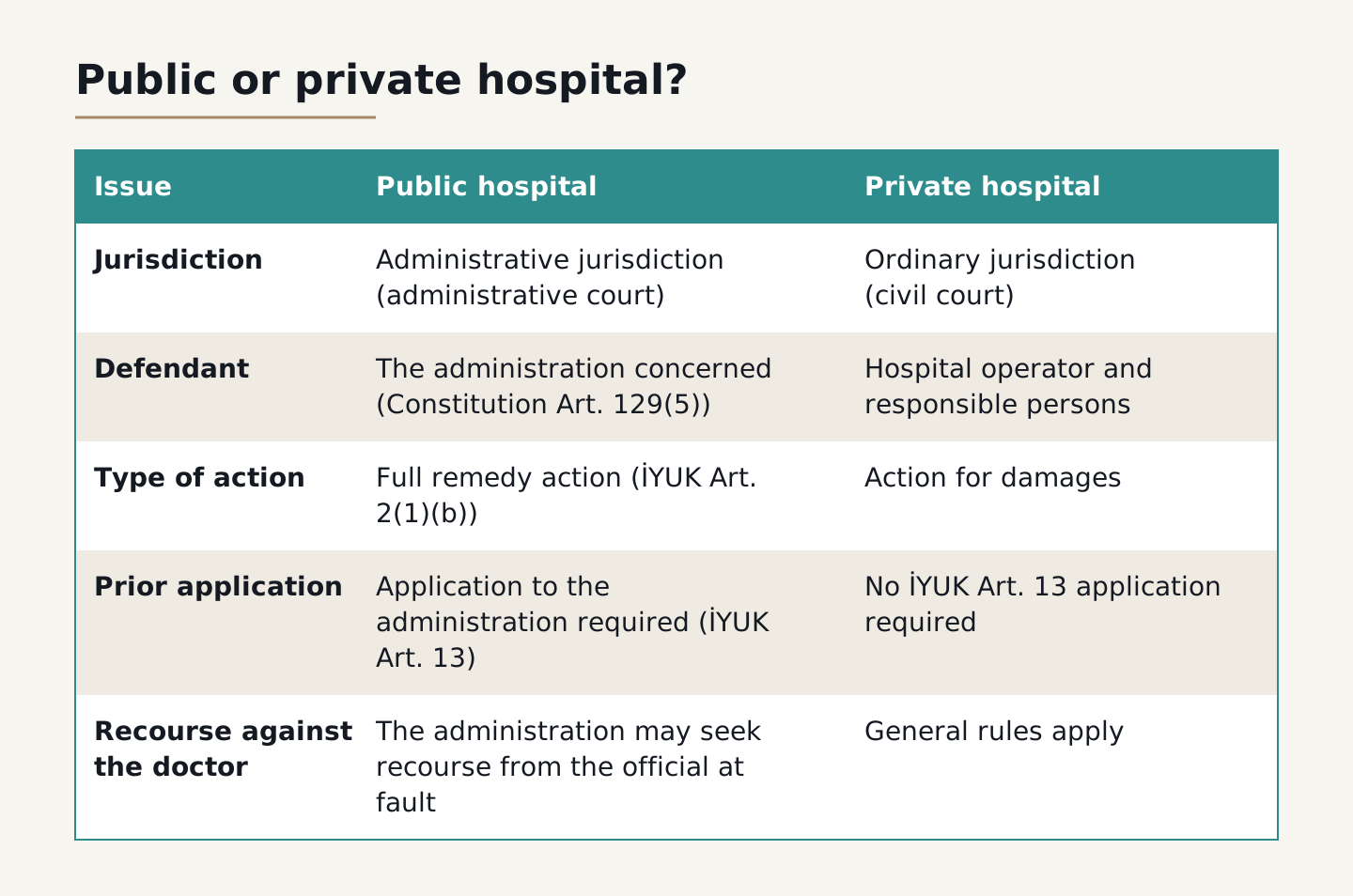
Disputes with private hospitals, by contrast, are heard by the ordinary civil courts, and the İYUK requirement to apply to the administration first does not apply. Where both a public and a private healthcare provider were involved in the same events, the liability of each is assessed separately in its own jurisdiction.
Do you have to apply to the administration before suing?
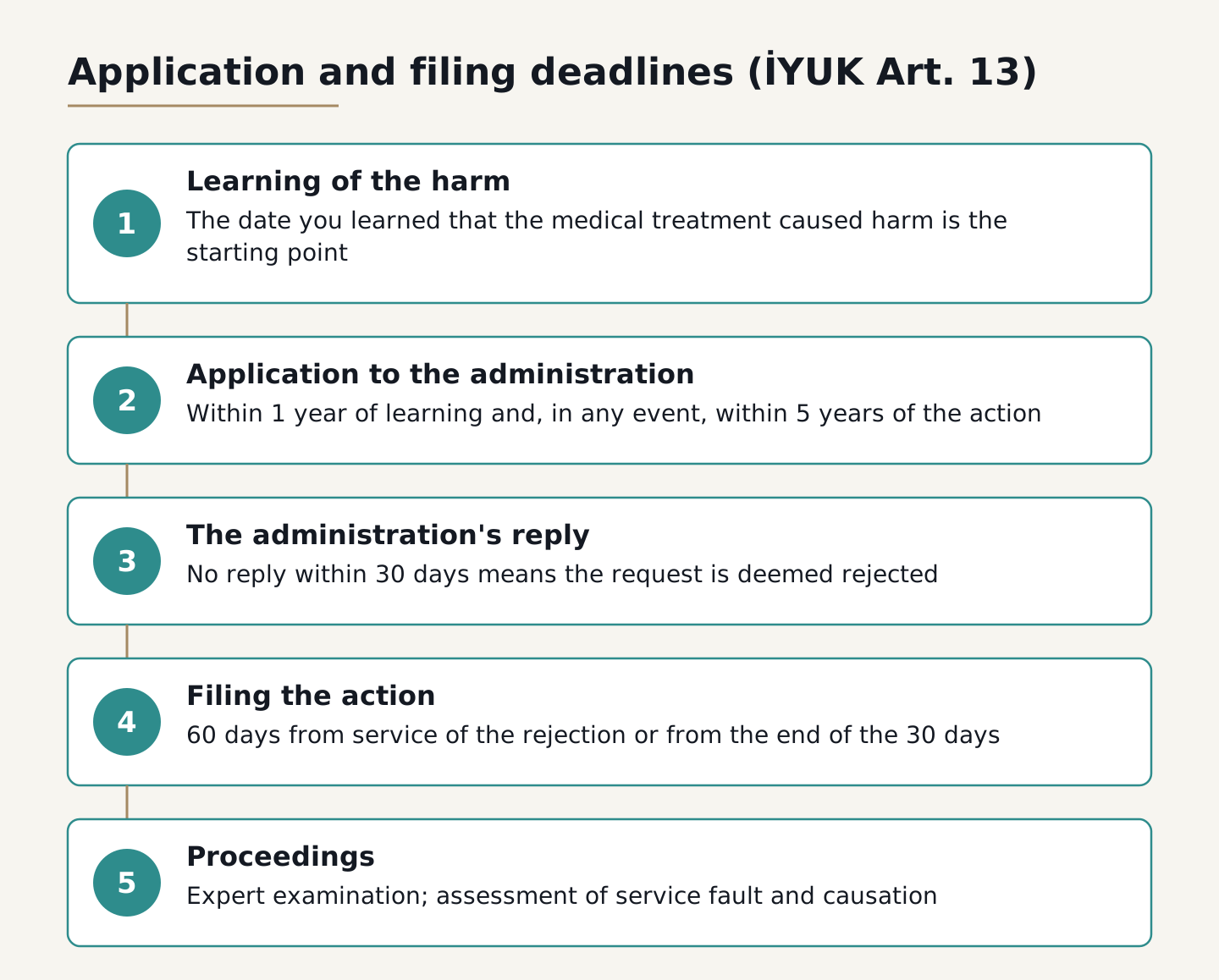
Yes. Because medical treatment is an administrative action, you cannot sue straight away; you must first apply to the administration concerned. Under Art. 13(1) İYUK, a person whose rights have been infringed by an administrative action must ask the administration for redress within one year of learning of the action and, in any event, within five years of the date of the action.
If the administration rejects the request in whole or in part, the action must be filed within the time limit running from the day after the rejection is served. If the administration does not respond within thirty days, the request is deemed rejected and the time limit for filing starts to run from the end of that thirty-day period.
What should the application to the administration include?
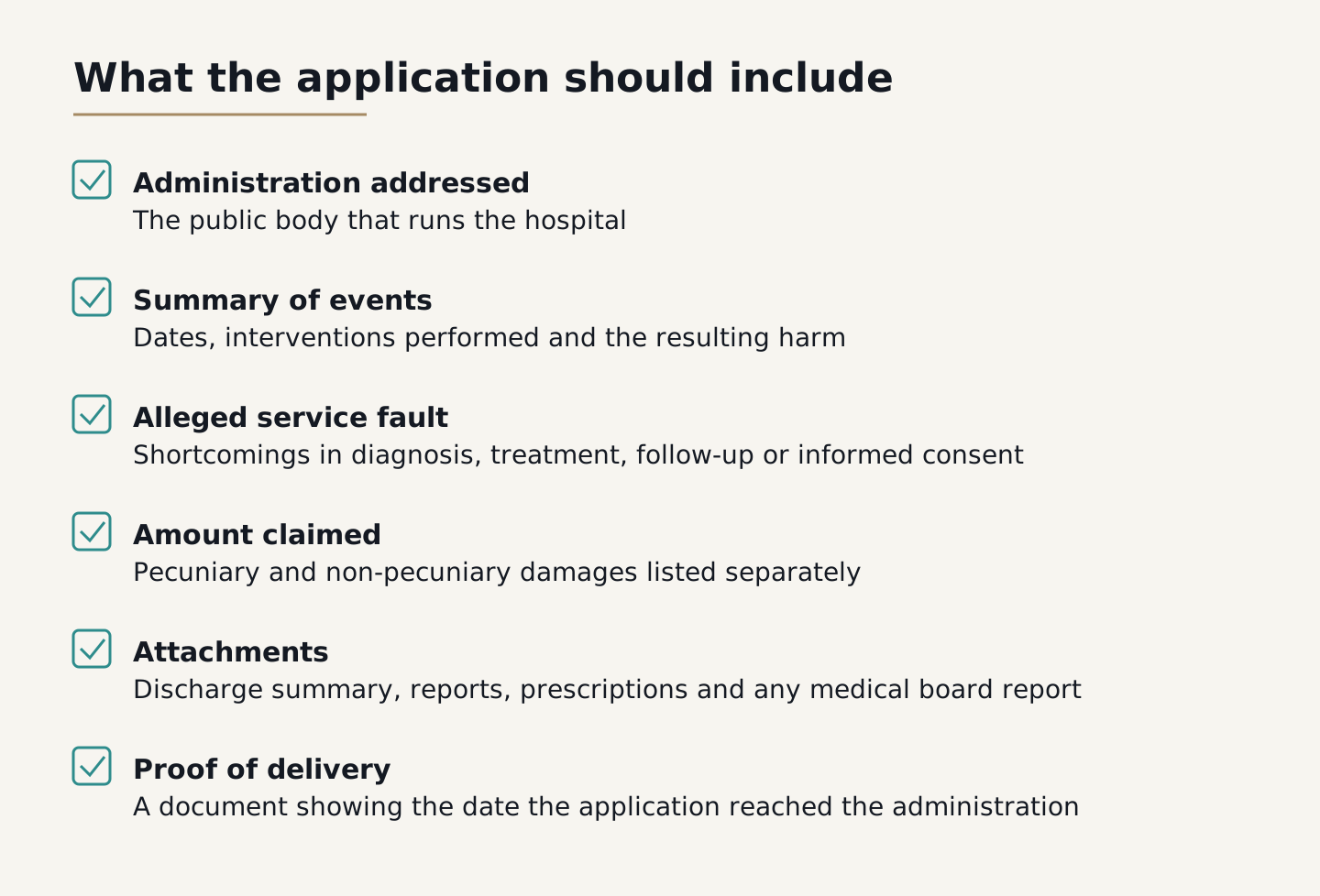
The application frames the public hospital malpractice claim that follows, so it should be prepared with care. It should set out the dates of the events, the medical interventions performed, the resulting harm and the alleged service fault, and state the pecuniary and non-pecuniary damages claimed separately.
The date on which the application reaches the administration determines both the thirty-day response period and the filing deadline that follows. It is therefore wise to submit it in a way that proves the date, such as an incoming document registration number, registered post with proof of delivery or an electronic notification record.
Can an action for annulment and a full remedy action be filed together?
Art. 12 İYUK allows a person whose rights are infringed by an administrative act to file a full remedy action directly, or to file an action for annulment and a full remedy action together. Alternatively, they may first seek annulment and then, depending on the outcome, file a full remedy action within the time limit.
In a public hospital malpractice claim, however, the dispute usually stems not from an administrative act but from the actual delivery of healthcare, in other words from an administrative action. That is why the Art. 13 İYUK route of applying to the administration is followed; where the particular case also involves an administrative act, the options under Art. 12 İYUK should be considered as well.
What is the time limit for filing the action?
The time limit for filing before the administrative courts is sixty days unless a special law provides otherwise (Art. 7(1) İYUK). It runs from service of the administration's express rejection or from the end of the thirty-day response period. Because a missed deadline can lead to dismissal without any examination of the merits, keep evidence of the application and service dates.
Under Art. 13(2) İYUK, if a full remedy action filed in the ordinary courts is dismissed for lack of jurisdiction, no prior application to the administration is required for the later action in the administrative courts. Even so, identifying the correct jurisdiction from the outset saves valuable time.
Patients or relatives living in the United States or the United Kingdom may need to complete these steps from abroad, for example by signing a power of attorney for a lawyer in Türkiye or by producing death or marriage certificates to prove heirship. Because Türkiye, the United States and the United Kingdom are all parties to the Hague Apostille Convention of 5 October 1961, such documents are authenticated with an apostille rather than consular legalisation. In the UK, the Legalisation Office apostilles powers of attorney certified by a UK notary or solicitor as well as birth, marriage and death certificates; in the US, documents notarised or issued under state authority are apostilled by the competent authority of the issuing state, and documents signed by federal officials by the US Department of State's Office of Authentications. These documents generally also need a Turkish translation, so build the time needed for apostilles and translations into the one-year and sixty-day deadlines.
How is service fault proved?
In a full remedy action for service fault, the existence of fault and the causal link between the fault and the harm are usually established by a report from the Council of Forensic Medicine (Adli Tıp Kurumu) or from specialist experts appointed by the court. The administrative court checks whether the report addresses the parties' arguments and whether it assesses the entire course of treatment.
For this reason, at both the application and the litigation stage, ask for every medical record in full, including discharge summaries, laboratory and imaging results, operation notes, nursing observation records and consent forms. A lack of informed consent can also form part of a service fault claim; on this point, see our article on patient rights and informed consent.
How can the expert report be challenged?
An objection to an expert report should show specifically which medical question the report leaves unanswered. For example, a report that examines treatment at only one hospital, skips the emergency department stage or does not discuss whether the requested consultations took place may be challenged as incomplete.
It helps to prepare a chronological summary of the treatment and to set out clear questions on whether accepted medical practice was followed at each stage. If the court finds the objections justified, it may order a supplementary report or a fresh report from a different board.
How does a criminal investigation relate to the full remedy action?
A criminal investigation into the doctor and a full remedy action for service fault against the administration are independent proceedings. The criminal investigation examines personal fault and the elements of the offence, while the full remedy action looks at the administration's service fault and its causal link to the harm.
In practice, forensic medical reports obtained by the public prosecutor's office can be submitted to the administrative court and weighed alongside the other evidence. However, waiting for the outcome of the criminal investigation does not stop the clock on applying to the administration or filing the action; those deadlines must be tracked separately.
What compensation can be claimed?
In a full remedy action, both pecuniary and non-pecuniary damages can be claimed. Pecuniary damages cover items such as treatment costs, loss of earnings due to loss of working capacity and, in the event of death, compensation for loss of support. Non-pecuniary damages are an amount awarded for the pain and suffering endured.
The exact amount of pecuniary loss is usually calculated during the proceedings by an actuarial expert. For more on the heads of damage and how they are calculated, see our article on compensation for medical errors.
The precise figure for pecuniary loss is often unknown when the action is filed. In practice, claimants start with a lower sum and then file a petition to increase the claim once the actuarial report obtained during the proceedings has established the loss. Because the date from which interest runs on the increased portion may depend on when that petition is served on the administration, this date should be tracked separately.
If the patient has died, relatives can claim their own loss of support and non-pecuniary damages for the grief they have suffered. Each claimant's claim should be stated separately, and documents proving heirship and the support relationship should be added to the file.
Interest and costs
The claim should state clearly the date from which interest runs and the type of interest sought. If the claim is partly upheld and partly rejected, the costs of proceedings and the attorney fee awarded by the court are divided between the parties in proportion to the outcome, so the amount claimed should be set realistically.
Step by step
- Ask the hospital for copies of all medical records and discharge summaries.
- Identify the public body that runs the hospital and the date on which you learned of the harm.
- Work out the one-year and five-year deadlines and submit a written application to the administration.
- Keep proof of the date the application reached the administration and track the thirty-day response period.
- If the request is rejected or goes unanswered, file the action before the administrative court within the sixty-day time limit.
- During the proceedings, back any objections to the expert report with specific medical reasons.
Common mistakes
- Naming the doctor as defendant, or suing a public hospital in the ordinary civil courts.
- Going straight to the administrative court without first applying to the administration.
- Mixing up the start dates: running the one-year limit from the date of the event instead of the date of learning, or the other way round.
- Missing the filing deadline that runs from the end of the thirty days when the administration stays silent.
- Collecting incomplete medical records and objecting to the expert report without giving reasons.
- Failing to look at the whole course of treatment when more than one healthcare provider was involved.
For a public hospital malpractice claim, the correct path is to apply to the administration first, within the time limits, and then to bring a full remedy action for service fault before the administrative court. A great deal turns on gathering complete medical records and on an expert report that covers the entire course of treatment. You can review our health law scope of services or reach us through our Contact page.