The foreign spouse of an investor, together with the minor or dependent foreign children of the investor and of the spouse, can obtain Turkish citizenship by investment within the same file, without any additional investment. The legal basis is Article 12(1)(b) of the Turkish Citizenship Law No. 5901 (Türk Vatandaşlığı Kanunu); parents and siblings, however, are not covered.
This article explains who counts as a family member in a citizenship by investment application, why the other parent’s consent matters for children, what the application steps are, and where the family stands if citizenship is later cancelled or withdrawn, drawing on the legislation and decisions of the Council of State (Danıştay, Türkiye’s highest administrative court). For details of the qualifying investment types, see our article on Turkish citizenship by investment.
Which family members can benefit from citizenship by investment?
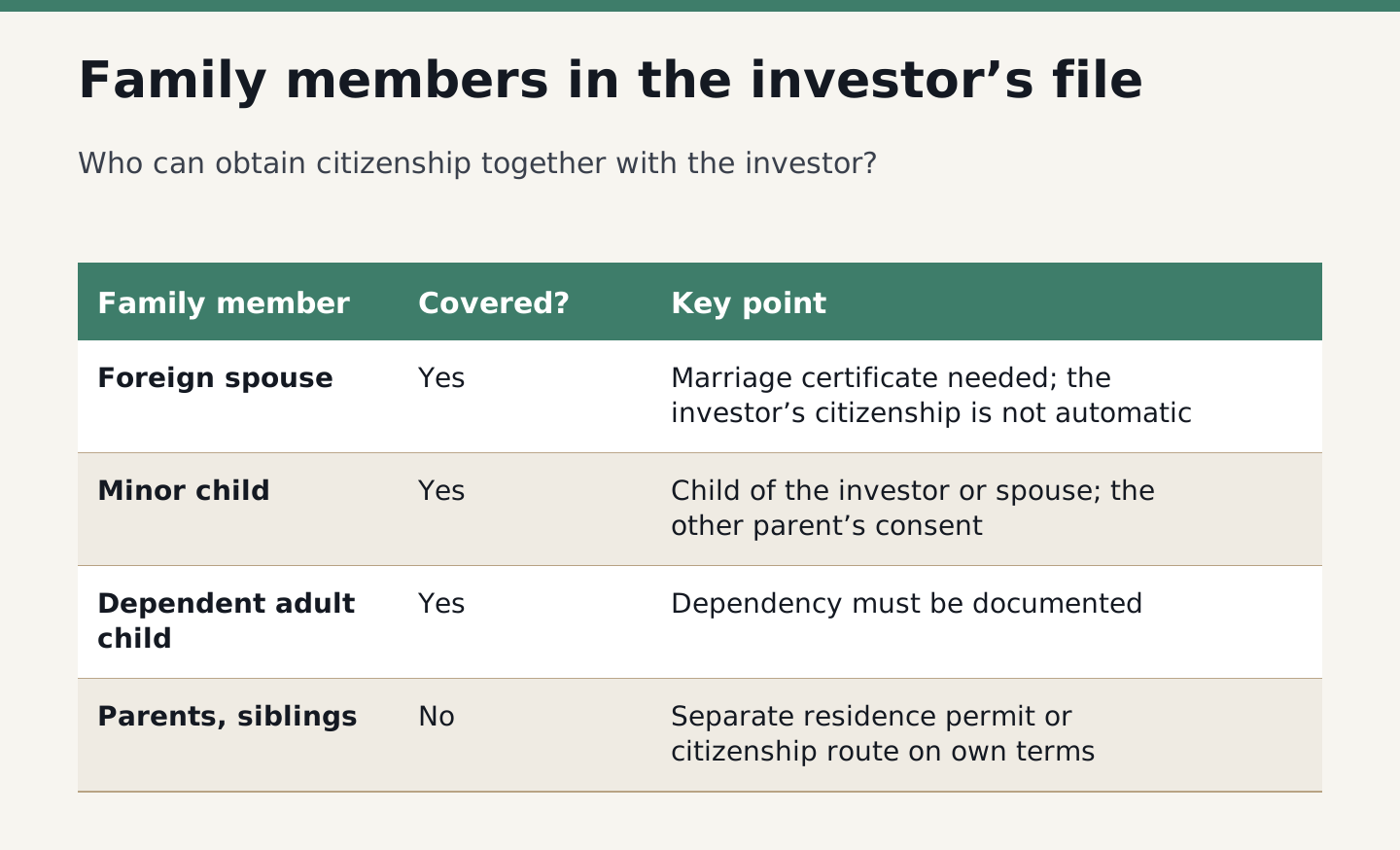
The law lists three groups of family members who may join the investor: the foreign spouse, the minor foreign children of the investor and of the spouse, and the dependent foreign children of the investor and of the spouse (Law No. 5901, Art. 12(1)(b)).
The same definition of family is used for the residence permit granted to the investor (Article 31(1)(j) of the Law on Foreigners and International Protection No. 6458, Yabancılar ve Uluslararası Koruma Kanunu).
Family member | Covered? | Point to watch |
|---|---|---|
Foreign spouse | Yes | A marriage certificate is required; the investor’s citizenship does not automatically change the spouse’s citizenship |
Minor child | Yes | May be the child of the investor or of the spouse; the other parent’s consent may be required |
Dependent adult child | Yes | Dependency must be shown with documents |
Parents, siblings | No | A separate residence permit or citizenship route is assessed under its own conditions |
Because the law refers to the child “of the investor and of the spouse”, a foreign child from the spouse’s previous marriage can also fall within the scope. In that case, the child’s custody arrangements and the consent of the other biological parent become particularly important.
What do “minor” and “dependent” child mean?
Article 3(1)(e) of Law No. 6458 defines a child as a person who has not yet reached the age of eighteen and has not attained majority. A dependent child is one who has turned eighteen but still needs care, meaning a child whom the mother or father is legally obliged to support.
For family residence permits, Article 30(5) of the Regulation on the Implementation of the Law on Foreigners and International Protection (Yabancılar ve Uluslararası Koruma Kanununun Uygulanmasına İlişkin Yönetmelik) provides that this assessment follows the Social Insurance and General Health Insurance Law No. 5510 (Sosyal Sigortalar ve Genel Sağlık Sigortası Kanunu). We recommend confirming in advance with the receiving authority which documents will be accepted as proof of dependency in the citizenship file.
Does the investor’s citizenship automatically extend to the spouse?
No. Acquiring citizenship by a decision of the competent authority does not affect the spouse’s citizenship (Law No. 5901, Art. 20(2)).
The foreign spouse therefore needs to appear in the citizenship by investment file as an applicant in their own right and submit their own documents.
If the spouse is left out of the file, they will later need another route to citizenship. For example, a foreigner who has been married to a Turkish citizen for at least three years, and whose marriage is continuing, may apply through citizenship by marriage, subject to conditions such as living together as a family (Art. 16). That route, however, involves a separate review and waiting period.
Why is the other parent’s consent needed for the children?
Under Article 20(2) of Law No. 5901, children in the custody of the mother or father acquire Turkish citizenship if the other spouse consents. If consent is not given, the matter is decided according to the court decision in the country of the parent’s habitual residence (the place where they ordinarily live).
Where both parents acquire citizenship together, the children also acquire it. In divorced or separated families, however, the custody document and the other parent’s written consent are the parts of the file most often missing. The legalisation and translation requirements for documents issued abroad should be confirmed with the receiving authority.
What happens if a child turns 18 while the file is pending?
Children who were not included with their mother or father are assessed under the ordinary procedure when they apply for citizenship after reaching majority (Law No. 5901, Art. 20(3) and Art. 11).
It is therefore important to clarify the position of children close to eighteen with the receiving authority before the file is opened.
What are the application steps for family members?
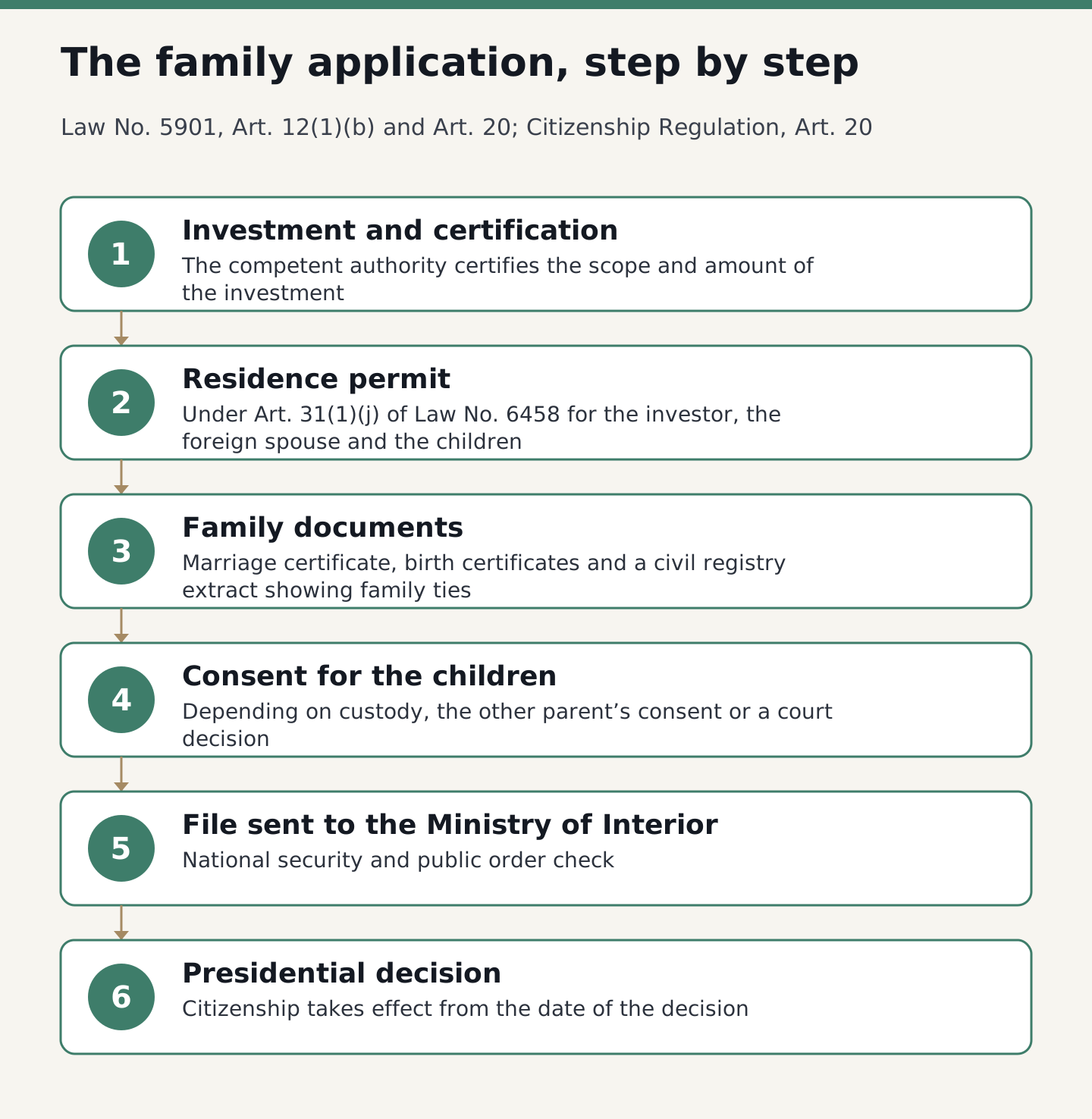
A citizenship by investment application starts with certification of the investment and ends with a Presidential decision, and family members take part alongside the investor at every stage. The Council of State has also stressed that the precondition for exceptional naturalisation is meeting the investment requirement in Article 31(1)(j) of Law No. 6458. The steps can be summarised as follows:
- Certification of the investment by the competent authority as to its scope and amount (Citizenship Regulation, Art. 20(2) and 20(9))
- Obtaining residence permits for the investor, the foreign spouse and the children under Article 31(1)(j) of Law No. 6458; this permit may be issued for periods of up to five years each (Art. 31(5))
- Preparing, for each family member, the application form, passport, civil status and birth documents, and a civil registry extract showing the family relationship (Regulation, Art. 20(3))
- Applications for minor children being made by their parent or guardian (Regulation, Art. 64(2))
- Sending the file to the Ministry of Interior for a decision, and the national security and public order review (Regulation, Art. 20(4); Law, Art. 12)
- Acquisition of citizenship by Presidential decision; the decision takes effect from its date (Law, Art. 20(1))
We cover related issues such as work permits and their link to residence in our article on work permit exemptions for foreign investors.
Which documents should be prepared?
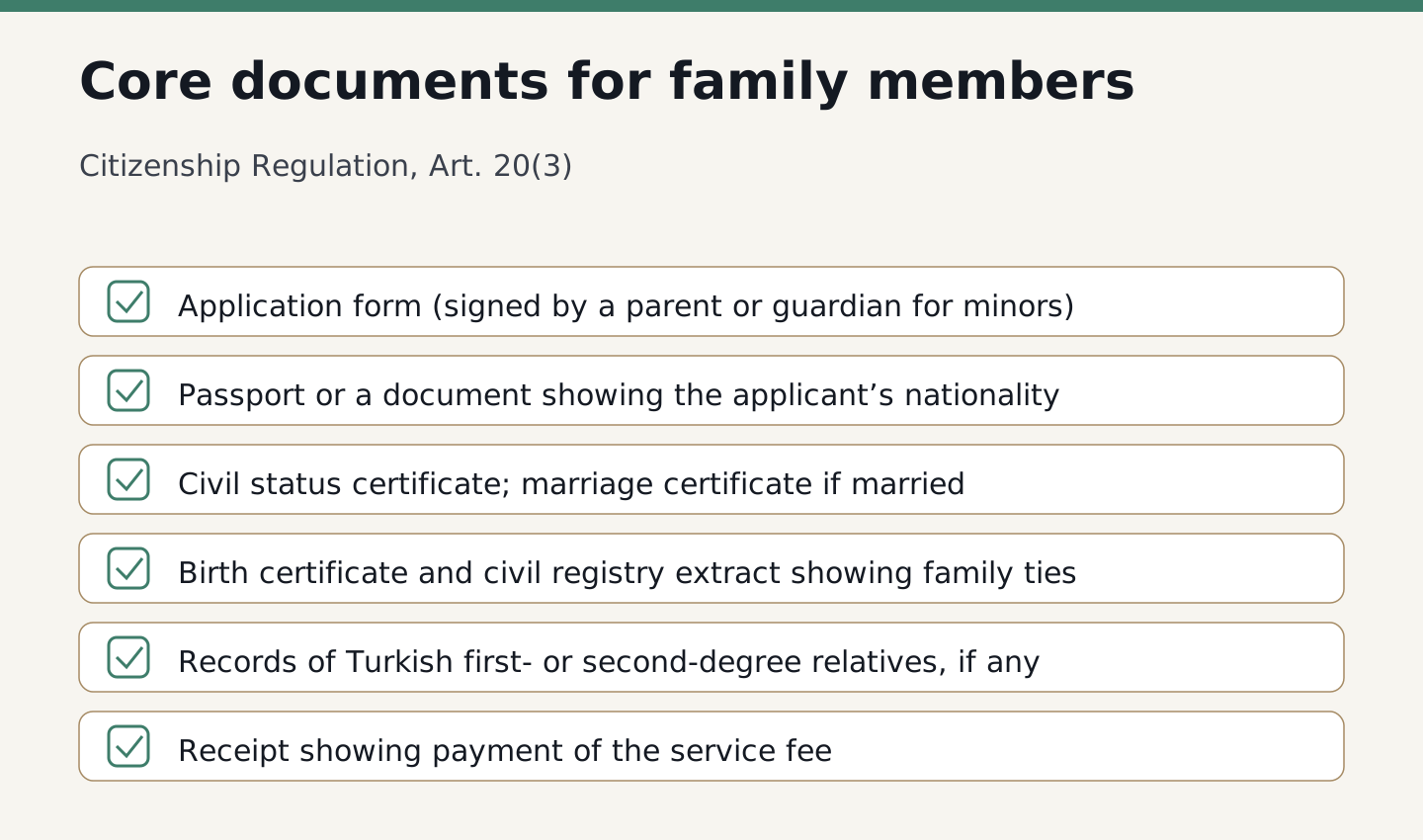
Article 20(3) of the Regulation on the Implementation of the Turkish Citizenship Law (Türk Vatandaşlığı Kanununun Uygulanmasına İlişkin Yönetmelik) lists the core documents required in an exceptional naturalisation file. For family members, the most important is the civil registry extract, or an equivalent document, proving the family relationship with the spouse and children.
How can family members stay in Türkiye while the decision is pending?
While the citizenship decision is pending, the investor’s spouse and children can stay in Türkiye together with the investor on a short-term residence permit (kısa dönem ikamet izni) under Article 31(1)(j) of Law No. 6458. Unlike other short-term permits, a permit granted under this provision can be issued for periods of up to five years each.
A family residence permit (aile ikamet izni) is an alternative. Under Article 34 of Law No. 6458, the foreign spouse and the minor or dependent foreign children of a foreigner holding a residence permit may be granted a family residence permit for up to three years at a time; this permit, however, cannot exceed the duration of the sponsor’s residence permit.
A family residence permit allows children to attend primary and secondary schools until the age of eighteen without a student residence permit. A child who has held a family residence permit for at least three years and has turned eighteen may, on request, switch to a short-term residence permit. For children’s family residence permits too, the consent of a parent outside Türkiye who shares joint custody is required.
Example: a 19-year-old university student
An investor’s 19-year-old child studying at a university abroad has reached majority, so the child can join the investor’s file only if they qualify as a dependent child. If the dependency condition is not met, the child is not assessed within this scope.
In that situation, a permit suited to the child’s own circumstances, such as a student residence permit, may be considered for staying in Türkiye. For citizenship, the child would have to apply later under the general provisions. Each family member over eighteen should therefore be assessed individually before the investment decision is made.
Do the investment requirements change with family size?
No. The number of family members does not increase the investment amount; a single investment covers the whole family. Under Article 20(2) of the Citizenship Regulation, for example, a property investment requires real estate worth at least USD 400,000 with a three-year no-sale annotation recorded on the title deed, while bank deposits, government debt instruments and fund investments require at least USD 500,000.
Since these amounts can be changed by Presidential decision, please confirm the current figures with the relevant authority before investing. We explain the valuation and annotation process for property investments in our article on the valuation report and title deed annotation in citizenship by real estate.
Are family members assessed individually?
Yes. Although there is a single investment, each family member in a citizenship by investment file is assessed as a separate applicant. Article 12 of Law No. 5901 requires, for exceptional naturalisation, that there be no impediment on grounds of national security and public order, and this condition is checked for every applicant separately.
A second paragraph added to the same article in 2017 provides that the Ministry will refuse the applications of persons for whom such an impediment exists. An adverse finding about one family member therefore does not automatically defeat the files of the others; but because the spouse and children apply in connection with the investor, an adverse outcome for the investor can affect the entire family.
In practice, each family member’s passport, address and identity details should match across all documents, and translations of foreign-language documents should use the same spelling. Even small differences in how names are spelled can lead to additional correspondence and delays, so the documents for a citizenship by investment file should be checked together, family by family.
What happens to the family if citizenship is cancelled or withdrawn?
Cancellation of citizenship affects the family too: a cancellation decision based on false declarations or concealment of material facts also applies to the spouse and children who acquired citizenship through that person (Law No. 5901, Arts. 31 and 32).
In addition, citizenship decisions later found to have been granted without the legal conditions being met are withdrawn (Art. 40).
The ground for a withdrawal decision, however, must be established with concrete information and documents. The Council of State reviewed a withdrawal decision based on national security and public order from this angle:
What are the common mistakes in citizenship by investment family applications?
- Assuming the foreign spouse automatically becomes a citizen through the investor’s citizenship.
- In divorced families, failing to add the other parent’s consent or the custody document to the file.
- Not clarifying the position of children approaching eighteen before applying.
- Not preparing documents that show the dependency of a dependent adult child.
- Not checking that the foreign currency and payment documents underlying the investment are genuine; a problem can affect the whole family.
- Assuming parents or siblings can be added to the same file.
For families based in the United States or the United Kingdom, much of the family file — marriage and birth certificates, custody orders and the other parent’s consent — will be foreign public documents. Türkiye, the US and the UK are all parties to the 1961 Hague Apostille Convention (Türkiye since 1985), so documents carrying an apostille need no further consular legalisation in Türkiye. In the US, federal documents are apostilled by the U.S. Department of State Office of Authentications, while state-issued documents such as birth and marriage certificates or notarized documents are apostilled by the designated authority of the relevant state, usually the Secretary of State; in the UK, the FCDO Legalisation Office issues apostilles on paper or as an e-Apostille. Documents in a foreign language generally also need a sworn Turkish translation, often notarised in Türkiye, so please check the current requirements with the relevant authority before submitting the file.
Citizenship by investment offers citizenship to the whole nuclear family through a single investment; however, the spouse and each child should be treated as separate applicants, and custody and consent documents should be completed from the outset. You can find the general eligibility rules in our article on Turkish citizenship application requirements. This text is for general information only; to explore our scope of services, you can visit our Foreign Investor Law page, and for questions, please use our Contact page.