To apply for Turkish citizenship through the ordinary route, you need to be an adult, have lived lawfully in Türkiye for five uninterrupted years before applying, show through your conduct that you intend to settle, speak adequate Turkish, earn enough to support yourself and raise no national security or public order concern. These Turkish citizenship requirements are listed in Article 11 of the Turkish Citizenship Law No. 5901 (Türk Vatandaşlığı Kanunu, TVK).
Meeting the requirements does not mean citizenship will be granted. Under TVK Art. 10/1, satisfying the conditions gives the applicant no absolute right, and the Ministry of Interior (İçişleri Bakanlığı) has wide discretion. This guide covers the conditions for ordinary naturalisation, which residence permits count towards the five years, how the procedure runs and what you can do if your application is refused.
What are the requirements for ordinary Turkish naturalisation?
TVK Art. 11/1 sets out eight conditions, and the Turkish citizenship requirements are cumulative: if one is missing, the application is either not processed at all or refused later on. The Regulation on the Implementation of the Turkish Citizenship Law (Türk Vatandaşlığı Kanununun Uygulanmasına İlişkin Yönetmelik, the Implementing Regulation) explains in Art. 15 how each condition is to be read.
Condition | Legal basis | How it is assessed in practice |
|---|---|---|
Being an adult with full mental capacity | TVK Art. 11/1-a | Under the applicant's own national law; Turkish Civil Code if stateless |
Five years of uninterrupted residence | TVK Art. 11/1-b, Art. 15 | Counted backwards from the application date, with a lawful residence permit |
Showing an intention to settle through conduct | TVK Art. 11/1-c | Buying property, setting up a business, working with a permit, applying as a family |
No disease posing a danger to public health | TVK Art. 11/1-ç | Proven by a medical report |
Good moral character | TVK Art. 11/1-d | Examined during the police investigation |
Speaking adequate Turkish | TVK Art. 11/1-e | Assessed at the commission interview |
Income or a profession sufficient for support | TVK Art. 11/1-f | Work permit, tax certificate, undertaking or similar documents |
No national security or public order impediment | TVK Art. 11/1-g | Assessed through agency archive checks |
Art. 15/1-c of the Implementing Regulation gives examples of conduct showing an intention to settle: acquiring property in Türkiye, starting a business, investing, working under a work permit, applying together with your family and completing your education in Türkiye. The Regulation also expects you to speak Turkish well enough to take part in everyday social life.
How is the five-year residence period calculated?
The five years are counted backwards from the date of application and cover only time spent in Türkiye lawfully under Turkish law (TVK Art. 15). The Law allows you to be abroad for a total of up to twelve months during that period, and this time abroad still counts as residence.
One detail deserves attention. Law No. 7039 raised this limit from six to twelve months in 2017, yet Art. 71/1-b and c of the Implementing Regulation still refer to six months. Although the Law ranks above the Regulation in the hierarchy of norms, if your time abroad exceeds six months it is sensible to review your entry and exit record carefully before you apply.
Which residence permits do not count?
Not every residence permit counts towards the five years. Under Art. 71/1-ç of the Implementing Regulation, time spent in Türkiye in the following situations is not treated as valid residence for citizenship purposes:
- Time spent on a student residence permit
- Time spent on a residence permit issued for tourism
- Residence permits for medical treatment or for accompanying a child in education
- Time spent as an applicant for asylum or refugee status, or as an asylum seeker
- Time spent with an identity card granting diplomatic or consular immunity
- Periods spent in Türkiye without a valid residence permit
Under Art. 71/1-d of the Regulation, if someone in Türkiye on a non-qualifying basis later moves to a qualifying type of residence, the earlier periods may also be counted; this does not apply to time spent on a tourist residence permit. To check which permit you hold, see our guide to residence permit types.
Where do you apply and which documents are needed?
You apply to the governorship (valilik) of the province where you live, which in practice means the Provincial Directorate of Civil Registration and Citizenship (İl Nüfus ve Vatandaşlık Müdürlüğü). You may apply in person or through a representative holding a power of attorney that expressly covers this (TVK Art. 37, Implementing Regulation Art. 16/1). The application form is published as form VAT-3 on the website of the General Directorate of Civil Registration and Citizenship Affairs.
Under Art. 17 of the Implementing Regulation, the file mainly contains:
- The application form and a passport or similar proof of nationality
- A birth certificate and a document on marital status; if married, proof of family ties to spouse and children
- A medical report stating that you have no disease dangerous to public health
- A work permit, tax certificate, undertaking or similar document showing how you support yourself
- A police document listing your entries into and exits from Türkiye over the last five years
- A residence permit valid long enough for the procedure to finish, and the service fee receipt
Documents issued by foreign authorities must be translated into Turkish and the translation notarised (Implementing Regulation Art. 67/2). The service fee is set by the Ministry under TVK Art. 45; please confirm the current amount with the provincial directorate before you apply.
If your documents come from the United States or the United Kingdom, plan the certification step early. Türkiye, the US and the UK are all parties to the Hague Apostille Convention, so a public document such as a birth or marriage certificate is generally authenticated with an apostille instead of consular legalisation. In the US, documents issued by a state are apostilled by that state's competent authority, usually the Secretary of State, while federal documents such as an FBI background check go to the State Department's Office of Authentications. In the UK, apostilles are issued by the FCDO Legalisation Office, and British embassies cannot legalise documents. After the apostille, you still need the Turkish translation and notarisation, so ask the directorate which documents it expects to see apostilled.
When is an application turned away at the outset?
At the preliminary review stage, the governorship does not process an application that clearly fails the conditions and informs the applicant in writing (Implementing Regulation Art. 16/2). This covers people who have not completed five years of residence, those whose permits do not count, incomplete files, and anyone under prosecution for any offence, convicted or held in pre-trial detention.
What happens after you apply?
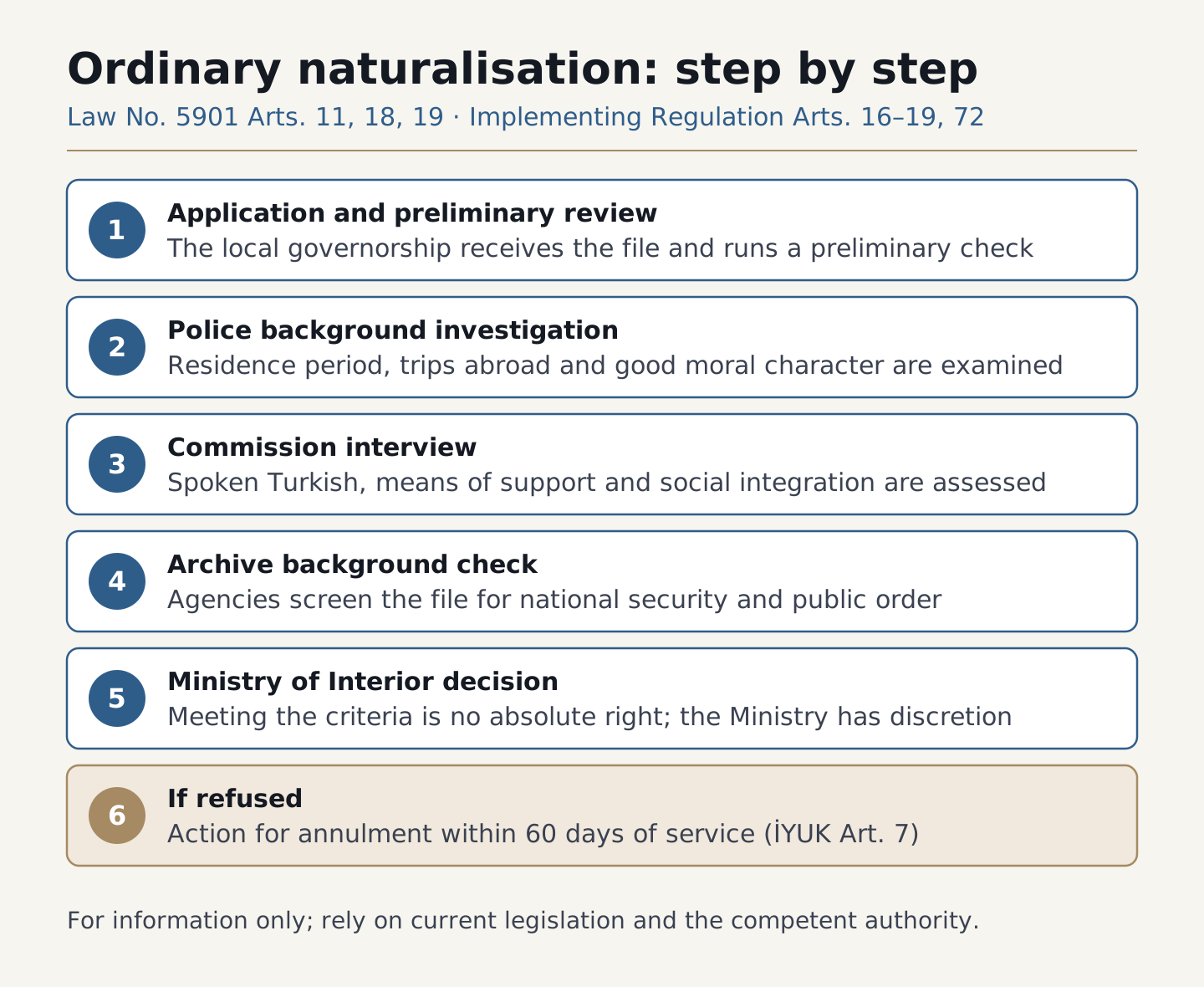
Once the file is complete, the provincial police directorate carries out an investigation, looking at your residence period, trips abroad and good moral character (Implementing Regulation Art. 18).
The file then goes to the citizenship application review commission, chaired by the governor or a deputy governor (TVK Art. 18, Regulation Art. 69).
The commission interviews the applicant and assesses spoken Turkish, means of support and integration into Turkish society (Regulation Art. 19).
Security units and intelligence agencies also run an archive background check, which remains valid for one year (Regulation Art. 72/1 and 4). If the applicant is found to meet the conditions, the file is sent to the Ministry of Interior, which takes the decision (TVK Art. 19).
How does a criminal conviction affect the application?
Under Art. 72/5 of the Implementing Regulation, a person sentenced to more than six months' imprisonment for an offence other than a negligent one cannot acquire Turkish citizenship. It makes no difference that the sentence was suspended, converted into a fine, subject to deferral of the announcement of the verdict (HAGB) or covered by an amnesty. The same rule applies to anyone found to be linked to terrorism, espionage, arms or drug trafficking, migrant smuggling or human trafficking.
What should you watch while the application is pending?
The Turkish citizenship requirements must continue to be met until the decision is made, not just on the day you apply. Because Regulation Art. 17/1-ğ requires a residence permit lasting until the procedure ends, keep track of its expiry date and renew it on time. Reporting changes of address, marital status or employer to the directorate prevents conflicts between your file and what you say at the interview.
The Law sets no binding deadline for a decision. Since checks and investigations stay valid for one year, they may be repeated in files that take longer (Regulation Art. 72/4). You can ask the provincial directorate where you applied about the status of your file. If a request goes unanswered for a long time, whether the implied rejection rule in İYUK Art. 10 applies has to be assessed on the facts of the specific file.
How does the application affect your spouse and children?
Acquiring citizenship by decision of the competent authority does not automatically change your spouse's nationality; a foreign spouse must apply separately under their own conditions (TVK Art. 20/2). Children in the applicant's custody acquire citizenship together with the applicant if the other parent consents; without consent, the matter follows a court decision in the country where the parent has their habitual residence.
Children not included in the application may apply in their own name through the ordinary route once they become adults (TVK Art. 20/3).
Spouses of Turkish citizens have a separate route that requires three years of marriage (TVK Art. 16), and investors may apply through the exceptional route described in our article on Turkish citizenship by investment (TVK Art. 12/1-b).
What can you do if your citizenship application is refused?
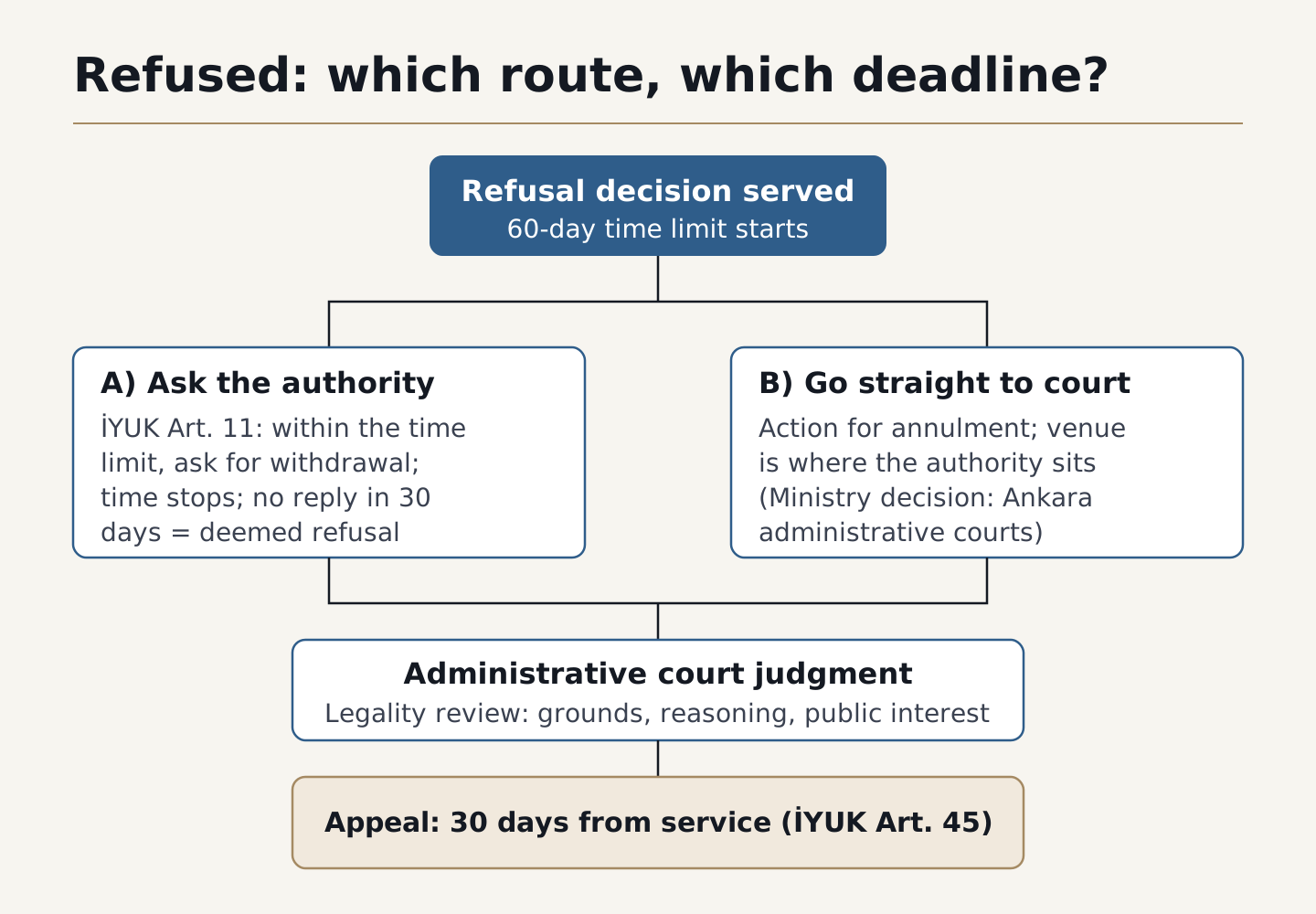
A refusal is an administrative act and can be challenged by an action for annulment in the administrative court within sixty days from the day after it is served (Law on Administrative Procedure No. 2577, İdari Yargılama Usulü Kanunu, İYUK Art. 7). Within the same period you may first ask the authority that issued the decision to withdraw it. This application stops the clock; if there is no reply within thirty days, the request is deemed rejected and the remaining time starts running again (İYUK Art. 11).
The competent court is the administrative court where the issuing authority is located (İYUK Art. 32).
Because refusals are issued by the Ministry of Interior's General Directorate of Civil Registration and Citizenship Affairs, these cases are in practice heard by the Ankara administrative courts. An appeal (istinaf) against the administrative court's judgment can be lodged with the regional administrative court within thirty days of service (İYUK Art. 45).
How do the courts review the Ministry's discretion?
The Council of State (Danıştay) accepts that granting citizenship is linked to sovereign power and that the administration has broad discretion, but it also holds that this discretion is subject to judicial review. It therefore matters whether the concrete facts behind a refusal are in the file and whether the decision is consistent with the public interest. The two decisions below show how this balance works.
The lesson from these decisions for Turkish citizenship requirements is this: a refusal resting only on an abstract reference to "discretion" and one based on concrete security findings may lead to different outcomes in court. The strategy for a case should be set after a careful review of the stated reasons and the documents in the file.
Common mistakes
- Counting years on a student or tourist residence permit towards the five years
- Applying without checking total time abroad against the entry and exit record
- Applying while criminal proceedings are still pending instead of waiting for the outcome
- Submitting income documents that are irregular or do not reflect your real financial situation
- Not recording the date the refusal was served and missing the sixty-day deadline
- Going into the interview without practising spoken Turkish or reviewing the information in your file
Turkish citizenship requirements are part of a lengthy administrative procedure in which everything from your residence history to your criminal record is assessed together. Events such as the refusal or expiry of your residence permit can directly affect the five-year period, so our articles on appealing a residence permit refusal and long-term residence permit requirements may also help. This article is for general information only and is not a substitute for legal advice. For our work in foreigners law, see our scope of services or visit the Contact page.