
A tenant eviction lawsuit in Türkiye allows a landlord to end a residential or roofed business lease (a lease of enclosed premises such as a shop or office) through a court judgment, but only on the grounds listed in the Turkish Code of Obligations (Türk Borçlar Kanunu – TBK) and within the deadlines it sets. The ground may be personal need, rebuilding, a written undertaking to vacate, two justified notices, the tenant owning a home in the same area, or unpaid rent; each has its own filing deadline.
Even a well-founded claim can fail on a missed deadline or a procedural slip. This guide covers the grounds for eviction, the filing deadlines, the mediation step that has been compulsory since 1 September 2023, and how the civil court of peace handles these cases, drawing on recent Court of Cassation (Yargıtay) decisions.
On what grounds is tenant eviction possible?
For residential and roofed business leases, a landlord can seek eviction through the courts only on the grounds exhaustively listed by law. TBK Art. 354 states that the rules on ending a lease by court action cannot be changed to the tenant's detriment. A clause such as "the landlord may demand eviction at any time" therefore cannot replace the statutory grounds.
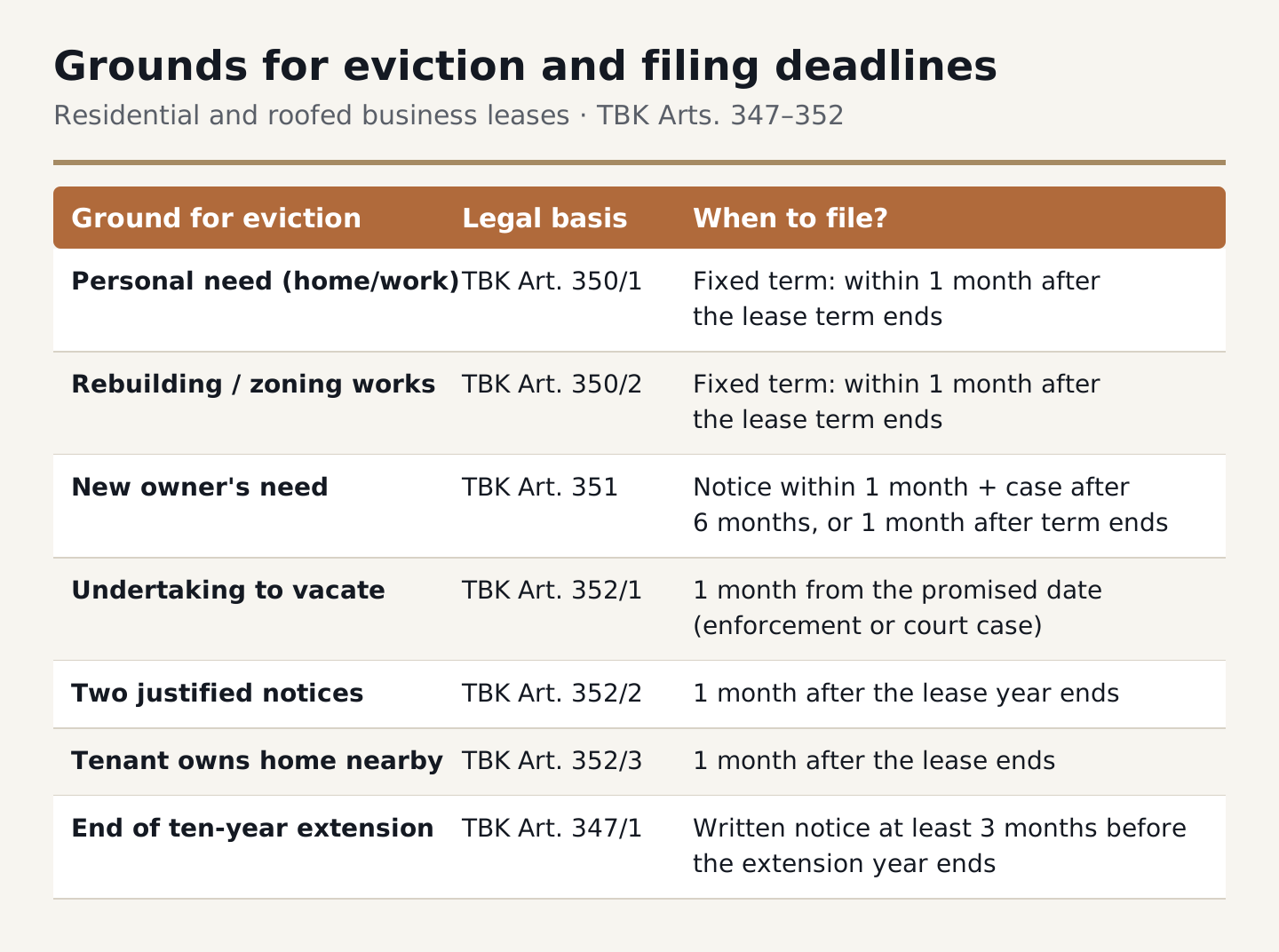
- Housing or business need of the landlord, their spouse, descendants, ascendants or dependants (TBK Art. 350/1)
- Rebuilding, or major renovation required for zoning purposes that makes use of the premises impossible (TBK Art. 350/2)
- The need of a new owner who acquires the property later (TBK Art. 351)
- The tenant failing to leave despite a written undertaking to vacate (TBK Art. 352/1)
- The tenant causing two justified notices by not paying rent (TBK Art. 352/2)
- The tenant or the spouse living with them owning a habitable home in the same district or municipality (TBK Art. 352/3)
- Default in paying rent followed by termination of the lease (TBK Art. 315)
In addition, once the ten-year extension period of a fixed-term lease has run, the landlord may end the lease by notice without giving a reason (TBK Art. 347/1). The mere expiry of the agreed term, however, is not a ground for eviction on the landlord's side: unless the tenant gives notice at least fifteen days before the end date, the lease is deemed renewed for one year on the same terms.
How does tenant eviction for personal need work?
To evict for personal need, the need must be genuine, sincere and compelling, and it must persist until the end of the trial. The law limits who can be the person in need: the landlord, their spouse, descendants, ascendants and anyone the landlord is legally obliged to support. A company in which the landlord is a partner does not qualify, because the company is a separate legal entity.
With a fixed-term lease, the case must be filed within one month after the lease term ends (TBK Art. 350). With an open-ended lease, the one-month period runs from the date determined by the general rules on termination periods and notice periods. These time limits are a matter of public order, so the court checks them of its own motion even if the tenant does not raise them.
Does a notice clause in the lease affect the deadline?
Yes. If the lease requires the landlord to give written notice a certain period before the term ends, that clause must be followed. The Court of Cassation has held that without such notice the lease is renewed for one year, and a case filed within the statutory one-month window is then not treated as timely. Always read the special terms of the lease before planning a claim.
How is the rebuilding ground proved?
Here the landlord must show that the premises need to be rebuilt, substantially repaired, extended or altered, and that the works make it impossible to use them (TBK Art. 350/2). Technical documents such as an approved project and a building permit help make the claim concrete. Painting or minor refurbishment that could be done while the tenant stays in place does not meet this test.
How does tenant eviction work after a sale to a new owner?
A person who buys a let property and needs it for themselves or a close relative can choose between two routes. Under the first, they notify the tenant in writing within one month of acquiring the property and may sue once six months have passed after that notice. Under the second, they file within one month after the lease term ends (TBK Art. 351).
A sale does not end the lease automatically; the new owner steps into the existing lease. That is why it pays to check the tenant's position and the lease term before you buy. Our checklist of checks to make before a title deed transfer covers this point.
When are an undertaking to vacate and two justified notices grounds for eviction?
A written undertaking to vacate is a valid ground only if it was given after the premises were handed over to the tenant. The landlord may start enforcement proceedings or file a case within one month from the promised move-out date (TBK Art. 352/1). Undertakings signed together with the lease, before handover, are often disputed in practice and need careful assessment.
The two-justified-notices ground requires that, in a lease of one year or longer, the tenant has caused two written formal notices within the same lease year by failing to pay rent. The case must be filed within one month after the end of the lease year in which the notices were served (TBK Art. 352/2). Each notice must be justified, meaning the rent was actually due and payable when the notice was sent.
What can a landlord do if the rent is not paid?
If rent goes unpaid, the landlord can give the tenant a written deadline and state that the lease will be terminated if payment is not made in time. For residential and roofed business leases this deadline is at least thirty days and starts on the day after written notice is given (TBK Art. 315).
Once the deadline has passed, the landlord may file an eviction case or, under Art. 269 of the Enforcement and Bankruptcy Law (İcra ve İflas Kanunu – İİK), request eviction through enforcement proceedings without a prior judgment.
Eviction through enforcement without a judgment is excluded from mandatory mediation. If the tenant objects to the payment order, though, the process can take longer, so the right route depends on the facts of each file.
Is mediation mandatory before a tenant eviction case?
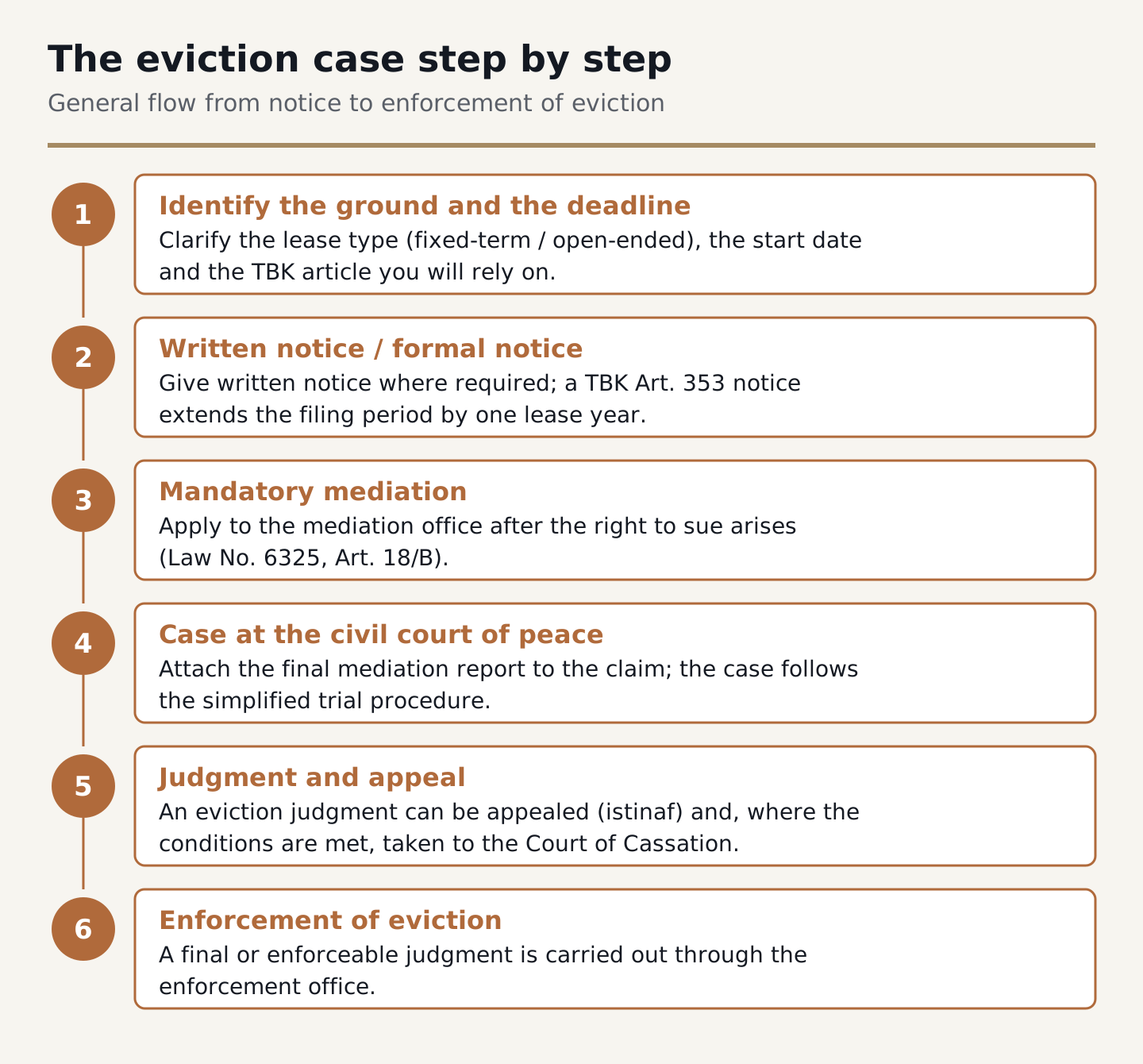
Yes. Since 1 September 2023, applying to a mediator before going to court is a procedural precondition in disputes arising from a lease. The rule comes from Article 18/B, added by Law No. 7445 to Law No. 6325 on Mediation in Civil Disputes (Hukuk Uyuşmazlıklarında Arabuluculuk Kanunu). The only exception is eviction through enforcement proceedings without a judgment under the İİK.
Timing matters too. The Court of Cassation has ruled that in personal-need cases the mediation application must be made after the right to sue has arisen, in other words within the filing period. The time between applying to the mediation office and the signing of the final mediation report is not counted towards the preclusive (forfeiture) period.
Which court hears the case, and under what procedure?
Tenant eviction cases arising from a lease are heard by the civil court of peace (sulh hukuk mahkemesi), whatever the value in dispute (Code of Civil Procedure – HMK Art. 4/1-a). Cases within that court's jurisdiction follow the simplified trial procedure (HMK Art. 316/1-a).
Under this procedure the number of written submissions is limited, and evidence should as a rule be listed with the petitions.
The original final mediation report recording that no agreement was reached, or a copy certified by the mediator, must be attached to the statement of claim. Prepare the lease, the formal notices and proof of service, documents showing the need (for example, the landlord's own tenancy agreement, or medical or job-change records) and the list of witnesses from the outset.
What should a landlord check before filing for tenant eviction in Türkiye?
Before filing, establish the start date, term and special conditions of the lease and the correct identity of the parties. Whether the property has changed hands, whether the lease is written or oral and how rent has been paid all affect the deadline calculation directly. Without these facts, the ground you choose may lead to the case being lost on procedure rather than on the merits.
The second step is to gather evidence that fits the chosen ground. In a personal-need case, document why the need arose and why it must be met by this particular property; with an undertaking to vacate, the date of the undertaking and the handover date are key. In two-notices files, the service dates of the notices and the payment records are assessed together.
Finally, mark the start and end of the filing period on a calendar and make the mediation application within that window. If landlord and tenant reach agreement in mediation, an enforceability annotation should be obtained for the settlement document from the civil court of peace (Law No. 6325, Art. 18/B).
For readers in the United States or the United Kingdom who own property in Türkiye and do not plan to travel for the case, the usual route is a power of attorney in favour of a Turkish lawyer. It can be signed at a Turkish consulate, or before a local notary and then apostilled: Türkiye, the US and the UK are all parties to the 1961 Hague Apostille Convention, so consular legalisation is not needed. A foreign-language document must then be translated into Turkish by a sworn translator, and the wording should expressly cover filing eviction claims and attending mediation.
How can the deadline be extended, and what is the ban on re-letting?
If the landlord tells the tenant in writing, at the latest within the filing period, that a case will be brought, the filing period is extended by one lease year (TBK Art. 353). This notice is widely used where more time is needed for mediation and for gathering evidence.
Notices of termination must also be in writing to be valid (TBK Art. 348).
A landlord who obtains eviction for personal need may not, without good reason, let the premises to anyone other than the former tenant for three years. A similar ban, together with a right of first refusal for the former tenant, applies to premises vacated for rebuilding or zoning works. A landlord who breaches these rules must pay the former tenant compensation of at least one year's rent at the rate paid in the last lease year (TBK Art. 355).
What defences can be raised against tenant eviction?
First, the tenant can ask the court to check whether the case was filed on time and whether the mediation precondition was properly met. In personal-need cases, the tenant may argue that the need is not genuine, sincere or compelling, for example because the landlord has another vacant and suitable property in the same area. In cases based on an undertaking to vacate, the main defence is that it was signed before handover.
In two-notices cases, the tenant may argue that the notices were not served in the same lease year, or that the rent was not yet due when a notice was sent. Each defence needs documentary support. Because the simplified procedure expects evidence to be listed with the statement of defence, tenants also need to prepare early.
Common mistakes
- Filing "early" before the term ends, or missing the one-month deadline
- Applying for mediation before the right to sue has arisen
- Ignoring a notice clause in the lease
- Relying on the need of a company partner or of relatives not listed in the law
- Relying on an undertaking to vacate signed at the same time as handover
- Selling the property, or otherwise ending the need, while the case is pending
A tenant eviction case in Türkiye depends as much on managing deadlines and the mediation step correctly as on choosing the right ground. Where the tenant or landlord is a foreign national, the effect on residence and address records should also be considered; our guide to residence permits for foreigners explains the basics. You can review our scope of services in real estate law or reach us via the Contact page. This article is for general information only and is not a substitute for legal advice.