
When deciding child custody in Turkey, the judge looks at the child's best interests, not at what either parent wants. The court weighs the child's physical, mental, emotional and social development, and a parent's fault in the divorce matters only to the extent that it affects the child's welfare.
This article explains the criteria Turkish judges apply in custody (velayet) proceedings, why the social investigation report and hearing the child carry so much weight, when joint custody is possible, and how a custody order can be changed later. We rely on the Turkish Civil Code (Türk Medeni Kanunu, TMK) and recent rulings of the Court of Cassation (Yargıtay). For the wider divorce process, see our guide to contested divorce in Turkey.
What is custody, and who gets it after a divorce?
Custody, or parental authority (velayet), is the bundle of rights and duties parents hold over a minor child, covering care, upbringing, education and legal representation. Under TMK art. 335, parental authority cannot be taken away from the mother and father without a legal ground. While the marriage continues, both parents exercise it together (TMK art. 336/1).
Where the spouses have stopped living together or a judicial separation has been ordered, the judge may award custody to one of them (TMK art. 336/2). After a divorce, custody belongs to the parent with whom the child is placed (TMK art. 336/3). When granting the divorce, the court regulates parental rights and the child's contact with the other parent, after hearing both parents wherever possible (TMK art. 182/1).
Which court hears a custody case?
Custody cases are heard by the family court (aile mahkemesi). Where no family court has been set up, the civil court of first instance (asliye hukuk mahkemesi) sits in its place. Custody is usually decided as part of the divorce judgment, but if circumstances change after the divorce, a separate action can be brought to modify the custody arrangement.
Where does the child live while the case is pending?
While the divorce is pending, the child's living arrangements are set by interim measures that the judge takes on the court's own motion. Under TMK art. 169, once a divorce or separation case is filed, the judge orders the measures needed for the children's care and protection for the duration of the proceedings. At this stage the court usually decides interim custody, temporary contact with the other parent and interim maintenance.
An interim order does not settle the final custody decision in advance. Even so, the routine a child builds with the parent they live with during the case often becomes a fact that the experts and the judge take into account. That is why it pays to request a well-considered interim arrangement at the very start of the case.
What does the best interests of the child mean?
The best interests principle means that when the interests of the child and the parents conflict, the child's interests come first. The 2nd Civil Chamber of the Court of Cassation describes it as the child's ability to grow up physically, intellectually and morally sound, together with the social, economic and cultural conditions this requires. In the Chamber's settled wording, the judge should decide the way the child would have decided for itself had it been an adult.
The principle is not confined to Turkish domestic law. Court of Cassation rulings frequently cite Article 12 of the UN Convention on the Rights of the Child and Articles 3 and 6 of the European Convention on the Exercise of Children's Rights. These provisions ensure that a child with sufficient understanding can express their views in proceedings that concern them.
Does a parent's fault decide custody?
A parent's fault in the breakdown of the marriage does not, on its own, decide custody. According to the Court of Cassation, the parents' fault, moral values and social standing are relevant only insofar as they affect the child's best interests. Infidelity, for example, may weigh heavily in the divorce itself, yet it may play little part in the custody ruling if it has no direct effect on the child's care.
What criteria does the judge look at in a custody case?
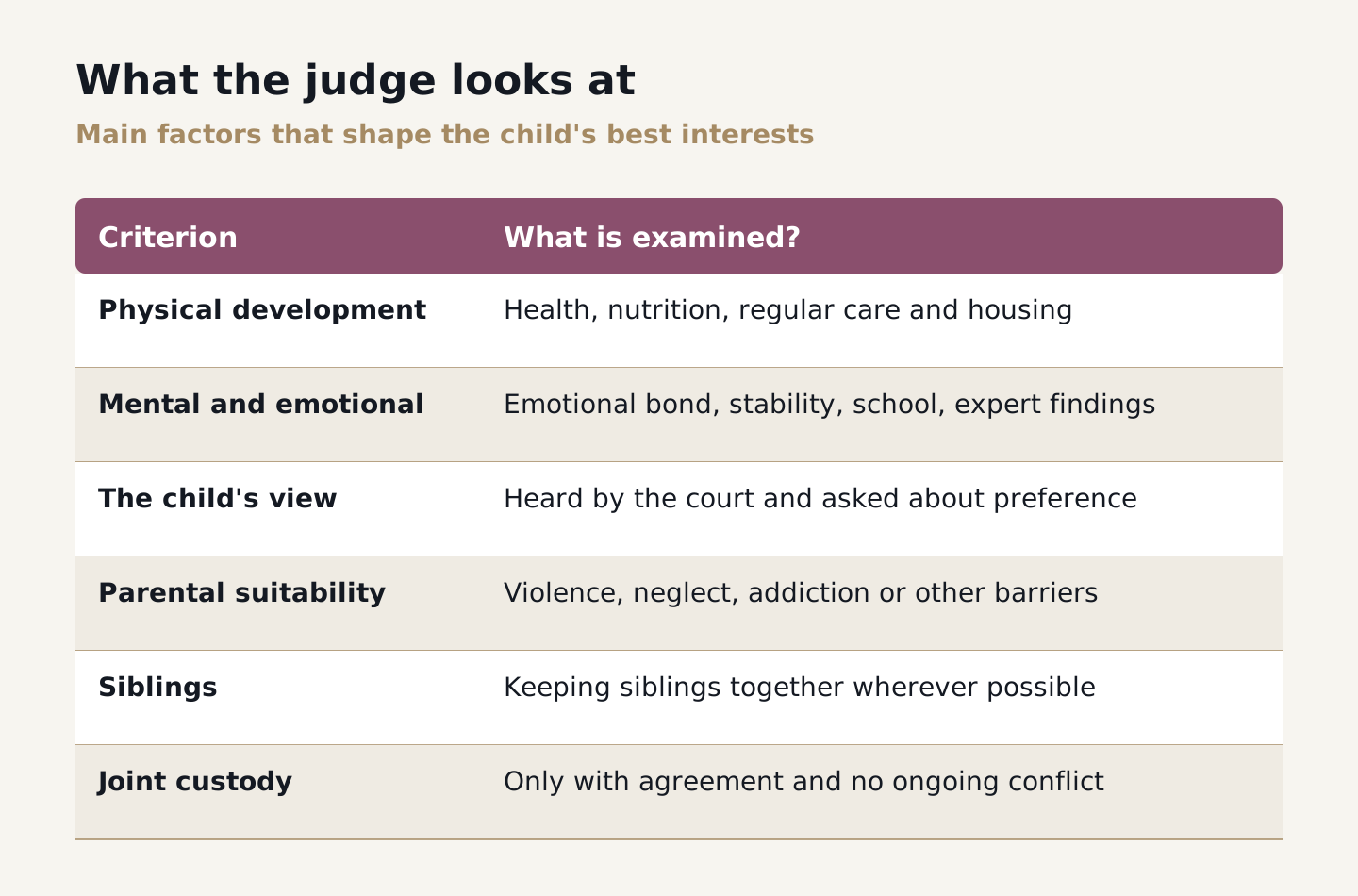
The judge tries to establish, on concrete evidence, with which parent the child is more likely to thrive. The law contains no exhaustive list; the criteria have been shaped by Court of Cassation case law. The main points the court examines are:
- Each parent's housing, income and working hours, and the time they can actually devote to the child
- The child's age, health and emotional bond with each parent
- Keeping the child's school, friends and familiar routine as stable as possible
- Circumstances that rule a parent out, such as violence, serious neglect or addiction
- Keeping siblings together wherever possible
- The views and preferences of a child who has reached the age of discernment
The Court of Cassation treats keeping siblings together as a principle the trial court must weigh. Splitting siblings between the parents is therefore upheld only when it rests on specific, well-reasoned grounds.
Why is the social investigation report so important?
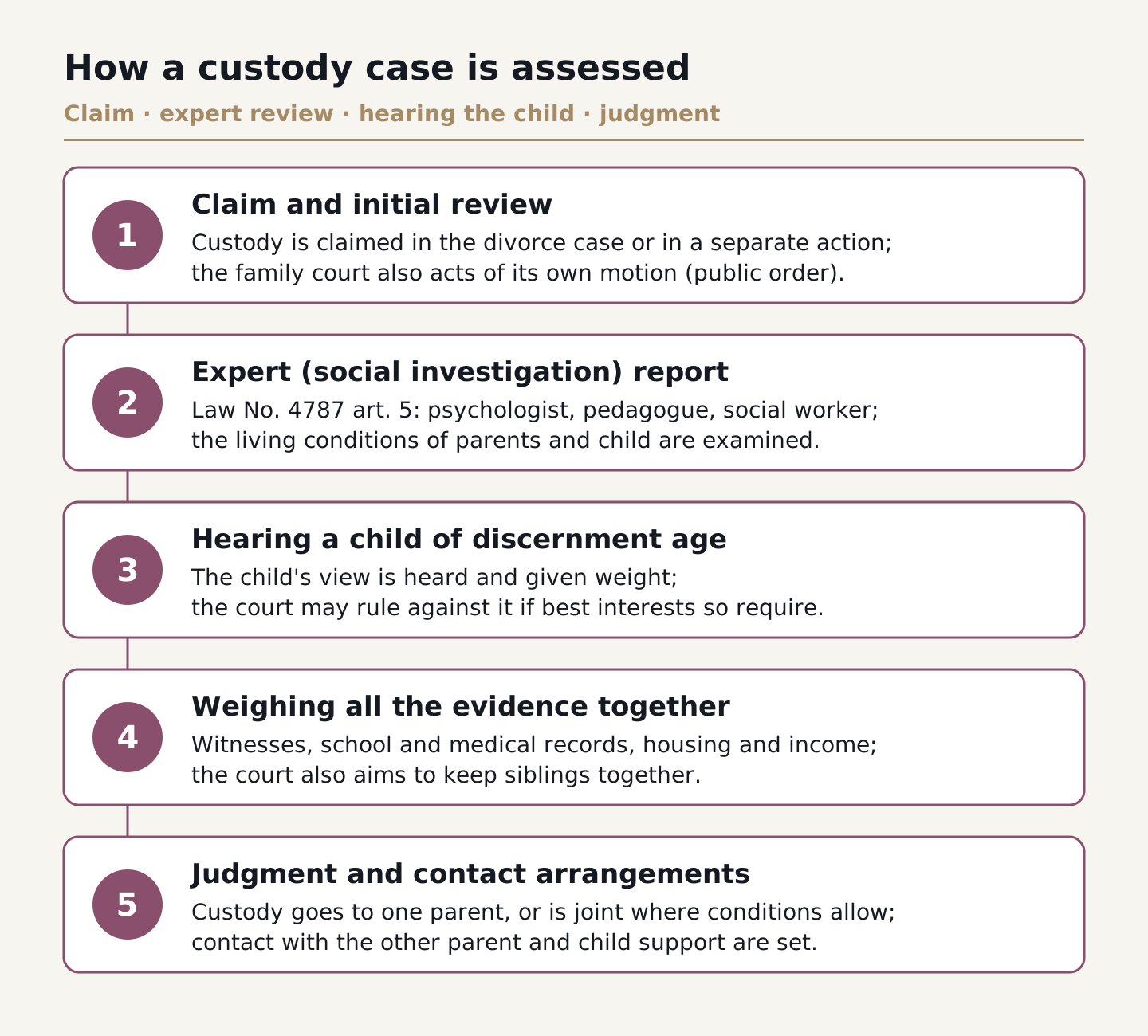
The social investigation report (sosyal inceleme raporu), also called the expert report, is the key technical evidence the judge relies on when assessing the child's best interests. Under art. 5 of Law No. 4787 on Family Courts (4787 sayılı Aile Mahkemelerinin Kuruluş, Görev ve Yargılama Usullerine Dair Kanun), family courts draw on psychologists, educational specialists (pedagogues) and social workers assigned to the courthouse to investigate the dispute. The parties may challenge these experts on the same grounds as a judge under the Code of Civil Procedure (Hukuk Muhakemeleri Kanunu, HMK).
The Court of Cassation does not accept as a sound basis for judgment a report prepared by a single expert that fails to state a clear view on which parent the child should live with. In that situation, a fresh report must be obtained from a panel made up of a psychologist, a pedagogue and a social worker, who interview both parents and the child.
Is the expert report binding on the judge?
The expert report does not bind the judge; it is weighed freely together with the other evidence. However, an incomplete or contradictory report can lead a higher court to set aside or reverse the custody decision. Parties may object to the report within the time allowed and ask for a supplementary report or a review by a new panel.
How much weight does the child's view carry?
A child who has reached the age of discernment (idrak çağı) must be heard by the court; their view matters, but it does not bind the judge on its own. The Court of Cassation reverses custody rulings made without hearing such a child and asking about their preference, treating them as based on an incomplete examination. At the same time, the court may rule against the child's wishes where their best interests require it.
There is no fixed statutory age for the age of discernment; the child's age and maturity are assessed together. The hearing usually takes place in the judge's chambers, with an expert present if needed, so the child is not put under pressure. TMK art. 339/3 also requires parents, as far as possible, to take the child's opinion into account in important matters.
When is joint custody possible?
Joint custody is possible where the parents can reach at least a basic level of agreement and the arrangement serves the child's best interests. The 2nd Civil Chamber of the Court of Cassation accepts that, once the parents have separated, custody may be left to both of them jointly. Joint custody is not a right, however; it is an order the court makes only when it suits the child.
In one case where the parents lived in different cities, could not agree on where the child should live and were locked in an ongoing dispute, the Court of Cassation held that joint custody was not in the child's best interests. So even where an uncontested divorce protocol provides for joint custody, the judge still reviews that arrangement. For more on drafting the protocol, see our article on the requirements for an uncontested divorce.
Issue | Sole custody | Joint custody |
|---|---|---|
Legal basis | TMK art. 336/2 | Court of Cassation case law, best interests of the child |
Precondition | The parent better placed to serve the child's interests | Agreement between the parents and low conflict |
Other parent | Contact rights and child support | Decisions taken together; the child's residence set separately |
Court review | Yes | Yes; a divorce protocol does not bind the judge |
What evidence can be submitted in a custody case?
Any evidence that concretely shows the child's living conditions and relationship with each parent can be submitted. The judge may investigate custody issues on the court's own motion without being limited to the parties' requests and evidence, but well-documented claims still make the assessment easier. Commonly used evidence includes:
- Witness statements from neighbours, teachers or relatives
- School attendance and progress records, and letters from the school counselling service
- Medical reports and records of the child's ongoing treatment
- Documents showing housing, income and working patterns
- Protection orders and official records where violence or neglect is alleged
- Messages between the parents, provided they were obtained lawfully
The aim of the evidence is not to discredit the other parent but to show where the child's needs will be better met. In their interviews, the expert panel also asks each parent about concrete plans for the child, such as schooling, day-to-day care and the contact schedule.
Documents from the US or the UK: apostille
If you want to rely on a school record, medical report or court document issued in the United States or the United Kingdom, keep in mind that Turkey, the US and the UK are all parties to the Hague Apostille Convention, so a public document from those countries generally needs an apostille rather than consular legalisation. In the UK, apostilles are issued by the FCDO Legalisation Office; in the US, state-issued documents are usually apostilled by the Secretary of State of the issuing state, while federal documents go to the Department of State's Office of Authentications. All three countries are also parties to the Hague Child Abduction Convention, which matters when one parent takes a child across borders without consent. Check with the court which translation and certification it requires before filing a foreign document.
Can custody be changed later?
Yes. Custody can be changed if circumstances change and the child's welfare requires it. Under TMK art. 183, where new facts make it necessary, such as a parent remarrying, moving away or dying, the judge takes the required measures on the court's own motion or at the request of either parent. Because custody is a matter of public order, the judge must consider such developments at every stage of the proceedings.
A custodial parent's remarriage does not in itself justify removing custody, although the custodial parent may be changed if the child's interests call for it (TMK art. 349). In addition, under a paragraph added to TMK art. 182 in 2021, the court warns in its judgment that custody may be changed if the contact arrangements are not complied with, provided this is not contrary to the child's interests. A paragraph added to TMK art. 324 in the same year expressly states that custody may be changed where the custodial parent fails to honour the contact arrangements.
Under TMK art. 324/1, each parent must refrain from harming the other parent's personal relationship with the child. A custodial parent who systematically prevents the child from seeing the other parent therefore gives the other side a significant argument in a custody modification case. Even then, the judge separately examines whether the change would be against the child's interests.
When does removal of parental authority come into play?
Removal of parental authority is a more severe measure than changing custody and is used only when other protective measures have failed. Under TMK art. 348, the judge removes parental authority where a parent cannot properly carry out their duties because of inexperience, illness or similar reasons, does not take sufficient care of the child, or seriously neglects their obligations. If parental authority is removed from both parents, a guardian is appointed for the child.
Common mistakes in custody cases
- Building the custody claim solely on the other parent's fault in the divorce
- Not objecting to the social investigation report in time or failing to request a supplementary report
- Steering the child towards one side or pressuring them before the hearing
- Failing to back up housing, schooling and care plans with documents
- Ignoring the contact schedule, which can lead to a change of custody
- Assuming that a joint custody clause in the protocol automatically binds the judge
A dispute over child custody in Turkey directly shapes a child's future, and every file turns on its own facts. Submitting evidence early and in an orderly way, preparing for the expert assessment and making sure the child's hearing does not cause them distress all matter. This article is for general information only and is not a substitute for legal advice. You can review the scope of our services on our Family and Inheritance Law page, browse our other publications, or get in touch via our Contact page.