Skip to content
+90 554 992 13 21
BÜYÜKAYLaw Office
  • About
  • Practice Areas

    View all
    • Immigration Law in Türkiye
    • Foreign Investment and Relocation Law
    • Real Estate Law in Türkiye
    • Family and Inheritance Law
    • Energy Law
    • Health Law
    • Criminal Law
  • Articles
  • Publications
  • Team
  • Contact
  • Türkçetr
  • Englishen
  • العربيةar
  • Русскийru
Contact
Criminal Law

Criminal Law

Human Trafficking in Türkiye: Penalty and Victim Rights (TCK 80)

  1. Home
  2. /
  3. Articles
  4. /
  5. Criminal Law
  6. /
  7. Human Trafficking in Türkiye (TCK Art. 80): Frequently Asked Questions

Published: October 31, 2026·Reading time: 5 min read

Author: Beyzanur BÜYÜKAY GENÇ

Summarize with AI

ChatGPTClaudeGrokGeminiPerplexity

Links open in a new tab. AI summaries may contain errors and are not a substitute for legal advice.

Cover: Human Trafficking in Türkiye article title, scales of justice drawing, BÜYÜKAY Law Office name and contact details

Short answer: Under Article 80 of the Turkish Criminal Code (TCK), human trafficking means recruiting, transporting, bringing into or taking out of Türkiye, or harbouring people for forced labour, prostitution, slavery or organ removal, using threats, force, deception or the victim's helplessness. The penalty is eight to twelve years' imprisonment and a judicial fine of up to 10,000 days. The victim's consent is invalid, and for children no coercive means need to be proven. Foreign victims receive a special 30-day residence permit that can be extended.

Key takeaways

  • An act, a coercive means and an exploitative purpose must all be present; crossing a border is not required.
  • The penalty is 8–12 years' imprisonment and up to 10,000 day-fines; cases are heard by the high criminal court.
  • The victim's consent is invalid; for persons under 18 no coercive means need to be shown.
  • If coercive means are not proven, the act is assessed as a prostitution offence; if both are committed, the offender is liable for both.
  • Foreign victims receive a 30-day residence permit, extendable up to 3 years, and are not deported while in the victim-support process.
Contents
  1. What is human trafficking under Turkish law?
  2. What is the penalty for human trafficking in Türkiye?
  3. If the victim agreed, is it still a crime?
  4. What does "exploiting helplessness" mean?
  5. How is trafficking distinguished from prostitution offences, and can both be punished?
  6. How does human trafficking differ from migrant smuggling?
  7. What rights do foreign victims have?
  8. How do the investigation and trial work?
  9. Can a suspect be held in pre-trial detention?
  10. Is there effective repentance for human trafficking?
  11. What is the statute of limitations?
  12. When do you need a lawyer?
  13. Sources

Human trafficking (insan ticareti) is defined in Article 80 of the Turkish Criminal Code (Türk Ceza Kanunu, TCK). It means bringing people into Türkiye, taking them out, recruiting, abducting, moving or harbouring them in order to subject them to forced labour or service, prostitution or slavery, or to have their organs removed, using threats, pressure, force, abuse of influence, deception or their helplessness. The penalty is eight to twelve years' imprisonment and a judicial fine (adli para cezası) of up to 10,000 days.

Below we explain, in question-and-answer form, the elements of the offence, why the victim's consent is legally invalid, how trafficking differs from prostitution offences and from migrant smuggling, and what rights foreign victims have.

What is human trafficking under Turkish law?

The offence has three components, and all three must be present (TCK Art. 80/1):

  • Act: bringing people into the country, taking them out, recruiting, abducting, moving or transferring them, or harbouring them.
  • Means: threats, pressure, force or violence, abuse of influence, deception, or obtaining consent by exploiting control over the person or their helplessness.
  • Purpose: forced labour, forced service, prostitution, slavery, or obtaining the person's organs.
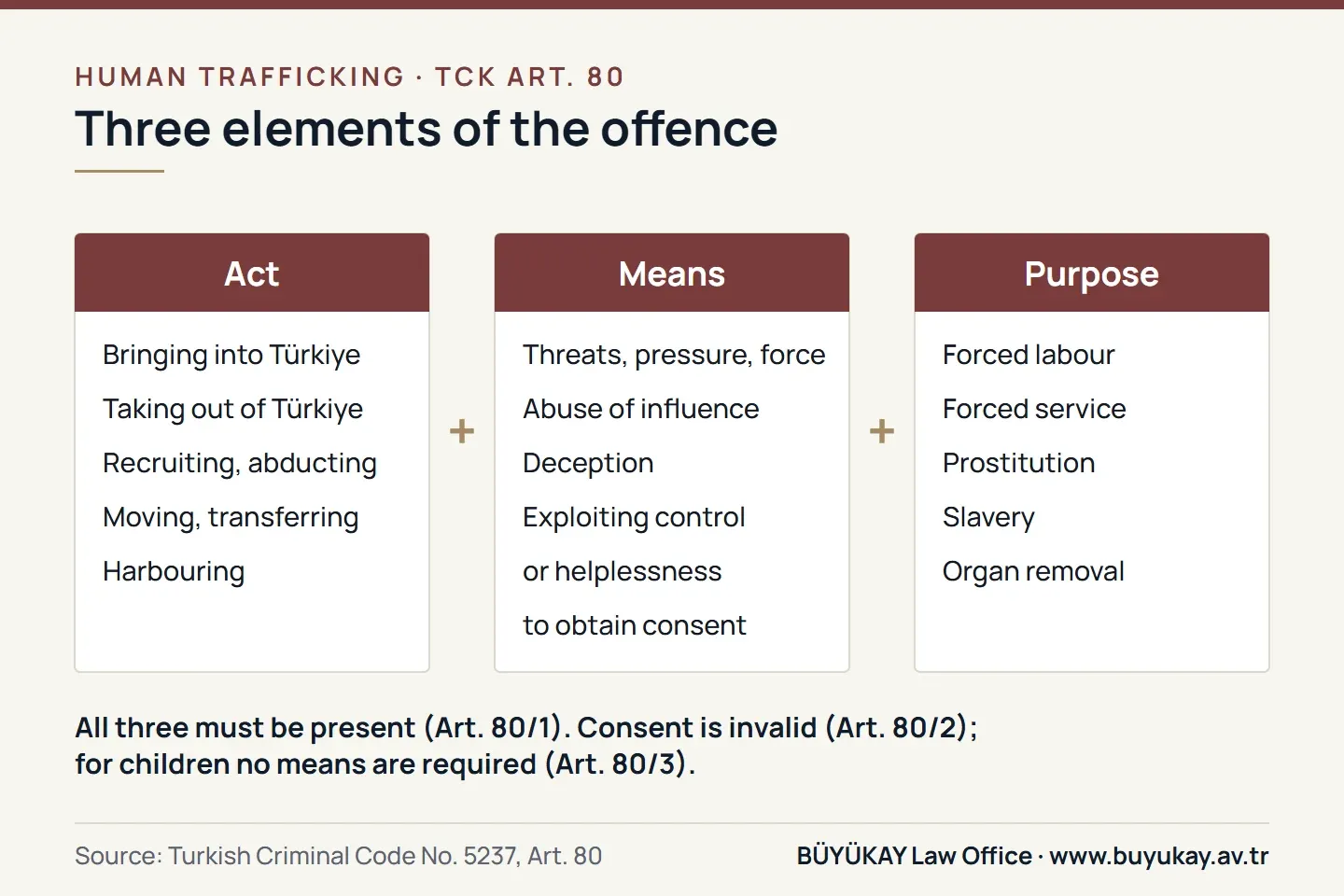
Three elements of human trafficking under TCK Article 80: act, means and exploitative purpose; consent and children rule
Act, means and purpose under TCK Art. 80/1.

Crossing a border is not required. Through recruitment, transfer or harbouring, the offence can be committed entirely within Türkiye.

What is the penalty for human trafficking in Türkiye?

The penalty is eight to twelve years' imprisonment and a judicial fine of up to 10,000 days (TCK Art. 80/1). Security measures are also imposed on legal entities involved (TCK Art. 80/4).

If the offence is committed within an organisation, founding or joining a criminal organisation is assessed separately (TCK Art. 220). Where the purpose is organ removal, the offence of trafficking in organs or tissue (TCK Art. 91) may also apply.

If the victim agreed, is it still a crime?

Yes. Where acts constituting the offence were carried out for the listed purposes, the victim's consent is invalid (TCK Art. 80/2). A "yes" obtained through threats, deception or exploitation of helplessness does not remove the offender's liability.

The rule is stricter for persons under eighteen. If a child is recruited, abducted, moved, transferred or harboured for these purposes, the offender receives the same penalty even if none of the coercive means was used (TCK Art. 80/3).

What does "exploiting helplessness" mean?

Helplessness means that the person has no other option in matters essential to survival, such as food, shelter or travel, and that the offender exploits this state of need. The Court of Cassation has held that this element is not met for people who came to Türkiye of their own will because of economic hardship at home and engaged in prostitution; such cases were assessed as prostitution offences rather than trafficking.

Court decisionCourt of Cassation (Yargıtay), 18th Criminal Chamber

E. 2015/1, K. 2015/1334 · 05/14/2015

Exploiting helplessness requires that the victim is in a situation of helplessness they cannot overcome and that this need is exploited. As the women had come to Türkiye because of economic hardship and engaged in prostitution of their own will, the element was not met and the acts were to be assessed as facilitating prostitution.

TCK Art. 80/1, Art. 227

How is trafficking distinguished from prostitution offences, and can both be punished?

The difference lies in the coercive means. If threats, force, deception or exploitation of helplessness cannot be proven, facilitating prostitution cannot be punished as trafficking; it is assessed under the prostitution offence (TCK Art. 227).

Court decisionCourt of Cassation (Yargıtay), 4th Criminal Chamber

E. 2020/7066, K. 2021/27530 · 11/24/2021

Neither the victims' and complainants' statements, the witness accounts nor the interception records mentioned threats, pressure, deception or exploitation of helplessness; convicting the defendants who facilitated prostitution of human trafficking was held unlawful.

TCK Art. 80/1, Art. 227

Where both offences are committed, the offender is liable for both. According to the Criminal General Assembly of the Court of Cassation, a person who carries out trafficking acts and then encourages, facilitates or mediates the victim's prostitution, or provides premises for it, must also be punished for the prostitution offence.

Court decisionCourt of Cassation (Yargıtay), Criminal General Assembly

E. 2019/271, K. 2019/708 · 12/19/2019

Where human trafficking and prostitution offences are committed together, the offender is also liable for the prostitution offence through which the aim was achieved. An offender who carries out trafficking acts and then encourages or facilitates the victim's prostitution, mediates it or provides premises must be punished separately for prostitution.

TCK Art. 80, Art. 227

How does human trafficking differ from migrant smuggling?

In migrant smuggling the person usually wants to cross the border illegally and the smuggler profits from it (TCK Art. 79). In trafficking the purpose is exploitation, and consent is obtained by force, deception or abuse of helplessness and is legally invalid. Smuggling always involves the border; trafficking can take place within the country.
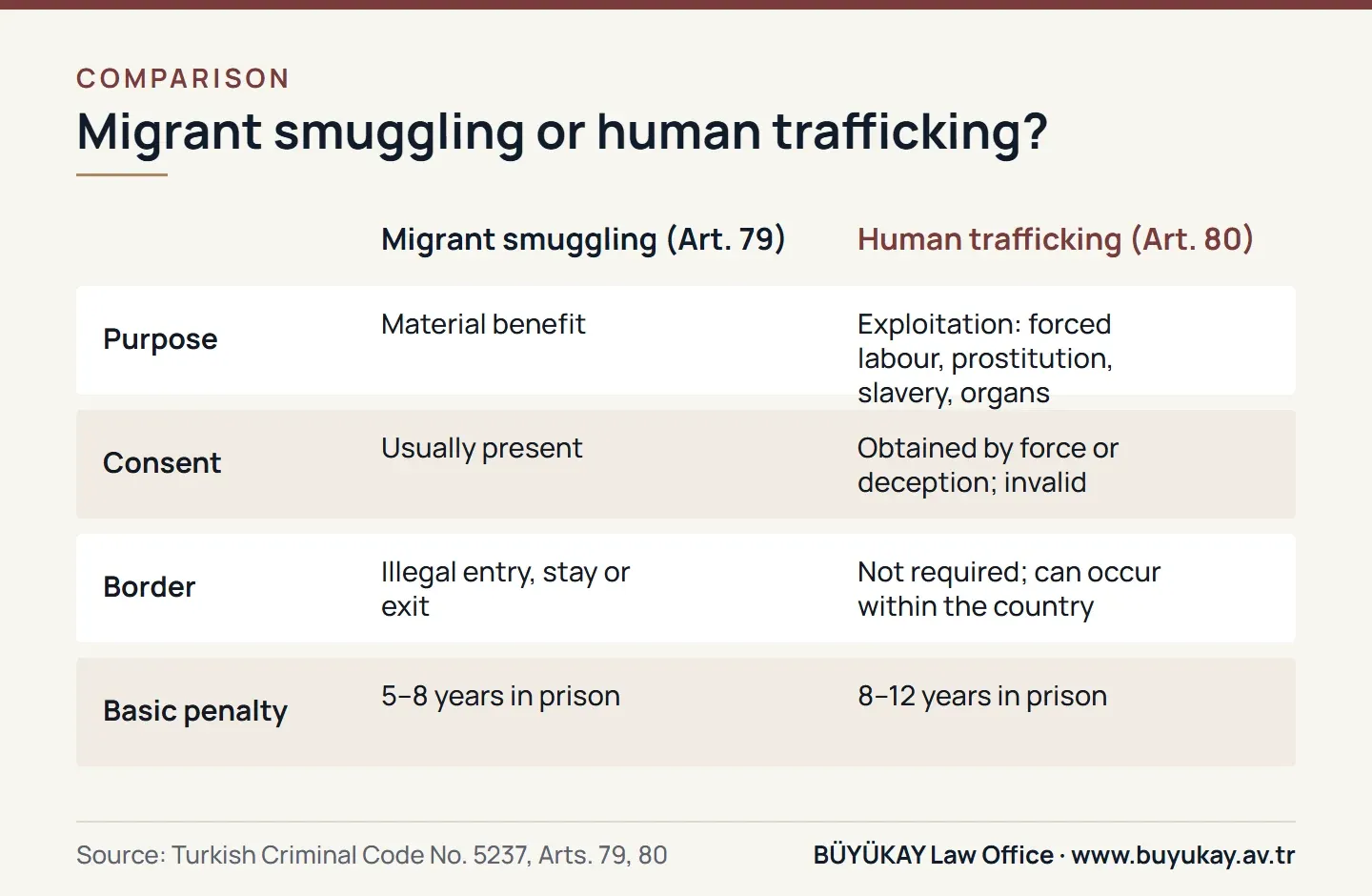
Comparison of migrant smuggling and human trafficking in Türkiye by purpose, consent, border element and basic penalty
Key differences between the two offences.

For the penalty, aggravating factors and the migrant's position, see our migrant smuggling guide.

What rights do foreign victims have?

Foreign nationals strongly suspected of being, or likely to be, victims of human trafficking receive a 30-day residence permit from the governorship, so that they can recover and decide whether to cooperate with the authorities. The usual conditions for residence permits do not apply (Law on Foreigners and International Protection No. 6458 (Yabancılar ve Uluslararası Koruma Kanunu, YUKK) Art. 48).

  • The permit can be extended in six-month periods for the victim's safety, health or special circumstances, up to a total of three years (YUKK Art. 49/1).
  • It is cancelled if the victim is found to have re-established contact with the offenders on their own initiative (YUKK Art. 49/2).
  • Trafficking victims benefiting from the victim-support process are not subject to a removal decision (YUKK Art. 55/1-ç).
  • The application can be made from within Türkiye (YUKK Art. 22).
  • A victim who does not speak Turkish is given an interpreter at the State's expense (Code of Criminal Procedure (Ceza Muhakemesi Kanunu, CMK) Art. 202, 324/5).
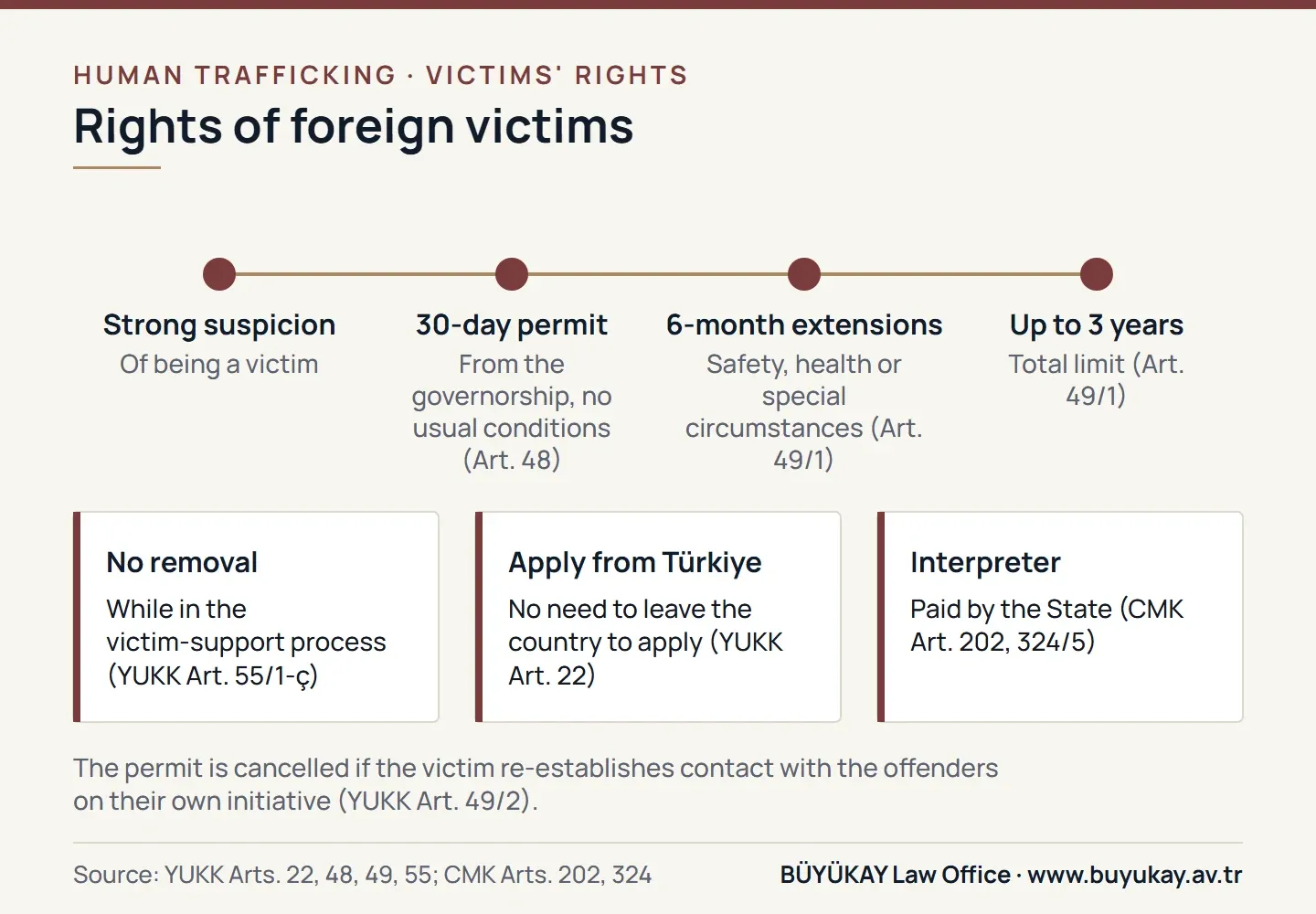
Rights of foreign trafficking victims in Türkiye: 30-day residence permit, extensions up to 3 years, no removal, interpreter
Rights of foreign victims under YUKK.

For English-speaking foreign nationals, a common pattern is a job offer abroad, for example as a model, nanny or hostess, that turns into confiscated passports and work the person never agreed to. Someone in that position can approach the police or the prosecutor's office directly; the 30-day permit exists precisely so that a victim can recover before deciding whether to cooperate. For general information on permits, see our residence permit guide and our Immigration Law page.

How do the investigation and trial work?

Human trafficking does not require a complaint; the prosecutor investigates on their own initiative after a report or a police finding, and mediation does not apply (CMK Art. 253). Because the maximum penalty exceeds ten years, the case is heard by the high criminal court (ağır ceza mahkemesi) (Law No. 5235 Art. 12).

Investigators may use interception of communications (CMK Art. 135), surveillance with technical devices (CMK Art. 140), seizure of assets (CMK Art. 128) and the appointment of a trustee to manage a company (CMK Art. 133).

Can a suspect be held in pre-trial detention?

Human trafficking is a catalogue offence under the CMK. Where strong suspicion is based on concrete evidence, a ground for detention may be presumed (CMK Art. 100/3-a-2). Detention may still not be ordered if it is disproportionate to the importance of the case and the expected penalty (CMK Art. 100/1); the judge may instead impose judicial control measures such as a travel ban or a reporting obligation (CMK Art. 109).

Is there effective repentance for human trafficking?

No. The Turkish Criminal Code has no specific effective-repentance provision for human trafficking. Where the offence was committed within an organisation, the effective-repentance rules of TCK Art. 221 can only apply to the offence of founding, managing or joining the organisation. They do not remove the penalty for trafficking itself.

What is the statute of limitations?

The limitation period for prosecution is fifteen years, because the maximum penalty is twelve years (TCK Art. 66/1-d). The suspect's statement before the prosecutor, a detention order, the indictment or a conviction interrupts the period, which then starts again, but in total it can be extended by no more than half (TCK Art. 67/2–4). The outer limit is therefore twenty-two and a half years.

When do you need a lawyer?

Anyone summoned to give a statement, taken into custody or indicted on suspicion of human trafficking should work with a lawyer. Because the minimum penalty is eight years, a suspect or defendant without a lawyer is assigned defence counsel without having to request it (CMK Art. 150/2–3).

Legal support matters for victims as well: the residence permit, protection against removal and the victim's rights in the criminal case need to be handled together.

This article is for general information and is not legal advice. For your specific situation, contact BÜYÜKAY Law Office. Our publications on criminal procedure are listed under Publications.

Sources

  • Turkish Criminal Code No. 5237, Arts. 66, 67, 80, 91, 93, 220, 221, 227 (mevzuat.gov.tr)
  • Code of Criminal Procedure No. 5271, Arts. 100, 109, 128, 133, 135, 140, 150, 202, 253, 324 (mevzuat.gov.tr)
  • Law on Foreigners and International Protection No. 6458, Arts. 22, 48, 49, 55 (mevzuat.gov.tr)
  • Law No. 5235 on the Establishment, Duties and Powers of First-Instance Courts and Regional Courts of Appeal, Art. 12 (mevzuat.gov.tr)
  • Court of Cassation, Criminal General Assembly, E. 2019/271, K. 2019/708, 19.12.2019
  • Court of Cassation, 4th Criminal Chamber, E. 2020/7066, K. 2021/27530, 24.11.2021
  • Court of Cassation, 18th Criminal Chamber, E. 2015/1, K. 2015/1334, 14.05.2015
Frequently asked questions

  • Can a domestic worker whose passport was taken be a trafficking victim?+

    Yes, potentially. Exploiting control over a person for forced labour or service is one of the coercive means of trafficking (TCK Art. 80/1). Confiscated documents, work imposed under the pretext of a debt and restricted freedom of movement are important indicators. Every case is assessed on its own evidence.

  • Is being lured abroad with a job offer and forced into prostitution trafficking?+

    Obtaining consent by deception and taking a person abroad in order to make them engage in prostitution has the elements of trafficking (TCK Art. 80/1). A fake job advert or false promises that make the person travel can amount to deception. In that case the victim's initial consent is invalid (TCK Art. 80/2).

  • Which offence is it to persuade someone to give an organ?+

    A person who recruits, moves or harbours someone, through deception or exploitation of helplessness, in order to obtain their organs commits human trafficking (TCK Art. 80/1). Buying, selling or brokering organs or tissue is a separate offence under TCK Art. 91, and TCK Art. 93 contains an effective-repentance rule for a person who sold their own organs or tissue.

  • What can a victim do if they are afraid to go to the police?+

    A victim can approach the police or go directly to the public prosecutor's office. The 30-day residence permit for foreign victims exists so that they can recover and decide whether to cooperate with the authorities (YUKK Art. 48). While in the victim-support process they are not deported (YUKK Art. 55/1-ç). Applying together with a lawyer makes the process safer.

  • Will a foreign victim be heard in their own language?+

    A victim who does not speak Turkish is heard through an interpreter, including during the investigation (CMK Art. 202). The cost is not added to court fees but is paid by the State (CMK Art. 324/5). A victim should not sign a record they do not understand; its content should be read to them through the interpreter, and they may state the language they speak best.

  • Can companies be sanctioned for human trafficking?+

    Yes. Security measures are imposed on legal entities for these offences (TCK Art. 80/4). During the investigation a trustee may be appointed to manage the company and its assets may be seized (CMK Art. 128, 133). The individual liability of managers and employees is assessed separately, and the type of measure depends on how the offence is linked to the company's activities.

  • Can phone tapping and technical surveillance be used?+

    Yes. Human trafficking is a catalogue offence for interception of communications (CMK Art. 135) and surveillance with technical devices (CMK Art. 140). These measures are applied under the conditions and procedure set by law, as a rule by judicial order. Recordings obtained unlawfully cannot be used as evidence.

  • Can a victim claim compensation from the offenders?+

    Yes. A victim can join the criminal proceedings and claim compensation for material and non-material damage by filing a separate action in the civil courts. Legal support helps to file the claim in time, before the right court, and with evidence consistent with the criminal file. The evidence and judgment in the criminal case are an important basis for the compensation claim.

Author

Beyzanur BÜYÜKAY GENÇ

Attorney at Law

Attorney Beyzanur BÜYÜKAY GENÇ practises across several areas of public and private law, with a particular focus on immigration law in Türkiye. She combines her academic background with practical experience in providing legal advice and representation to clients.

Related practice areas

  • Criminal Law

Last verified: October 31, 2026

This article is for general information only; consult an attorney for advice on a specific matter.

Related publications

  • Cover: Migrant Smuggling in Türkiye article title, scales of justice drawing, BÜYÜKAY Law Office name and contact details
    Criminal LawOctober 31, 2026

    Migrant Smuggling in Türkiye (TCK Art. 79): Frequently Asked Questions

    What counts as migrant smuggling under Turkish law, the prison range, aggravating factors, detention, limitation periods and the migrant's own position, with Court of Cassation rulings.

    Beyzanur BÜYÜKAY GENÇ·7 min read
  • Cover: residence permit guide for foreigners in Türkiye, residence card drawing, BÜYÜKAY, www.buyukay.av.tr and phone
    Immigration LawOctober 29, 2026

    Residence Permits in Türkiye: A Guide for Foreign Nationals

    A guide to Turkish residence permits for foreigners staying over 90 days: permit types, requirements, the e-İkamet application, documents, renewal and appeals.

    Beyzanur BÜYÜKAY GENÇ·7 min read
BÜYÜKAYLaw Office

Select language

  • Türkçe
  • English
  • العربية
  • Русский

Firm

  • About
  • Team
  • Articles
  • Publications
  • Contact
  • Search

Practice Areas

  • Immigration Law in Türkiye
  • Foreign Investment and Relocation Law
  • Real Estate Law in Türkiye
  • Family and Inheritance Law
  • Energy Law
  • Health Law
  • Criminal Law
  • View all

Contact

Hukukçular Towers, Mustafa Kemal Paşa Caddesi, Seyitgazi Sokağı, No: 66 A Blok D: 15Kartal / İSTANBUL

+90 554 992 13 21WhatsApp

Monday–Friday 09:00–18:00

This website has been prepared in accordance with the Advertising Ban Regulation of the Union of Turkish Bar Associations. Information on this site is of a general nature and does not replace legal advice.

© 2026 BÜYÜKAY