
Migrant smuggling (göçmen kaçakçılığı) is defined in Article 79 of the Turkish Criminal Code (Türk Ceza Kanunu, TCK). It covers bringing a foreign national into Türkiye or enabling them to stay by illegal means, and enabling a Turkish citizen or a foreigner to leave the country illegally, in each case to obtain a direct or indirect material benefit. The penalty is five to eight years' imprisonment and a judicial fine (adli para cezası) of 1,000 to 10,000 days.
Below we answer the questions people ask most often, based on the current text of the law and rulings of the Turkish Court of Cassation (Yargıtay). Because the two offences are often confused, we also explain how migrant smuggling differs from human trafficking.
What is migrant smuggling under Turkish law?
The law makes two kinds of conduct a crime. In both, the act must be carried out by illegal means and with the aim of obtaining a material benefit (TCK Art. 79/1):
- Bringing a foreign national into Türkiye or enabling them to stay: for example, guiding people across the border, or transporting or housing irregular migrants for money.
- Enabling a Turkish citizen or a foreign national to leave Türkiye: for example, organising an illegal crossing by sea or land.
The article itself contains no definition. The Court of Cassation relies on the definition in the UN Protocol against the Smuggling of Migrants, to which Türkiye is a party: procuring, for a financial or other material benefit, the illegal entry of a person into a state of which they are not a national or permanent resident.
Does the offence require that money was actually paid?
A material benefit motive is an essential element. The law requires that the person acted "in order to obtain a direct or indirect material benefit". What matters is that motive; the benefit does not have to be received.
Where a defendant says they gave migrants a lift out of kindness, the Court of Cassation expects the trial court to examine the benefit motive on concrete evidence. Convictions entered without that analysis are quashed.
What is the penalty for migrant smuggling in Türkiye?
The basic penalty is five to eight years' imprisonment and a judicial fine of 1,000 to 10,000 days (TCK Art. 79/1). Law No. 7445 (Official Gazette, 5 April 2023) raised the minimum prison term from three to five years.
For acts committed before that change, the court applies whichever law is more favourable to the defendant (TCK Art. 7/2).
Even if the offence remains at the attempt stage, the penalty is imposed as if it had been completed (TCK Art. 79/1, last sentence). Being stopped before reaching the border does not reduce the sentence.
What are the aggravating factors?
The law lists four aggravating situations and a separate measure for legal entities:
Situation | Effect | Legal basis |
|---|---|---|
The offence endangers the victims' lives | Penalty increased by one half to two thirds | TCK Art. 79/2-a |
The victims are subjected to degrading treatment | Penalty increased by one half to two thirds | TCK Art. 79/2-b |
Committed jointly by more than one person | Penalty increased by up to one half | TCK Art. 79/3 |
Committed within the activities of an organisation | Penalty increased by one half to one time (doubled) | TCK Art. 79/3 |
Committed within the activities of a legal entity | Security measures specific to legal entities | TCK Art. 79/4 |
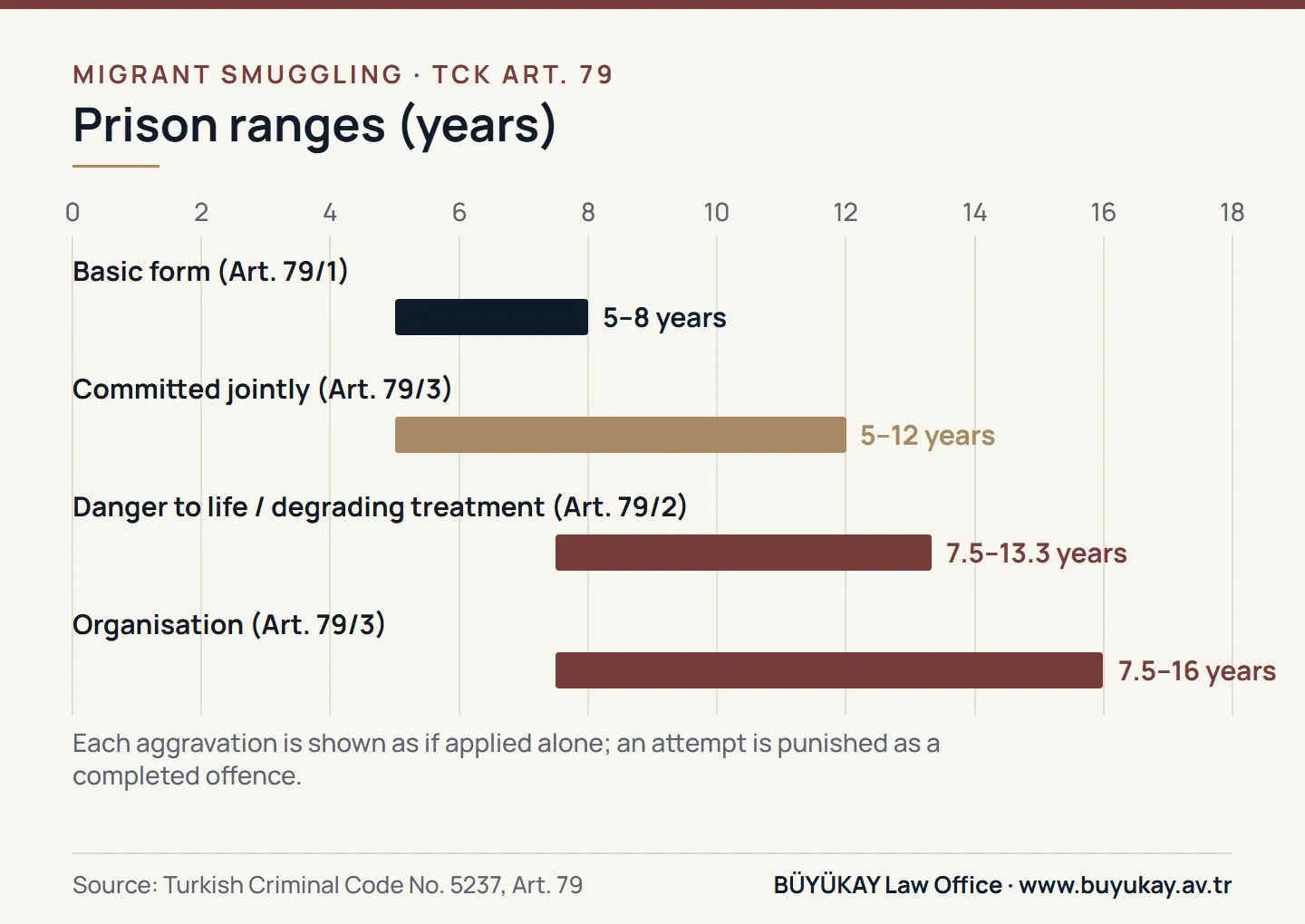
The danger-to-life aggravation needs concrete evidence of an actual danger. The Court of Cassation has held that carrying more passengers than a vehicle's capacity is not enough on its own.
How does migrant smuggling differ from human trafficking?
The key differences are purpose and consent. In migrant smuggling the person usually wants to cross the border illegally and the smuggler profits from it. In human trafficking the purpose is exploitation (forced labour, prostitution, slavery, organ removal) and consent is obtained through threats, deception or by abusing the victim's helplessness (TCK Art. 80/1).
Migrant smuggling (TCK Art. 79) | Human trafficking (TCK Art. 80) | |
|---|---|---|
Purpose | Material benefit | Exploitation: forced labour, prostitution, slavery, organs |
Consent | Usually present | Obtained by force, deception or abuse of helplessness; legally invalid |
Border element | Illegal entry, stay or exit | Not required; can occur within the country |
Basic penalty | 5–8 years and 1,000–10,000 day-fines | 8–12 years and up to 10,000 day-fines |
Both offences can arise in the same case. See our human trafficking guide for details.
Is it smuggling to take someone illegally to their own country?
According to the settled case law of the Court of Cassation, illegally taking a person into the country of which they are a national does not constitute migrant smuggling. The rulings rely on the UN Protocol definition and on Article 3 of Protocol No. 4 to the European Convention on Human Rights, which guarantees everyone's right to enter their own country.
Is the smuggled migrant criminally liable?
The offender is the person who guides, transports or houses the migrant. The law refers to smuggled persons as "victims" (TCK Art. 79/2), and it does not provide for punishing the migrant as a perpetrator of this offence.
Illegal entry or exit still has administrative consequences. Foreign nationals who enter or leave Türkiye illegally, or attempt to do so, face an administrative fine under the Law on Foreigners and International Protection No. 6458 (Yabancılar ve Uluslararası Koruma Kanunu, YUKK) Art. 102/1-a.
A separate rule protects people seeking international protection (asylum): those who apply to the governorship on their own initiative within a reasonable time and explain valid reasons for their illegal entry or stay are not subject to criminal proceedings for breaching the entry rules (YUKK Art. 65/4).
If you are a foreign national questioned in Türkiye, you are entitled to an interpreter during the investigation as well as at trial, and the State pays for it (Code of Criminal Procedure (Ceza Muhakemesi Kanunu, CMK) Art. 202 and 324/5). Do not sign a statement whose content has not been translated to you. For legal ways to stay in Türkiye, see our residence permit guide and our Immigration Law page.
How do the investigation and trial work?
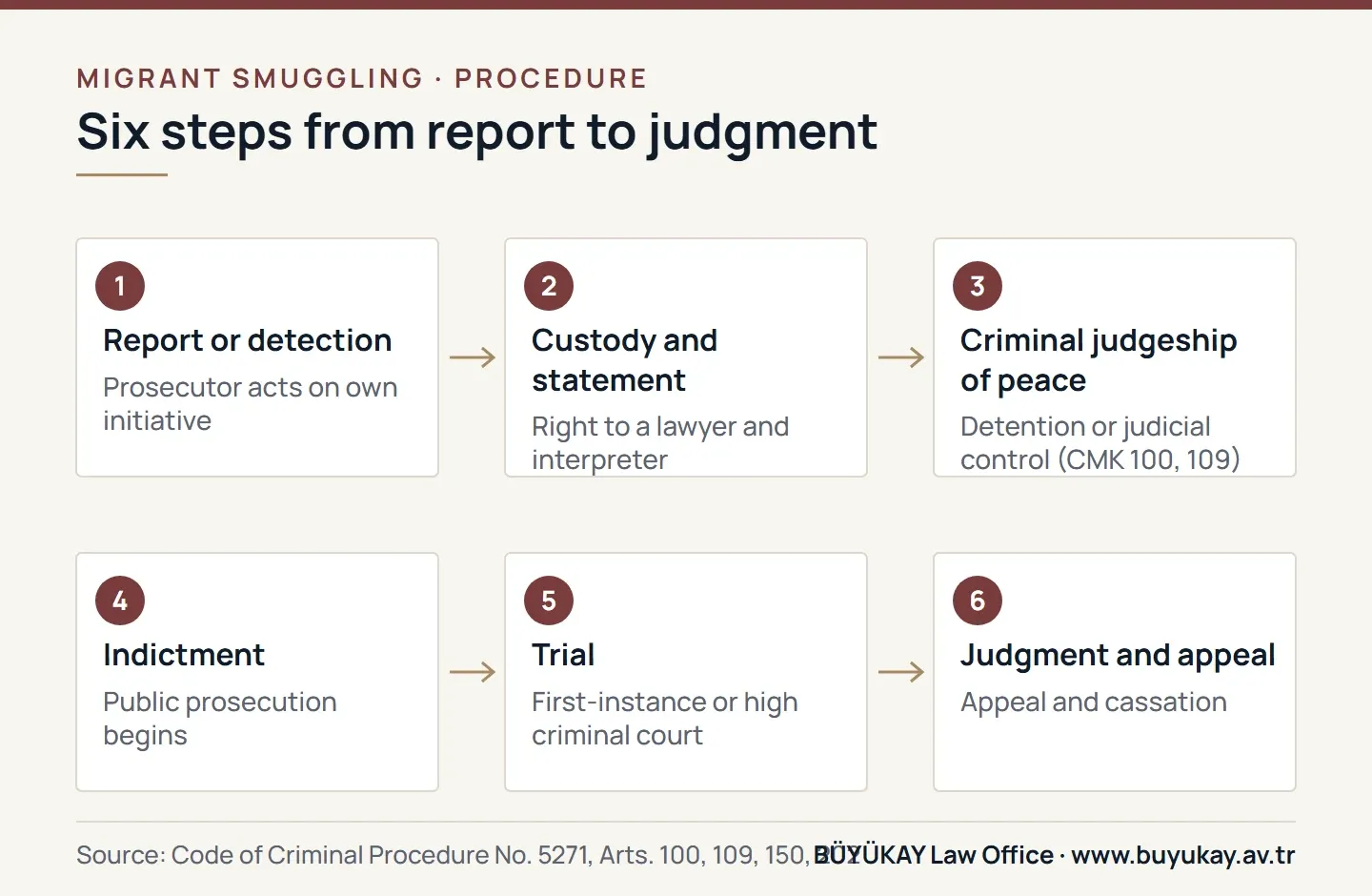
No complaint is needed: the public prosecutor's office opens an investigation on its own initiative after a report or a police finding. The offence is not among those eligible for mediation (uzlaştırma), so the parties cannot settle the case (CMK Art. 253).
The law allows intrusive investigative measures for this offence:
- Interception and recording of communications (CMK Art. 135)
- Surveillance with technical devices (CMK Art. 140)
- Seizure of real estate, rights and receivables (CMK Art. 128)
- Appointment of a trustee to manage a company (CMK Art. 133)
Whether the case is heard by a criminal court of first instance (asliye ceza) or a high criminal court (ağır ceza) depends on whether the maximum penalty, including aggravating factors, exceeds ten years (Law No. 5235 Art. 12).
Can a suspect be held in pre-trial detention?
Migrant smuggling is a catalogue offence under the CMK. Where strong suspicion is based on concrete evidence, a ground for detention may be presumed without separately showing a risk of flight or of tampering with evidence (CMK Art. 100/3-a-2). This was added by Law No. 7196 in 2019.
Detention is still not automatic: it may not be ordered if it is disproportionate to the importance of the case and the expected penalty (CMK Art. 100/1). The judge may impose judicial control (adli kontrol) instead (CMK Art. 109). Common obligations include:
- A ban on leaving Türkiye
- Reporting regularly to a designated place
- Not leaving one's home or a specified area
- Depositing security set by the judge
Does effective repentance apply?
No. The Turkish Criminal Code has no specific effective-repentance (etkin pişmanlık) provision for migrant smuggling. Where the offence was committed within an organisation, effective repentance can only arise for the organisation offence: a member who leaves voluntarily and informs the authorities, or who gives information on the organisation, may escape or reduce the penalty for founding, managing or joining it (TCK Art. 221). The penalty for migrant smuggling itself remains.
What is the statute of limitations?
In the basic form the limitation period for prosecution is fifteen years, because the maximum penalty is more than five and less than twenty years (TCK Art. 66/1-d). Aggravating factors shown by the evidence are taken into account (TCK Art. 66/3).
The period is interrupted by the suspect's statement before the prosecutor, a detention order, the indictment or a conviction, and then starts again. In total it can be extended by no more than half (TCK Art. 67/2–4), so the outer limit in the basic form is twenty-two and a half years.
When do you need a lawyer?
Contact a lawyer as soon as you are summoned to give a statement, taken into custody or served with an indictment. The first statement often shapes the rest of the case, and the benefit motive and any aggravating factors must be tested against the evidence.
In the basic form the minimum penalty is exactly five years, so mandatory defence counsel does not apply automatically; it applies to offences with a minimum of more than five years (CMK Art. 150/3). A suspect without a lawyer who says they cannot appoint one is assigned defence counsel on request (CMK Art. 150/1).
This article is for general information and is not legal advice. For your specific situation, contact BÜYÜKAY Law Office. Our publications on criminal procedure are listed under Publications.
Sources
- Turkish Criminal Code No. 5237, Arts. 7, 66, 67, 79, 221 (mevzuat.gov.tr)
- Law No. 7445, Art. 16 (Official Gazette, 5 April 2023)
- Code of Criminal Procedure No. 5271, Arts. 100, 109, 128, 133, 135, 140, 150, 202, 253, 324 (mevzuat.gov.tr)
- Law on Foreigners and International Protection No. 6458, Arts. 65, 102 (mevzuat.gov.tr)
- Law No. 5235 on the Establishment, Duties and Powers of First-Instance Courts and Regional Courts of Appeal, Art. 12 (mevzuat.gov.tr)
- Court of Cassation, 4th Criminal Chamber, E. 2021/27636, K. 2022/17663, 21.09.2022
- Court of Cassation, 4th Criminal Chamber, E. 2021/21454, K. 2022/20887, 26.10.2022
- Court of Cassation, 4th Criminal Chamber, E. 2020/14237, K. 2020/18647, 07.12.2020
- Court of Cassation, 4th Criminal Chamber, E. 2021/31237, K. 2024/6839, 16.05.2024
- Court of Cassation, 18th Criminal Chamber, E. 2017/1180, K. 2019/2921, 13.02.2019