
A contested divorce in Turkey (çekişmeli boşanma) is the type of case filed when spouses cannot agree on the divorce or on its consequences, such as maintenance, custody, compensation or fault, so the judge decides on the basis of the evidence. The spouse who files must prove at least one ground for divorce listed in the Turkish Civil Code (Türk Medeni Kanunu, TMK) and the facts relied on.
Unlike an uncontested divorce, this route rarely ends at a single hearing: written pleadings, a preliminary examination, the hearing of witnesses and possible appeals all need to be planned for. Below we walk through the grounds for divorce, the preclusive periods (deadlines that extinguish the right to sue once missed), the rules of evidence and the stages of the case.
When is a contested divorce filed?
A contested case is needed when one spouse does not want a divorce, or when both accept the divorce but cannot settle property, maintenance, custody or compensation. Even if the spouses initially agreed, the case continues as a contested one once their agreement on the settlement protocol breaks down.
If the marriage has lasted at least one year and the spouses agree on every consequence, the requirements for an uncontested divorce under TMK Art. 166(3) offer a shorter path. Without such agreement, a contested case based on one of the grounds below is the remaining option.
What are the grounds for divorce in Turkey?
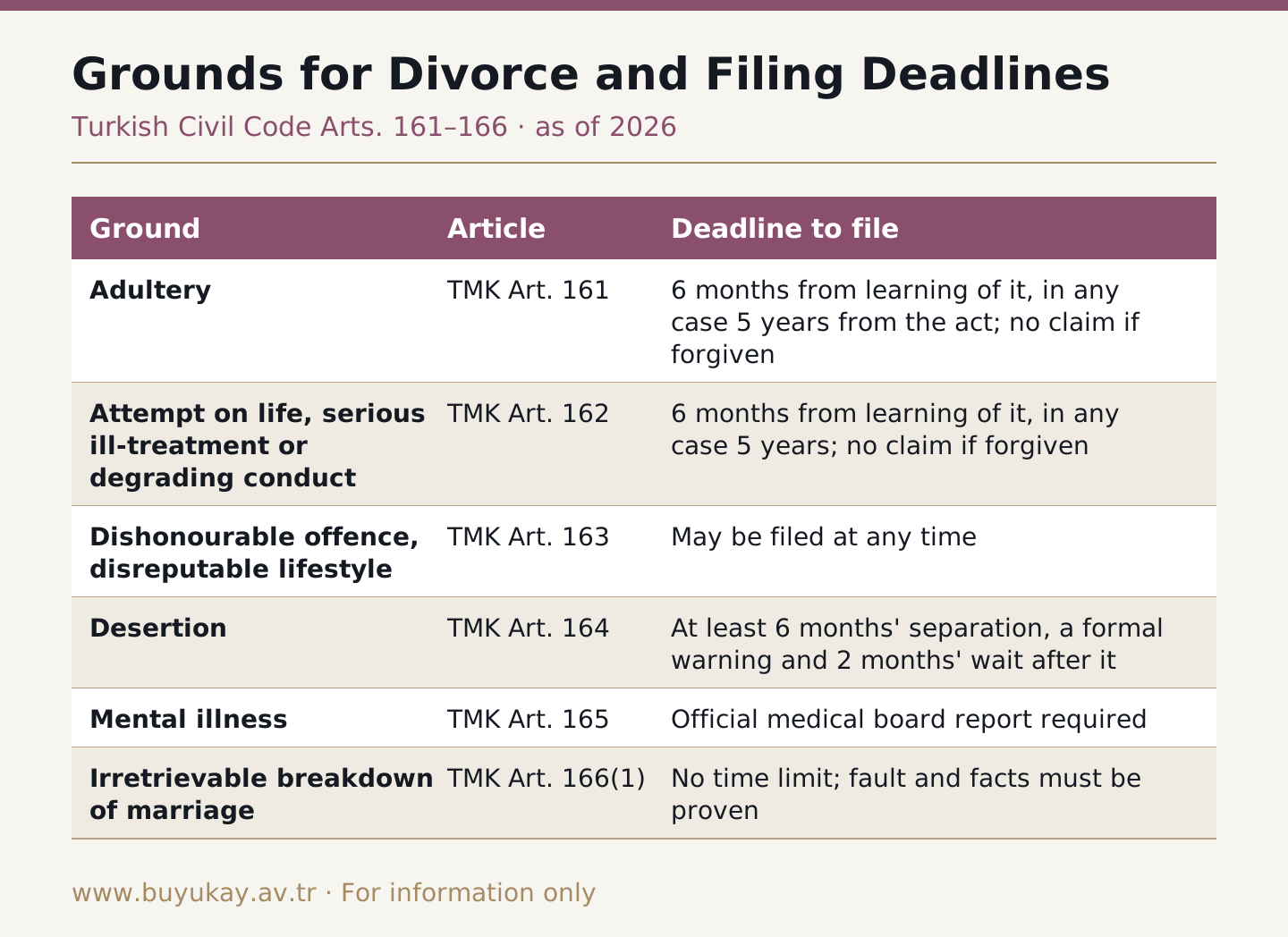
Turkish law divides the grounds for divorce into specific and general grounds. For specific grounds (TMK Arts. 161–165), proving the event itself is usually enough; for the general ground (TMK Art. 166(1)), the claimant must show that the marriage has been shaken to such an extent that the spouses cannot be expected to continue their life together.
- Adultery (TMK Art. 161): a spouse's infidelity; a spouse who has forgiven it cannot sue on this ground.
- Attempt on life, serious ill-treatment or degrading conduct (TMK Art. 162): violence, grave insults, humiliation.
- A dishonourable offence or disreputable lifestyle (TMK Art. 163): situations in which living together cannot be expected.
- Desertion (TMK Art. 164): a specific ground that depends on a formal warning procedure.
- Mental illness (TMK Art. 165): incurability must be established by an official medical board report.
- Irretrievable breakdown of the marriage (TMK Art. 166): the general ground most frequently used in practice.
How is irretrievable breakdown proven?
Under this ground, the court identifies each concrete event that can be attributed to either spouse and weighs which of them bears the greater share of fault. Constant arguments, economic abuse, indifference, conduct undermining trust in breach of the duty of fidelity, or insults directed at the other spouse's family may all be assessed here.
If the claimant is more at fault, the defendant has a right to object to the divorce (TMK Art. 166(2)). The court may still grant the divorce, however, where the objection amounts to an abuse of rights and continuing the marriage no longer serves any interest of the defendant and the children that deserves protection.
Serious ill-treatment and criminal proceedings
Violent or threatening conduct can be both a ground for divorce and a separate criminal offence. For the criminal side, see our articles on intentional injury, the offence of threat and the offence of insult; medical reports and police records from the criminal file can also be submitted in the divorce case.
What deadlines apply in a contested divorce?
For adultery, attempts on life and serious ill-treatment, the case must be filed within six months of learning of the ground and, in any event, within five years of the event (TMK Arts. 161(2) and 162(2)). These are preclusive periods: once they lapse, the same event can no longer support a claim on the specific ground, although it may still be assessed under the general ground.
For desertion, the separation must have lasted at least six months; a formal warning may only be requested after the fourth month, and the case cannot be filed until two months have passed since the warning (TMK Art. 164(2)). The warning, issued by a judge or a notary public, tells the deserting spouse to return to the family home within two months.
The one-year rule after a dismissed divorce case
Under TMK Art. 166(4), as amended by Law No. 7532 (Official Gazette, 27.11.2024), if a divorce case is dismissed by a final judgment and the spouses do not resume their life together within one year, the marriage is deemed to have irretrievably broken down. The court then grants a divorce at the request of either spouse; under the previous rule, this period was three years.
In its decision of 12.02.2026 (Case No. 2025/203, Decision No. 2026/39), the Constitutional Court (Anayasa Mahkemesi) found that this one-year period did not violate the Constitution and rejected the challenge. If your case will rely on this provision, it is important to confirm the date on which the dismissal became final with a document from the court registry.
What evidence can be used in a divorce case in Turkey?
In divorce cases the judge assesses the evidence freely, and an admission by a party is not binding on the court (TMK Art. 184). Rather than relying on a single admission, you should therefore support each event with different types of evidence.
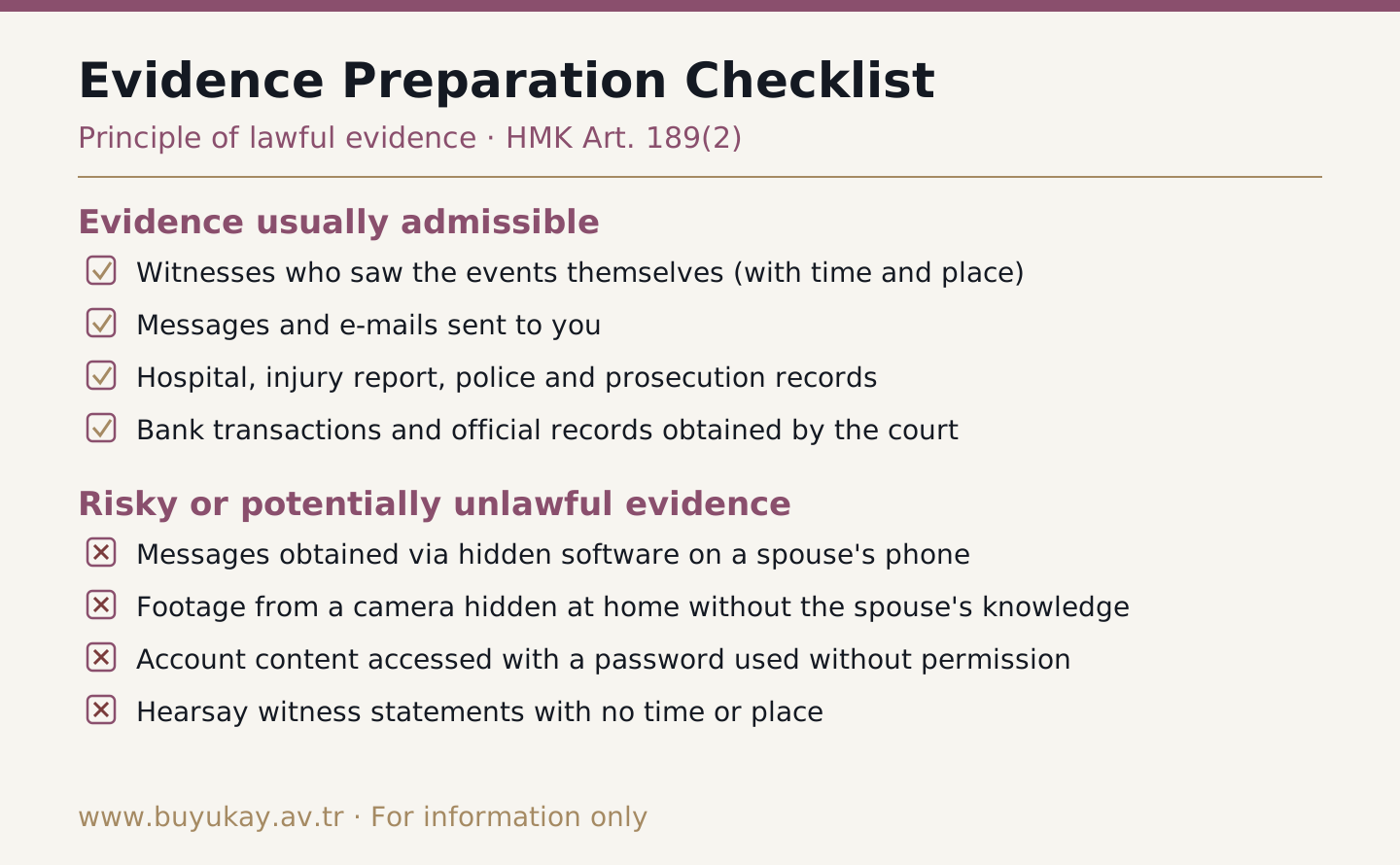
- Statements of people who personally witnessed the events
- Messages, e-mails and social media posts your spouse sent directly to you
- Medical reports on injuries, hospital records, police reports and prosecution files
- Bank, land registry, hotel or communication records obtained through the court
- Where needed, a social worker's report and a court-appointed expert's examination
How are witness statements assessed?
In divorce cases, witnesses are often the most important evidence, but the court gives weight only to people who saw or heard the event themselves. According to Court of Cassation (Yargıtay) decisions, a witness who merely repeats what one of the parties told them is not, on their own, sufficient proof.
When preparing your list of witnesses, it helps to note in advance which event each witness saw, and when and where. Relatives are not barred from testifying; the judge freely assesses whether their accounts are consistent and fit with the other evidence.
Why is unlawfully obtained evidence disregarded?
Under Article 189(2) of the Code of Civil Procedure (Hukuk Muhakemeleri Kanunu, HMK), evidence obtained unlawfully cannot be used to prove a fact. The Court of Cassation stresses that courts must examine of their own motion how evidence was obtained and must exclude unlawful evidence even if the other side does not object.
Secretly installing software on a spouse's phone, placing a hidden camera at home or using their password without permission can cost you that evidence in the divorce case and may also lead to criminal liability. Before gathering evidence, consider whether the method you plan to use is lawful.
How is a contested divorce filed and what are the stages?
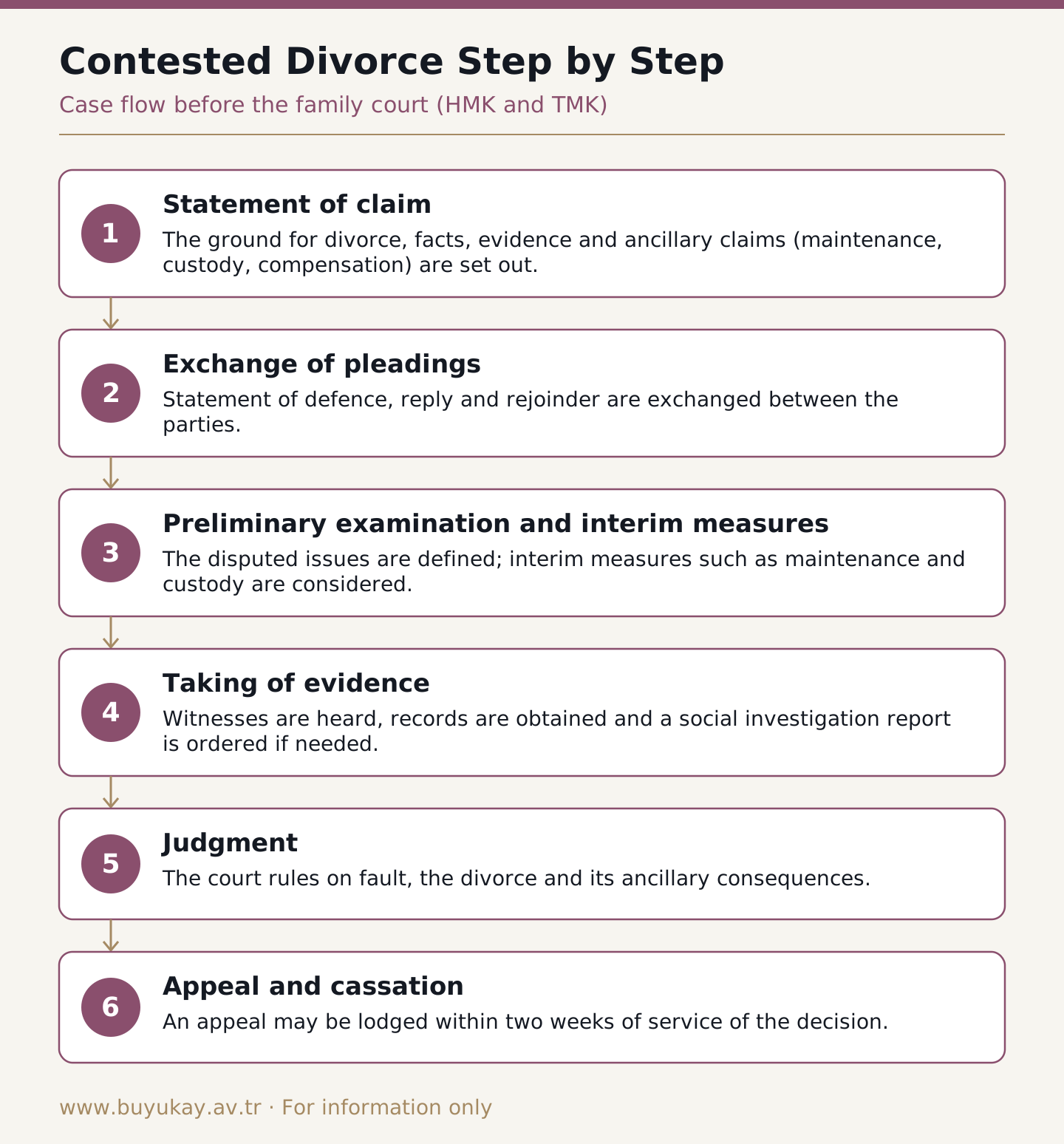
The case is opened by filing a statement of claim with the family court (aile mahkemesi) or, where there is none, with the civil court of first instance acting as a family court. Subject-matter jurisdiction rests on Article 4 of Law No. 4787 on Family Courts; territorially, the court of either spouse's domicile or of the place where they lived together for the last six months before filing is competent (TMK Art. 168).
The statement of claim should clearly set out the ground for divorce, the facts with dates and places, the evidence and the ancillary claims (claims attached to the main request, such as maintenance, custody and compensation). Because the parties themselves must bring forward the facts in divorce cases, events and evidence not raised in the pleadings may not be taken into account later.
Interim measures while the case is pending
Once the case is filed, the judge of their own motion takes the interim measures needed for the spouses' housing and support, the management of property and the care of the children during the proceedings (TMK Art. 169). Interim maintenance and temporary custody arrangements fall within this scope; we are preparing a separate guide on the types of maintenance.
How long does a contested divorce take in Turkey?
The law sets no fixed duration; it depends on the number of witnesses, service of documents, any social investigation report and the court's caseload. An appeal (istinaf) against the judgment must be lodged within two weeks of service of the judgment (HMK Art. 345), and an appeal on points of law (temyiz) against the regional court of appeal's decision within two weeks of service as well (HMK Art. 361).
How do forgiveness and tolerance affect the case?
Forgiveness extinguishes the right to sue on the grounds of adultery, attempt on life and serious ill-treatment (TMK Arts. 161(3) and 162(3)). In practice, spouses reconciling and continuing to live together after the event is often treated as forgiveness or at least as tolerance.
An event that has been forgiven or tolerated may not, on its own, be attributed as fault in a case based on the general ground. Describing the events in chronological order and separating the periods before and after any reconciliation therefore makes it easier for the court to assess fault.
How is custody decided in a contested divorce?
Custody is decided on the basis of the child's best interests, and the spouses' fault is not decisive on its own. Wherever possible, the court hears both parents before ruling on custody and on the child's personal contact with the other parent (TMK Art. 182(1)).
Under TMK Art. 182(2), added by Law No. 7343, the court warns in its judgment that custody may be changed if the contact arrangements are not complied with, provided this does not conflict with the child's interests. The parent who is not granted custody must contribute to the child's care and education costs according to their means (TMK Art. 182(3)).
What should foreign nationals and spouses with ties to the UK or US consider?
Under Article 14 of the Turkish Private International and Procedural Law (Milletlerarası Özel Hukuk ve Usul Hukuku Hakkında Kanun, MÖHUK), the grounds and effects of divorce are governed by the spouses' common national law; if they hold different nationalities, the law of their common habitual residence applies and, failing that, Turkish law, while interim measures are always governed by Turkish law. Because Türkiye, the United Kingdom and the United States are all parties to the Hague Apostille Convention, documents issued there, such as a marriage certificate, generally need an apostille followed by a sworn Turkish translation; ask the court whether notarisation of the translation is also required. To rely on a Turkish divorce judgment in England and Wales, recognition is governed by section 46 of the Family Law Act 1986, while in the United States the question is decided under the law of the relevant state.
Step-by-step preparation for the case
- Write a chronology of events during the marriage, with dates, places and witnesses.
- If you rely on adultery or serious ill-treatment, fix the date you learned of it and calculate the six-month period.
- Note how each piece of evidence was obtained and assess whether it is lawful.
- List separately the official records (reports, police records, bank statements) you want the court to obtain.
- Clarify your maintenance, custody, contact and compensation claims, including amounts.
- Identify the competent court based on domicile and the shared home of the last six months.
How are fault, compensation and maintenance determined?
The finding of fault directly affects the financial consequences of the divorce. A spouse who is not at fault, or less at fault, and whose existing or expected interests are harmed by the divorce may claim pecuniary damages, and a spouse whose personality rights were violated may claim non-pecuniary damages (TMK Art. 174).
Spousal support (yoksulluk nafakası) is awarded to a spouse who would fall into poverty because of the divorce and whose fault is not greater (TMK Art. 175).
In its decision of 04.06.2026 (Case No. 2025/156, Decision No. 2026/131), the Constitutional Court annulled the words “for an unlimited period” in this article, with the annulment taking effect on 30.06.2027; any new legislation on this point should be followed closely.
Claims arising from the divorce, such as compensation and maintenance, become time-barred one year after the divorce judgment becomes final (TMK Art. 178). Raising these claims together with the divorce case removes the need for, and the risk of, a separate lawsuit.
Common mistakes
- Describing events in general terms without dates or places
- Missing the six-month preclusive period for adultery or serious ill-treatment
- Relying on an event after conduct that may count as forgiveness
- Submitting records taken from a spouse's phone or account without permission
- Naming only witnesses who know the events from hearsay
- Failing to state maintenance, compensation and custody claims clearly in the pleadings
A contested divorce in Turkey is shaped by how accurately the events are presented and how lawfully the evidence is gathered, and each file can lead to a different outcome. This article is for general information only and does not replace legal advice on your specific case. You can learn more about our work in family law on the Family and Inheritance Law page, or reach us through the Contact page with your questions.